 Lynden Roofing
 Wiser Lake's Siding Environment Is Tougher Than It Looks
Homes around Wiser Lake sit in one of the more moisture-heavy pockets of Whatcom County. Mature tree cover along the shoreline keeps large sections of siding shaded for most of the day, driving rain off the foothills drives water sideways into wall assemblies, and the marine-influenced air that moves through this part of Washington keeps humidity levels high even between storms. None of that is unusual for northwest Washington, but it adds up to a specific set of demands on exterior siding: resistance to standing moisture, resistance to moss and mildew growth in shaded areas, and a finish that can take repeated wet-dry cycling without failing.
A lot of siding products can handle one or two of those stressors. Very few handle all three for decades without maintenance. That's the problem we're solving when we recommend James Hardie fiber cement specifically for Wiser Lake properties, rather than a generic "siding replacement" pitch.
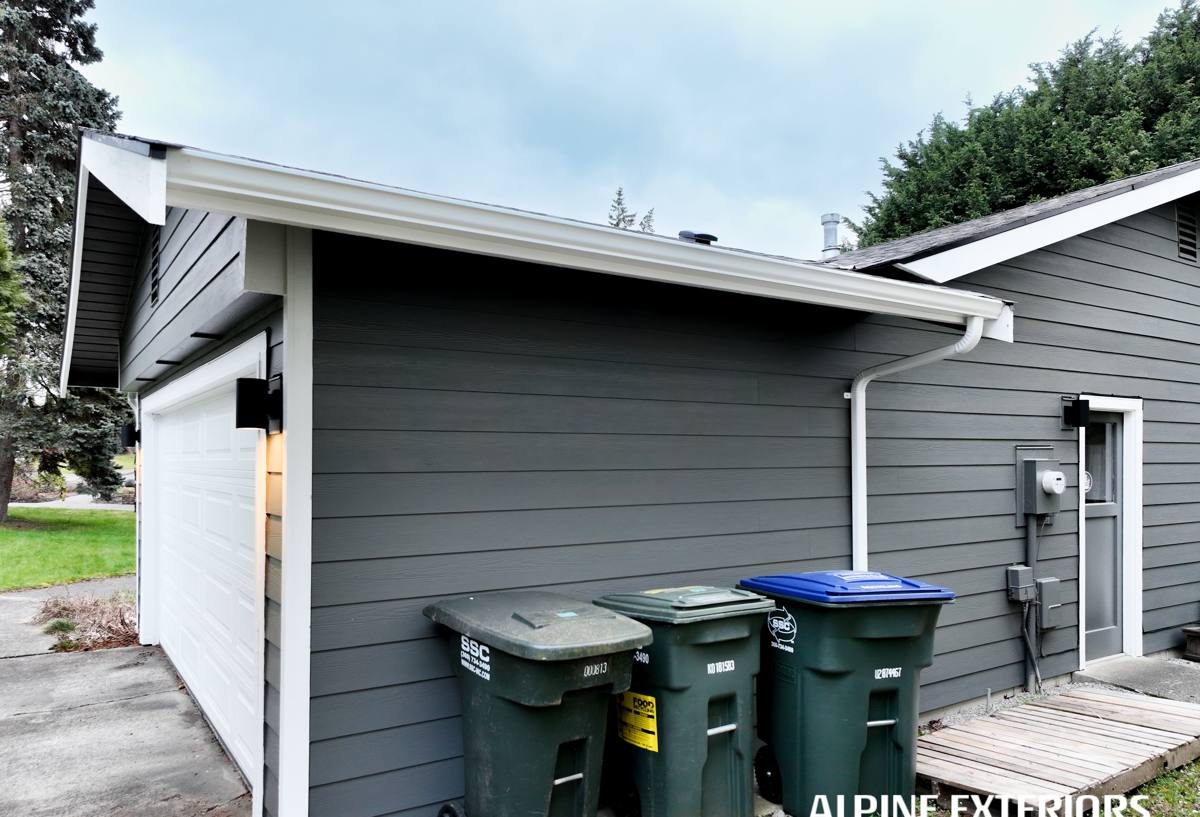
Why We Only Install James Hardie
We don't install LP SmartSide, vinyl, Cemplank, Allura, primed spruce, or cedar. That's not marketing — it's a standard we set because of what we've seen happen to those products in exactly this kind of climate. Wood-based composites and untreated wood siding depend on an intact factory coating or field-applied paint to keep moisture out; once that layer is compromised at a cut edge, a fastener hole, or a shaded corner that never fully dries, moisture gets into the substrate and the clock starts running. Vinyl doesn't rot, but it flexes, fades, and can't be painted to refresh its appearance, and it offers no real fire resistance. Cedar is a beautiful product that requires real, ongoing maintenance commitment to survive a wet climate long-term.
James Hardie fiber cement is cement, sand, and cellulose fiber — it doesn't feed mold or moss the way wood-based products can, it doesn't absorb water the way wood does, and it holds its factory finish far longer than field-applied paint on wood or composite siding. For a shaded, moisture-prone site like Wiser Lake, that difference in long-term behavior is the whole reason we recommend it.
What Hardie Gets Right — and What It Doesn't Solve By Itself
To be fair to the product: Hardie siding is not maintenance-free, and it's not magic. It still needs to be installed with correct clearances, flashing, and fastening, and it still needs periodic cleaning in shaded, moss-prone spots. What it does give you is a substrate that doesn't rot, swell, or delaminate the way organic materials can, and a factory finish (ColorPlus) that's baked on and warranted, rather than something a crew brushes on in the field. The performance ceiling is a lot higher — but you still have to install it correctly to reach it.
HZ5 Products and Why the Line Matters in This Zone
James Hardie makes climate-specific product lines, and for the Pacific Northwest that means HZ5 — engineered for wetter, colder climates than the HZ10 line used in the Southeast. HZ5 products are formulated to resist the moisture cycling that's common in western Washington: repeated wetting from rain, slow drying under tree cover, and freeze events in the shoulder seasons. Using the correct HZ line isn't a marketing distinction — it affects how the board performs against moisture absorption and dimensional stability over the life of the siding. On a lake-adjacent, tree-shaded lot like Wiser Lake, this is not a place to cut a corner with a generic or mismatched product.
What Correct Installation Actually Involves
Most siding failures we get called out to inspect aren't a product problem — they're an installation problem. Fiber cement is unforgiving of shortcuts in a few specific spots:
- Ground and roof clearance: Hardie specifies minimum clearance from grade, decks, patios, and roof lines. Skip this and you're wicking moisture into the bottom edge of the siding every time it rains.
- Flashing at every penetration: Windows, doors, hose bibs, light fixtures, and vents all need proper flashing and integration with the water-resistive barrier behind the siding — not just a bead of caulk.
- Fastener placement and type: Hardie requires specific fastener types, spacing, and depth. Overdriven or wrong-gauge fasteners crack the board or fail to hold it correctly over time.
- Joint and butt seam treatment: Field-cut edges need to be sealed or primed per Hardie's specification, especially in a wet climate where an unsealed cut edge is a moisture entry point.
- Caulking at trim and transitions: Done right, caulk is a secondary defense, not the only thing keeping water out.
Get these details wrong and even the best siding product in the world will underperform. Get them right, and you get the multi-decade lifespan Hardie is known for.
ColorPlus Finish: A Real Advantage in a Shaded, Wet Site
For homes with heavy tree cover — which describes a lot of Wiser Lake properties — the factory-applied ColorPlus finish matters more than it might elsewhere. Field-applied paint on any siding substrate is only as good as the prep, the paint quality, and the weather conditions it was applied under, and it starts breaking down unevenly, especially on shaded north- and east-facing walls where paint dries slower and moss gets a foothold faster. ColorPlus is baked onto the board in a controlled factory process before it ever reaches the site, giving it more consistent, longer-lasting color and finish integrity, backed by its own finish warranty separate from the substrate warranty. It won't stop moss from landing on a shaded wall entirely — nothing does — but a hard, consistent factory finish is easier to rinse clean and holds up better than a field-painted surface exposed to the same conditions.
Comparing Siding Options for a Wiser Lake Property
| Factor | James Hardie Fiber Cement | Wood-Based Composite / Cedar | Vinyl |
|---|---|---|---|
| Moisture absorption | Low — cement-based, non-organic | Higher — organic substrate | None, but traps moisture behind panel if not vented properly |
| Moss/mildew resistance in shade | Better — hard, non-porous surface | More susceptible if finish is compromised | Resistant to growth but can trap moisture behind it |
| Finish longevity | Factory ColorPlus, long-interval repaint | Field-applied, needs more frequent recoating | No repainting option once faded |
| Fire resistance | Non-combustible | Combustible | Can melt/deform under heat |
| Installation sensitivity | High — must follow spec closely | Moderate | Lower, but limited repair/refresh options |
Our Process for Wiser Lake Homes
Every job starts with an on-site assessment, not a phone quote. Because so much of what determines a good Hardie install is site-specific — grade slope, tree shade patterns, existing moisture damage, window and roof detailing — we walk the property before we talk numbers.
- Assessment: Inspect existing siding, sheathing, and trim for hidden moisture damage, especially at ground level and around window/door penetrations.
- Plan: Confirm the correct HZ5 product, panel style, and ColorPlus color, and map out flashing and clearance details for the specific home.
- Prep: Remove old siding, address any compromised sheathing or water-resistive barrier before new material goes on — this step gets skipped by corner-cutting crews and it's the single biggest predictor of a failed install down the road.
- Install: Fasten, flash, and seal to Hardie's written specification, not a generalized approach.
- Final walkthrough: Review clearances, caulk lines, and finish with the homeowner before calling the job done.
Signs Your Current Siding Is Struggling in This Climate
- Soft or spongy spots when pressed, especially near the bottom courses
- Persistent dark streaking or moss growth that returns quickly after cleaning
- Paint that's peeling, bubbling, or chalking unevenly, especially on shaded walls
- Visible gaps or cracking at butt joints and trim edges
- Musty smell or interior moisture signs on exterior walls
Why It Matters to Hire a Crew That Already Works This Area
Wiser Lake homes share a set of conditions — shoreline tree cover, higher ambient humidity, exposure to driving rain off the foothills — that don't show up the same way on a dry, open lot across town. A crew that installs siding regularly in this specific area already knows where moisture tends to collect on lake-adjacent homes, which sides of a house need extra attention to flashing and clearance, and how the local moss season affects long-term finish choices. That local pattern recognition is worth more than a lower bid from a crew unfamiliar with the area — a Hardie install done to spec on a tricky site holds up; one done generically often doesn't, and the failure shows up years later when it's expensive to fix.
If you're considering new siding for a Wiser Lake home, we're happy to come take a look, walk the property with you, and give you a straight, no-pressure estimate — no invented urgency, no upsell to a product we don't stand behind. Use the form below to request a free estimate.