 Lynden Roofing
 Picking a shingle sounds simple until you're standing in a supply house looking at a dozen product lines, each with its own warranty booklet and marketing claims. For homeowners in Lynden and the rest of Whatcom County, the decision matters more than it might in drier parts of the country, because our climate is genuinely hard on roofs. Salt-tinged air moving in off the Sound, long stretches of driving rain, and a moss season that can run eight months out of the year all work against a roof that isn't matched to the conditions. This guide walks through what actually affects shingle performance here, so you can make a decision based on how a product behaves over fifteen or twenty years, not how it looks in a brochure.
Why Lynden's Climate Is Harder on Shingles Than It Looks
Whatcom County doesn't get hurricanes or hailstorms the way other regions do, and that can lull people into thinking any shingle will do fine here. The reality is that our climate attacks roofs in slower, quieter ways.
Moisture is the biggest factor. Lynden sits close enough to the water and the foothills that we get long stretches of damp, overcast weather where roofs simply don't dry out between rain events. That constant dampness is exactly what moss, moss spores, and algae need to take hold. A shingle that isn't rated for algae resistance, or that has a rough, porous surface that holds water, will show streaking and moss growth years before an equivalent product designed with our climate in mind.
Wind-driven rain is the second factor. We don't get the sustained hurricane-force winds of the Gulf Coast, but we do get a lot of horizontal rain during fall and winter storms, especially on roofs facing west or south. That kind of weather tests the sealant strip and the shingle's ability to stay flat and tight at the edges. A shingle with a weak or under-sized sealant bond can lift at the tabs during a windy rain event, and once water gets under a shingle, it doesn't take long to find a nail head or a seam.
Salt air is a smaller factor for most of Lynden compared to homes right on Bellingham Bay or Birch Bay, but it's not zero. Salt-laden moisture accelerates corrosion on any exposed metal — nails, flashing, vents — and can degrade certain granule coatings faster over time. It's one more reason we pay attention to the metal components of a roof system, not just the shingle itself.
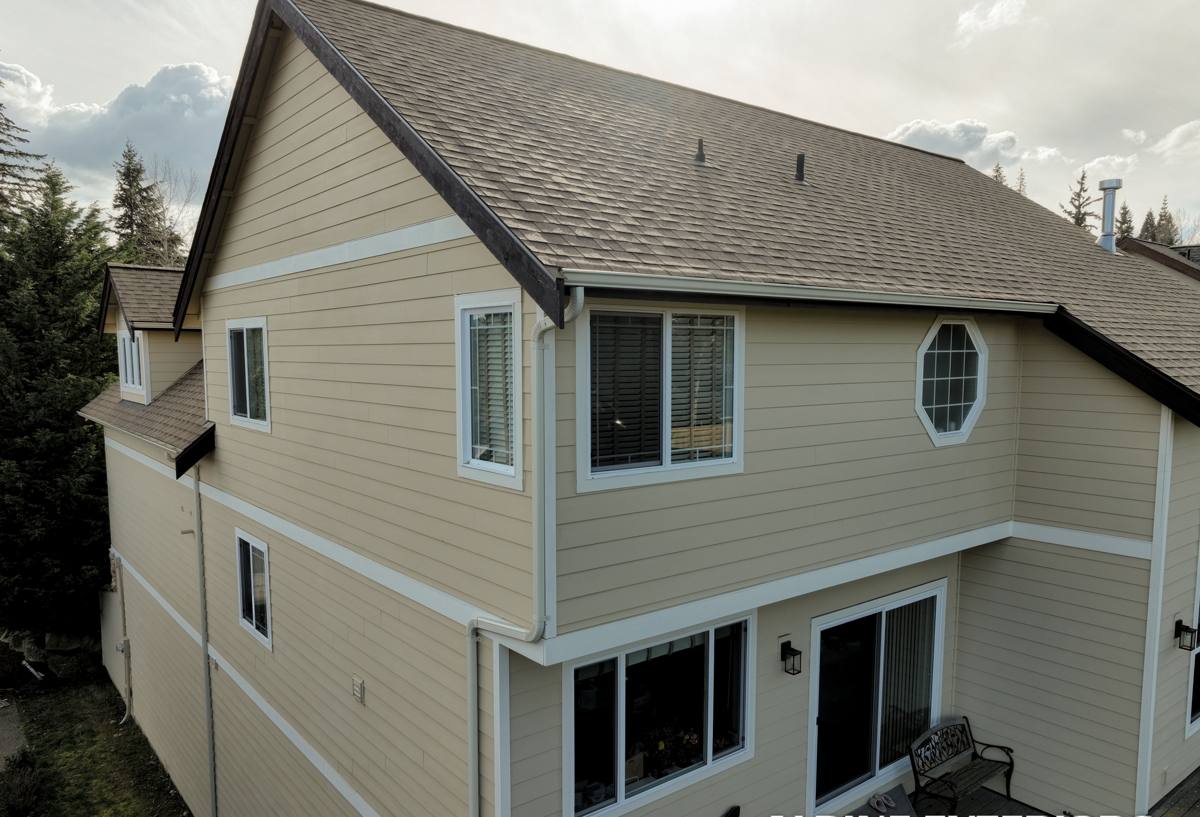
The Main Shingle Types We Work With
3-Tab Asphalt Shingles
These are the lightest, flattest, and least expensive asphalt shingle option. They're a single layer, laminated to nothing, which keeps the price down but also means less material mass to shed water and resist wind uplift. In a climate with as much sustained wet weather as ours, 3-tab shingles tend to show wear — curling edges, granule loss, algae streaking — sooner than heavier products. We'll still install them on a budget-conscious project, but we're upfront that they're the shortest-lived option in this climate.
Architectural (Laminate) Shingles
This is what we recommend for the large majority of Lynden re-roofs. Architectural shingles are built from two or more layers laminated together, giving them more thickness, a heavier presence on the roof, and a stronger wind rating. That extra mass matters directly for our driving-rain weather pattern — a heavier shingle with a wider sealant strip resists wind lift better and tends to hold its seal longer through repeated wet-dry cycles. Most manufacturers back these with 30-year to lifetime limited warranties, and the algae-resistant granule options are worth the small upcharge here given how much moss pressure this area gets.
Premium / Designer Shingles
These mimic the look of cedar shake or slate using heavier asphalt composite construction. They perform similarly to architectural shingles in terms of weather resistance, sometimes better due to even greater thickness, but the main reason homeowners choose them is appearance — a more dimensional, upscale look on the street. They cost more and are heavier to install, so we make sure the roof deck and structure can support them before recommending this route.
Metal Roofing (Standing Seam or Panel)
Not a shingle in the traditional sense, but it comes up often enough in these conversations that it's worth mentioning. Metal sheds water aggressively, handles moss better than asphalt because there's less texture for spores to grip, and holds up well against wind-driven rain. The trade-offs are a higher upfront cost and a different repair profile — dents and coating scratches are handled differently than a torn shingle. For homeowners planning to stay in a home long-term, it's worth a conversation, but it's a bigger investment than asphalt.
Algae and Moss Resistance: What It Actually Means
You'll see "algae-resistant" or "AR" shingles marketed heavily in the Pacific Northwest, and for good reason — it's one of the most relevant features for our climate. These shingles have copper or zinc granules blended into the surface. As rain washes across the roof, trace amounts of that metal inhibit algae and moss growth on the shingle surface.
It's important to set realistic expectations here. Algae-resistant granules reduce staining and slow moss colonization; they don't make a roof moss-proof. Moss still needs somewhere to establish itself, and that's usually where organic debris — needles, leaves, seed pods — sits and holds moisture, often in valleys, behind chimneys, or under overhanging branches. AR shingles paired with routine debris clearing and gutter maintenance is what actually keeps a Lynden roof clean-looking for the long haul, not the shingle alone.
What We Look At Beyond the Shingle Brand
- Underlayment quality — synthetic underlayment sheds and resists moisture far better than old-style felt, especially important given how much rain this roof will see over its life.
- Ice-and-water shield placement — even though we don't get heavy ice here, this membrane at eaves, valleys, and penetrations is one of the best defenses against wind-driven rain backing up under shingles.
- Ventilation — a roof deck that can't breathe traps moisture from inside the attic, which shortens shingle life from underneath, regardless of how good the shingle itself is.
- Flashing condition — the metal around chimneys, skylights, and sidewalls fails more often than the shingles do. New shingles installed over old, corroded flashing is a common shortcut we won't take.
- Nailing pattern and sealant activation — proper nail placement and enough sun exposure for the sealant strip to bond are what actually keep shingles locked down in our windy rain events, more than the product line itself.
Comparing Shingle Options for a Lynden Home
| Shingle Type | Typical Lifespan Here | Wind/Rain Performance | Moss Resistance (with AR granules) | Relative Cost |
|---|---|---|---|---|
| 3-Tab Asphalt | 15-20 years | Fair — lighter material, lower wind rating | Fair | Lowest |
| Architectural Asphalt | 25-30+ years | Good — heavier mass, stronger sealant strip | Good | Moderate |
| Premium/Designer Asphalt | 30+ years | Very good | Good | Higher |
| Standing Seam Metal | 40-50+ years | Excellent — sheds water fast, high wind resistance | Very good — minimal surface texture | Highest |
These are general ranges based on typical performance in this climate, not manufacturer guarantees — actual lifespan always depends on installation quality, ventilation, slope, and how well the roof is maintained.
Cost Factors That Matter More Than the Shingle Price Tag
The per-square price of the shingle itself is often the smallest variable in the total project cost. What actually moves the number is roof complexity — steep pitches, multiple valleys, dormers, and chimneys all add labor time regardless of shingle choice. Tear-off and disposal of the old roof, deck repair if there's rot underneath (common on older Lynden homes with limited ventilation), and the quality of underlayment and flashing all factor in before you even get to the shingle line item. We'd rather walk a homeowner through where their money is actually going than let the shingle brand be the only thing they're comparing.
Color and Appearance Considerations
Darker shingles show algae streaking more visibly over time in a wet climate, since the contrast against green or black staining is more obvious. Lighter and mid-tone colors, particularly grays and weathered woods, tend to hide the gradual granule and moss discoloration that's nearly inevitable here better than very dark charcoal or black. This isn't a reason to rule out a dark roof if that's the look you want — it's just something worth knowing going in, especially paired with algae-resistant granules and a maintenance plan.
A Practical Checklist for Choosing Your Shingle
- Confirm the shingle carries algae-resistant (AR) granules, given how long our moss season runs
- Check the wind rating and confirm it meets or exceeds what's typical for our exposure
- Ask what underlayment and ice-and-water shield placement is included, not just the shingle brand
- Have flashing around chimneys, skylights, and walls inspected — don't assume it's being reused without a look
- Confirm attic or roof ventilation is adequate for the shingle warranty to remain valid
- Get the warranty terms in writing, including what's prorated after the first several years
- Ask how debris in valleys and behind chimneys will be handled going forward to limit moss regrowth
Our Honest Take
For most homes in Lynden, a mid-to-upper-tier architectural shingle with algae-resistant granules, installed over synthetic underlayment with proper ice-and-water protection at the vulnerable spots, gives the best balance of upfront cost and real-world performance in our climate. 3-tab shingles have their place on a tight budget, but we tell homeowners plainly that they'll likely be looking at a shorter roof life here than in a drier region. Metal is worth considering for anyone planning to stay long-term and wanting to minimize moss and maintenance, but it's a bigger investment and not the right fit for every budget or home style. There's no single "best" shingle — there's the right shingle for your roof's pitch, your home's ventilation, your budget, and how much upkeep you want to do down the road.
If you're weighing options for an upcoming roof replacement, we're happy to take a look at your roof, talk through what we're seeing, and put together a free, no-pressure estimate — no obligation, just straight answers about what would actually hold up on your home.