 Lynden Roofing
 Living With Birch Bay's Coastal Climate
Birch Bay homes take a beating that inland Whatcom County houses simply don't deal with. Sitting right on the water means siding here is exposed to salt-laden air, near-constant wind-driven rain off the Salish Sea, and a moss season that can run most of the year in shaded, damp corners of a lot. Siding that would hold up fine a few miles inland can show real wear in Birch Bay well before its expected lifespan is up.
That doesn't mean every Birch Bay home needs a full re-side. Most of the calls we get are for siding repair — a section that's cracked, a corner that's soft, a spot where moss has taken hold and paint is failing. Done correctly, repair work can add years of life to siding and protect the wall assembly behind it. Done poorly, or with the wrong material, the same problem tends to come back within a season or two. This page covers what siding repair actually requires in a Birch Bay environment, and why the details matter more here than almost anywhere else we work in Whatcom County.
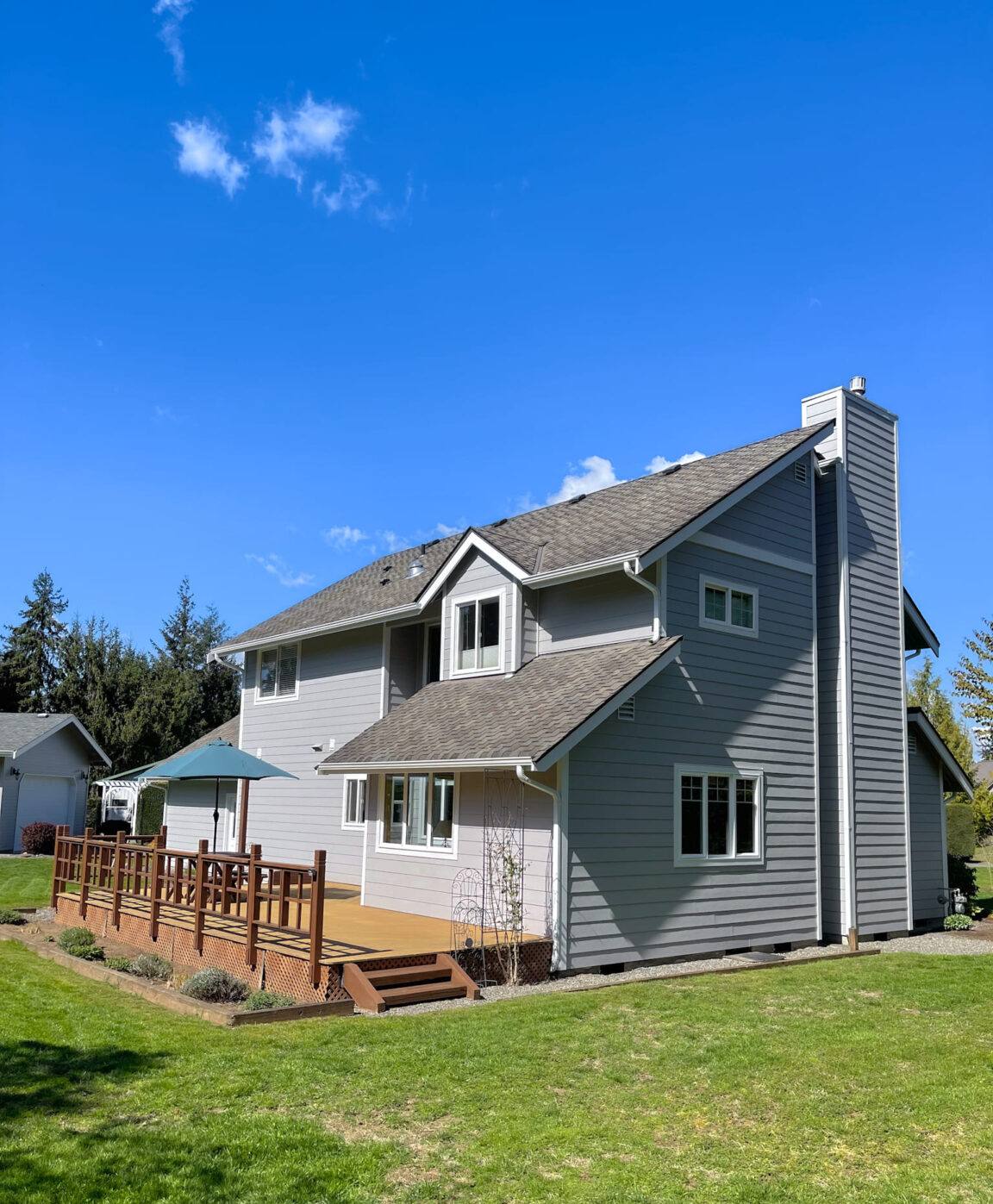
How Salt Air, Driving Rain, and Moss Damage Siding
Salt Air and Corrosion
Airborne salt doesn't just sit on the surface of siding — it works its way into fasteners, joints, and any exposed metal trim or flashing. Over time this accelerates corrosion in nails, screws, and flashing components, which weakens the connection between siding and the wall behind it. Corroded fasteners are one of the most common reasons a siding panel starts to loosen or lift near the coast, even when the siding material itself still looks fine.
Wind-Driven Rain and Moisture Intrusion
Birch Bay gets rain that doesn't fall straight down — it comes in sideways off the water. That matters because siding systems are designed to shed water that runs down a wall, not water that's being pushed horizontally into seams, laps, and butt joints. Wind-driven rain finds gaps that would never be a problem in a calmer inland location, and once moisture gets behind siding, it can sit against sheathing and framing far longer than it takes to dry back out.
Moss, Algae, and Constant Dampness
Shaded walls, tree cover, and the general dampness of a coastal Pacific Northwest lot create ideal conditions for moss and algae growth on siding. Beyond the cosmetic issue, moss holds moisture directly against the siding surface for extended periods, which softens caulking, breaks down paint film, and — on wood-based or engineered wood products — can lead to swelling and rot at the areas where moss has been sitting longest.
Signs Your Birch Bay Home Needs Siding Repair
Most siding problems show early warning signs long before they become structural issues. Walk your exterior and look for these:
- Soft or spongy spots when you press on the siding, especially near the bottom courses or around windows and doors
- Visible cracking, splitting, or buckled panels, particularly on the side of the house facing the water or prevailing wind
- Moss or dark streaking that keeps returning to the same area even after cleaning
- Paint that's peeling, bubbling, or flaking in patches rather than evenly across the wall
- Gaps opening up at seams, corners, or where siding meets trim, window frames, or the foundation
- Rust staining bleeding out from fastener heads or metal flashing
- A musty smell or visible staining on interior walls that share an exterior wall with damaged siding
Any one of these on its own might be minor. Several showing up together, or damage that's spreading rather than staying contained to one small area, usually means it's time for a closer look.
Repair or Replace? What Determines the Right Call
Not every damaged section needs a full re-side, but repair isn't always the right answer either. We look at a few key factors before recommending one path over the other.
| Factor | Favors Repair | Favors Replacement |
|---|---|---|
| Extent of damage | Isolated to one or two sections | Spread across multiple walls or elevations |
| Moisture behind siding | None found on inspection | Sheathing or framing already wet or soft |
| Age of existing siding | Well within expected service life | Nearing or past its expected lifespan |
| Material and finish match | Product still available or a close match exists | Discontinued profile, color, or texture |
| Root cause | Fixable with proper flashing or fastening | Systemic issue affecting the whole installation |
A short, honest inspection usually makes the right answer clear. We'd rather tell a Birch Bay homeowner that a repair will hold than talk them into a replacement they don't need — and we'd rather be upfront that a patch is going to be a short-term fix than let it fail again in a year.
What a Correct Siding Repair Actually Involves
Inspecting What's Behind the Siding
Any legitimate repair starts by pulling back the damaged section far enough to see the water-resistive barrier, sheathing, and framing underneath. In a coastal environment like Birch Bay, this step isn't optional — moisture that's been driven in by wind-blown rain often does its damage below the surface, and patching over a wet or compromised substrate just traps the problem.
Flashing and Water Management
A large share of siding repairs we make in Birch Bay trace back to flashing that was missing, undersized, or installed incorrectly around windows, doors, and roof-to-wall transitions. Correcting the flashing detail — not just replacing the visible siding — is what keeps the same failure from happening again in the same spot.
Matching Material and Finish
A repair that stands out visually is still a repair job the homeowner has to look at every day. Matching profile, exposure, and color as closely as possible matters, which is one reason we standardized on a factory-finished product system rather than field-painted materials — finish consistency is far easier to hold to when the color comes from the factory, batch to batch, instead of being mixed and applied on site.
Why We Repair (and Replace) With James Hardie Fiber Cement
We install and repair with James Hardie fiber cement exclusively — we don't run vinyl, LP SmartSide, primed wood, or comparable fiber cement alternatives on our jobs. That's a deliberate standard, not a default, and it matters more in a place like Birch Bay than it might inland.
Fiber cement is non-combustible and doesn't absorb and swell with moisture the way wood-based and engineered wood siding products can, which is a real advantage in an environment where wind-driven rain and near-constant dampness are the norm rather than the exception. Hardie's climate-engineered HZ product lines are specifically formulated for regional exposure conditions, and the factory-applied ColorPlus finish is built to hold color and resist the kind of fading and peeling that's harder to avoid with field-applied paint in a salty, damp climate. The product also carries a strong transferable warranty when installed to manufacturer specification — something worth asking about no matter which contractor you hire.
None of this means other siding materials are worthless — vinyl, engineered wood, and other fiber cement products all have their place. It means that after years of doing this work on the Whatcom County coast, we settled on the one system that gave us the fewest callbacks and the most consistent long-term performance, and we'd rather stand behind one product we trust completely than offer several we don't.
Our Siding Repair Process in Birch Bay
- Inspection. We assess the damaged area and check what's happening behind the siding, not just what's visible on the surface.
- Diagnosis. We identify the root cause — flashing failure, fastener corrosion, moss retention, impact damage — so the repair addresses the source, not just the symptom.
- Scope and estimate. We tell you plainly whether repair will hold or whether replacement is the more honest long-term answer, along with what it will cost.
- Removal and prep. Damaged material comes off cleanly, any compromised sheathing or barrier is addressed, and flashing is corrected where needed.
- Repair installation. New material is installed to manufacturer specification, matched as closely as possible in profile and finish.
- Cleanup and walkthrough. We clear the site and walk the work with you before we consider the job finished.
What Siding Repair Costs Depend On
Every repair is different, but the same handful of factors drive cost on most Birch Bay jobs.
| Cost Factor | Why It Matters |
|---|---|
| Size of the affected area | More square footage and more sections mean more material and labor |
| Accessibility | Second-story sections, tight setbacks, or waterfront wind exposure can add time and equipment needs |
| Hidden damage | Wet sheathing or framing found once siding is removed adds scope beyond the visible repair |
| Material availability | Matching an existing profile or discontinued color can affect sourcing and cost |
| Flashing and detail work | Correcting the underlying water management issue, not just the cosmetic patch |
We won't quote a number without seeing the specific area — anyone who does over the phone, sight unseen, is guessing. What we can tell you upfront is that we price the job after inspection, not before, so the estimate reflects what your siding actually needs.
Why a Crew That Regularly Works Birch Bay Matters
Coastal siding repair is a different job than the same repair three miles inland. A crew that works Birch Bay regularly already knows which elevations tend to take the worst of the wind-driven rain, where moss builds up fastest given the local tree cover and shade patterns, and how quickly salt air corrodes exposed fasteners and flashing if the wrong hardware gets used. That familiarity shows up in fewer surprises during the job and fewer repeat calls afterward.
It also matters for logistics — Whatcom County permitting requirements, seasonal weather windows for exterior work, and the practical realities of working waterfront and near-waterfront properties. A crew that's done this repeatedly in the same community isn't learning those things on your job.
If you're seeing damage, moss buildup, or paint failure on your Birch Bay home's siding, we're glad to take a look and give you a straight answer about what it needs. Reach out for a free, no-pressure estimate using the form below.