 Lynden Roofing
 What Attic Ventilation Actually Does
Most homeowners think about their roof as the shingles, metal, or tile on top of the house. But the attic underneath is doing just as much work — or should be. Attic ventilation is a simple system with one job: keep air moving through the attic space so heat and moisture don't build up against the underside of your roof deck.
The system works on a basic principle. Cooler, drier air enters low, usually through soffit vents under the eaves. Warmer, moist air exits high, through a ridge vent, box vents, or a gable vent near the roof's peak. When intake and exhaust are balanced, air flows continuously through the attic. When they're not — or when vents are blocked, undersized, or missing altogether — the attic turns into a sealed box that traps heat in summer and moisture year-round.
That trapped moisture is the part that matters most here in Whatcom County. It's not dramatic. It doesn't show up as a leak you can point to. It shows up slowly, as rot in the roof deck, mold on the rafters, and shingles that fail years before they should.
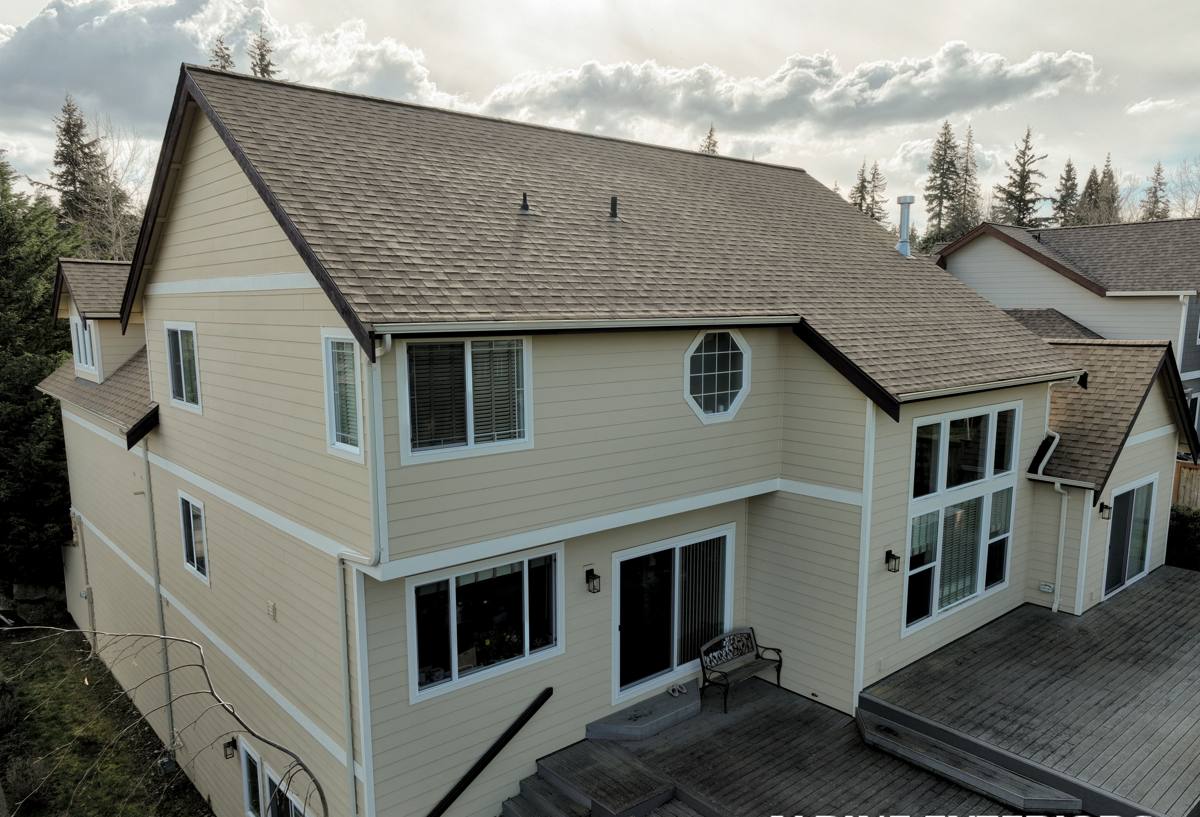
Why It Matters More in a Climate Like Ours
Every roof needs ventilation, but the stakes are higher in Lynden than they are in a dry inland climate. Between the marine-influenced air moving up from the Sound, the long stretch of driving rain we get from fall through spring, and a moss season that seems to run most of the year, this area gives moisture a lot of chances to get into places it shouldn't be.
Humid air off the water works its way into attics through everyday household moisture — showers, cooking, laundry, even breathing — if there's nowhere for it to escape. Add a roof that's already staying damp longer between rain events because of our weather pattern, and you've got conditions where a poorly ventilated attic can develop real problems in a handful of years instead of a couple decades.
Moss adds its own wrinkle. A shaded, north-facing roof plane that stays damp and cool is exactly what moss wants. Moss itself doesn't come from attic ventilation, but a roof deck that's already softened from below by trapped attic moisture has far less resistance to the moss and organic growth working on it from above.
Salt Air and Metal Components
For homes closer to the water, airborne salt can accelerate corrosion on vent hoods, flashing, and fasteners. It's not usually the deciding factor in a ventilation plan, but it's one more reason we lean toward corrosion-resistant materials for vent components on Whatcom County homes rather than the cheapest option available.
Signs Your Attic Isn't Ventilating Properly
You don't need to climb into your attic to notice most of these. Common signs include:
- Ice or heavy frost forming unevenly on the roof during cold snaps, or the interior edges of the roof staying wet longer than the rest
- Peeling paint or stained drywall on ceilings below the attic, especially near the eaves
- A musty smell in upstairs rooms or closets that share a wall with the attic
- Visible mold or dark staining on the underside of the roof sheathing or on rafters
- Shingles that look prematurely worn, curled, or granule-bare in patches rather than evenly across the whole roof
- Noticeably higher summer cooling bills compared to similar homes nearby
Any one of these on its own isn't proof of a ventilation problem — plenty of things can cause a musty smell or a stained ceiling. But together, or persistent over more than one season, they're worth having a roofer actually look at rather than just repainting the ceiling and moving on.
The Two Halves of the System: Intake and Exhaust
Ventilation only works when intake and exhaust are sized to match each other. A roof with plenty of exhaust vents but blocked or undersized soffit vents will still trap moisture, because there's no fresh air being pulled in to replace what's leaving. This is one of the most common issues we find on older Lynden homes — insulation stuffed into the eaves over the years has quietly choked off the soffit vents without anyone noticing.
| Vent Type | Function | Typical Use | Notes |
|---|---|---|---|
| Soffit vents | Intake | Continuous strip or individual vents under the eaves | Most common intake source; easily blocked by insulation or paint |
| Ridge vent | Exhaust | Runs the length of the roof peak | Low profile, works well when paired with full soffit intake |
| Box vents (static) | Exhaust | Scattered across the upper roof plane | No moving parts; needs several to match ridge vent output |
| Gable vents | Exhaust or intake | Mounted in the gable end wall | Can short-circuit airflow if combined incorrectly with a ridge vent |
| Power attic fans | Exhaust (powered) | Thermostat or humidistat controlled | Useful in specific cases, but can pull conditioned air from the house if intake is insufficient |
There's no single "best" vent type for every roof. The right combination depends on the roof's shape, the attic's layout, and what's already in place. A roof with a long, simple ridge line is often a good candidate for a continuous ridge vent. A more complex roof with hips and multiple short ridges may do better with a cluster of box vents.
How Ventilation Affects Roof Lifespan and Warranties
This is the part that surprises a lot of homeowners: most shingle manufacturers write proper attic ventilation into their warranty terms. A shingle that fails prematurely because of attic heat and moisture buildup — rather than a manufacturing defect — can fall outside warranty coverage, because the manufacturer tested and rated that product assuming a ventilated attic underneath it.
Beyond the warranty paperwork, the physical effect is straightforward. Excess heat trapped in an attic during summer bakes the underside of the shingles from below at the same time the sun is baking them from above. In winter, trapped moisture condenses on cold roof sheathing and slowly saturates the wood. Either way, the roof deck and the shingles above it age faster than the manufacturer's rated lifespan assumes.
Insulation and Ventilation Have to Work Together
Ventilation and insulation are often talked about separately, but they're really one system. Insulation's job is to keep conditioned air inside the living space. Ventilation's job is to manage the unconditioned attic air above it. When insulation is pushed up against the roof deck or crammed into the soffit area, it blocks the airflow path ventilation depends on — even if the vents themselves are in good shape.
We typically check for a clear air channel — sometimes called a baffle or vent chute — running from the soffit vent up to the open attic space, especially in homes with shallow eaves where insulation and airflow are competing for the same few inches of space.
Common Mistakes We See in Attics
Mixing Vent Types Incorrectly
Combining a ridge vent with gable vents or a power fan on the same attic can cause exhaust vents to pull air from each other instead of pulling fresh air up from the soffits. The system ends up working against itself.
Painting Over Soffit Vents
It happens during routine exterior painting more often than you'd think — the perforated vent panel gets a coat of paint and the openings clog. It's a quick fix once it's identified, but it's easy to miss from the ground.
Undersized Exhaust for the Roof Area
A roof that's been added onto or reroofed over the years sometimes ends up with exhaust vent capacity sized for a smaller original structure. The fix is usually adding vent area, not replacing what's already there.
What a Proper Ventilation Assessment Looks Like
A real assessment isn't a five-minute glance from the ladder. It generally includes checking the attic from the inside for moisture staining, insulation coverage, and airflow paths; measuring existing intake and exhaust vent area against the attic's square footage; and inspecting the roof exterior for vent condition, blockage, and any signs of moss or organic growth concentrated near poorly ventilated sections.
From there, recommendations should be specific — not just "add more vents," but which type, how many, and where, based on the roof's actual shape and the attic's actual layout.
A Quick Self-Check Before You Call Anyone
- Stand outside and look at your soffits — are the vent openings visibly painted over, clogged with debris, or covered by insulation from inside?
- In the attic, feel for airflow near the soffit on a breezy day — you should sense at least some air movement
- Look at the underside of the roof deck for dark staining, especially near the ridge or in corners
- Check for daylight or gaps around any powered fan housing, which can indicate it's pulling conditioned house air instead of attic air
- Note whether moss or dark streaking on the roof surface concentrates over specific rooms or areas rather than being spread evenly
None of this replaces a proper inspection, but it's enough to tell you whether it's worth scheduling one.
Bringing It Back to Your Roof
Attic ventilation isn't a glamorous topic, and it's easy for it to get overlooked during a reroof if intake and exhaust aren't part of the conversation. But in a climate that gives Lynden roofs a long, wet season and a moss problem that never fully goes away, it's one of the most cost-effective things a homeowner can get right. A well-ventilated attic won't stop every problem a Whatcom County winter throws at your roof, but it takes a lot of the slow, invisible damage off the table.
If you're not sure how your attic is set up, or you've noticed any of the signs above, we're happy to take a look and give you a straightforward, no-pressure estimate — no guesswork, just what your roof actually needs.