 Lynden Roofing
 Asphalt Shingle Roofing Built for the Wiser Lake Area
Wiser Lake sits in a part of Whatcom County where the roof over your head works harder than it does in a lot of other places. The mix of mature tree cover around the lake, low winter sun angles, and near-constant marine airflow off the Salish Sea creates a set of conditions that a roofing crew either understands or doesn't. Shaded rooflines hold moisture longer. Driving rain off passing fronts finds every weak lap and nail pop. And the salt-tinged, humid air that moves through this corridor of Whatcom County accelerates the breakdown of cheap materials and sloppy flashing work faster than most homeowners expect.
None of that means asphalt shingles are a poor fit here — they're still the most practical, cost-effective roofing material for the vast majority of Wiser Lake homes. It means the installation details matter more than the brand name on the shingle wrapper. This page walks through what a shingle roof actually needs to hold up around Wiser Lake, what a correct installation involves, and what to look for when you're deciding who gets the job.
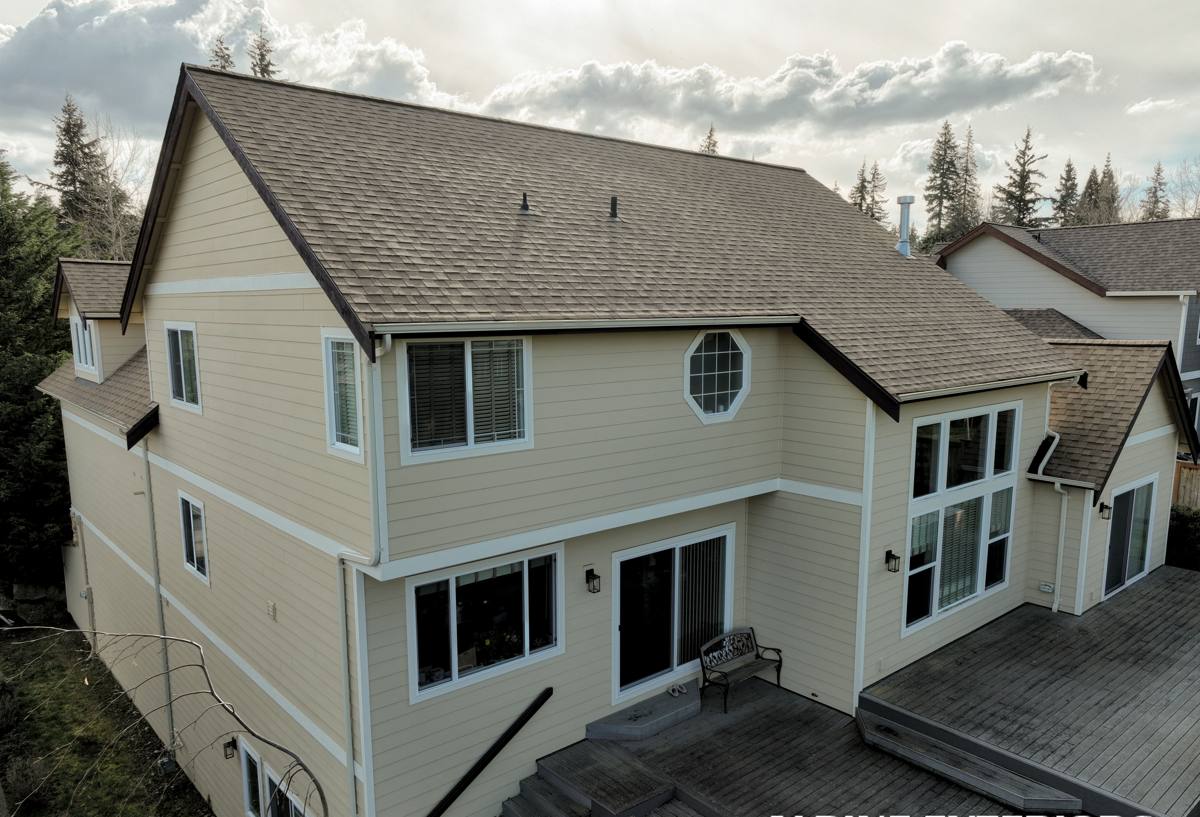
Why Asphalt Shingles Still Make Sense Around Wiser Lake
Asphalt shingles remain the standard choice for good reason: they're proven, repairable, reasonably priced, and available in enough tiers to match almost any budget and roof pitch. For a lake-adjacent property with tree cover, shingles also have a practical advantage over some alternatives — they're easier to spot-repair after a storm knocks down a branch, and a skilled crew can blend in a repair without re-roofing the whole slope.
The trade-off is that asphalt shingles are more sensitive to installation quality than a lot of homeowners realize. A shingle roof installed with the right underlayment, flashing, and ventilation will comfortably outlast one that looks identical from the ground but was rushed. In a climate like this one, where a roof rarely gets more than a few dry weeks in a row to fully dry out, that gap in workmanship shows up early — usually as moss, granule loss, or leaks at the valleys and penetrations.
What a Correct Asphalt Shingle Installation Includes
A shingle roof is a system, not a single layer of material. Skipping or shortcutting any one part of that system is where most premature failures start, especially in a wet, shaded environment like the Wiser Lake area.
Deck Inspection and Prep
Before any shingle goes down, the existing roof deck needs to be checked for soft spots, delamination, and rot — particularly around old flashing, skylights, and any area that's been shaded and damp for years. Replacing bad decking before covering it is non-negotiable; shingles fastened to a spongy deck won't hold their nailing pattern and will fail early regardless of shingle quality.
Underlayment and Ice-and-Water Protection
A synthetic underlayment goes down across the full deck as the first line of defense against wind-driven rain. In the eaves, valleys, and around penetrations — the spots most exposed to standing water and ice damming during cold snaps — a self-adhering ice-and-water membrane adds a second, more waterproof layer. Given how much sideways rain this area sees during fall and winter systems, this step matters more here than it does in drier parts of the state.
Flashing at Every Transition
Valleys, chimneys, skylights, dormers, and wall-to-roof transitions are where leaks actually start, far more often than in the open field of shingles. Correct flashing means new metal, properly lapped with the underlayment and shingle courses, not old flashing reused to save time or new shingles caulked over tired metal.
Ventilation That Actually Balances
Intake at the eaves and exhaust at the ridge need to work together, not just exist. Under-ventilated attics trap moisture against the underside of the deck, which shortens shingle life from below and feeds the exact mold and rot problems this climate already pushes toward from above.
Nailing Pattern and Fastening
Manufacturer nailing patterns exist for wind resistance, and they're specific to shingle type and roof pitch. Correct nail placement and count is the difference between a shingle that stays put in a winter windstorm and one that lifts, curls, or blows off entirely.
Moss, Algae, and Shade: The Biggest Long-Term Threat
Ask around Wiser Lake and moss will come up before wind or hail ever do. The combination of tree canopy, north-facing slopes that rarely see direct sun, and a long stretch of the year with damp air gives moss and algae exactly the conditions they need to take hold. Left alone, moss doesn't just look bad — it holds moisture against the shingle surface, lifts shingle edges as it grows, and works its way under laps where it can start rot in the decking underneath.
A few things help meaningfully:
- Algae-resistant shingles with copper or zinc granules built in, which slow (not eliminate) algae growth on shaded slopes
- Keeping overhanging branches trimmed back so more light and airflow reach the roof surface
- Zinc or copper strips installed near the ridge on especially shaded or moss-prone slopes, letting rain carry trace metals down the roof
- Routine moss removal done by soft-washing or hand-brushing rather than pressure-washing, which strips granules and shortens shingle life
- Clean gutters so trapped debris at the eaves doesn't hold water against the shingle edge year-round
None of these steps make moss impossible around a lake with this much shade — they extend the time between problems and keep small issues from becoming deck-level rot.
Shingle Options Compared
Homeowners around Wiser Lake generally choose between three practical tiers of asphalt shingle. Each has a place depending on budget, roof pitch, and how much shade or wind exposure the property gets.
| Shingle Type | Typical Lifespan | Wind Rating | Best Fit |
|---|---|---|---|
| 3-Tab | Shorter end of the range | Lower | Budget-focused projects, simple roof shapes |
| Architectural / Laminate | Mid-to-long range | Higher, dimensional profile | Most Wiser Lake homes; better looks and wind performance |
| Impact-Resistant (Class 4) | Long range | Highest, resists granule loss from debris | Heavily treed lots with falling branch risk |
Architectural shingles are the most common recommendation in this area — they carry better wind ratings than 3-tab, and their thicker profile holds up better against the branch debris and moss pressure that come with lakefront tree cover. Impact-resistant shingles cost more up front but earn that back in fewer repairs on lots with a lot of overhanging canopy.
Cost Factors Worth Understanding
Every roof around Wiser Lake prices out a little differently. The factors below move the estimate more than shingle brand alone.
| Factor | Why It Matters Here |
|---|---|
| Roof pitch and access | Steeper slopes and tree-obstructed access around the lake add labor and safety setup time |
| Layers to tear off | Older homes with a second layer of shingles need full tear-off before re-decking is possible |
| Decking condition | Rot from long-term moss or old leaks means plywood replacement before shingles go down |
| Ventilation upgrades | Adding proper intake/exhaust venting on older homes is common and worth budgeting for |
| Valley and flashing count | Complex rooflines with multiple valleys and dormers need more flashing material and labor |
A straightforward, well-maintained roof with good access will land toward the lower end of a project's likely range; a steep, moss-damaged roof with rotted decking and poor ventilation will land higher — not because of the shingle chosen, but because of what has to be fixed underneath it first.
Our Process, Start to Finish
- On-site inspection — we walk the roof, check the attic for ventilation and moisture issues, and look for deck soft spots before quoting anything
- Written estimate — a clear scope covering tear-off, decking repair allowances, underlayment, flashing, ventilation, and shingle selection
- Material staging — delivery scheduled around weather windows, since this area rarely offers long dry stretches
- Tear-off and deck repair — old material removed, deck inspected in daylight, any rot or soft spots replaced before covering anything up
- Underlayment, flashing, and shingle installation — installed to manufacturer spec, not shortcuts
- Ventilation check — intake and exhaust confirmed to be balanced before the job is called done
- Cleanup and magnetic sweep — yard, driveway, and landscaping cleared of debris and stray fasteners
- Final walkthrough — we go over the finished roof and warranty paperwork together before we consider the job complete
Signs Your Wiser Lake Roof Needs a Closer Look
Because so much of the damage in this climate builds slowly under moss or in shaded valleys, it's easy to miss until a leak shows up inside. Worth checking for:
- Moss or dark streaking concentrated on north-facing or heavily shaded slopes
- Granules collecting in gutters or at downspout outlets
- Curling, cupping, or cracked shingles, especially on older 3-tab roofs
- Soft or spongy spots when walking the attic floor near the roof edges
- Daylight visible through the roof deck from inside the attic
- Water staining on ceilings near valleys, chimneys, or skylights
- Sagging along the ridge line or between rafters
Any one of these on its own isn't necessarily an emergency, but they're worth a professional look before the next wet season, not after it.
Why Local Experience on Wiser Lake Roofs Matters
A crew that already works this specific pocket of Whatcom County knows things a roofer from outside the area has to learn on your dime: which slopes around the lake hold moss the longest, how much ventilation older homes in this area typically lack, and how to schedule tear-off around a weather pattern that doesn't always cooperate. That local knowledge shows up in fewer surprises during the job and a roof that's built for the conditions it will actually face, not generic best practices from a drier climate.
It also matters for the parts of the job that happen after the shingles are on. Warranty coverage, moss-related maintenance questions, and storm damage assessments are all easier to handle with a contractor who's a short drive away and familiar with your specific property, rather than a crew that moved on after the invoice was paid.
Get a Straightforward Estimate
If you're weighing a repair against a full replacement, or just want an honest read on how much life is left in your current roof, we're happy to take a look. The estimate is free, there's no pressure to commit on the spot, and you'll get a clear explanation of what your roof actually needs — use the form below to get started.