 Lynden Roofing
 New Roof Installation in Sumas: What Local Homes Are Up Against
Sumas sits in the northern reach of Whatcom County, close enough to the Nooksack floodplain and the Puget Sound air mass that roofs here take a particular kind of beating. It isn't one dramatic storm that ends a roof's life — it's the accumulation of a wet, mild climate working on the same surface for years without a break. Long stretches of drizzle keep shingles damp far longer than they'd stay damp in a drier region. Moisture-carrying air moving in off the Sound settles into shaded, north-facing slopes and never fully dries out between rain events. And moss, given that kind of standing dampness plus tree cover common on Whatcom County lots, doesn't just grow on old roofs — it grows on roofs that are only a few years old if the original installation didn't account for drainage and airflow.
A new roof installation in Sumas has to be built for that reality from the first course of underlayment to the last ridge cap. That means material choices, flashing details, and ventilation planning that are different from what you'd spec in a dry inland climate, even though the finished roof looks the same from the street.
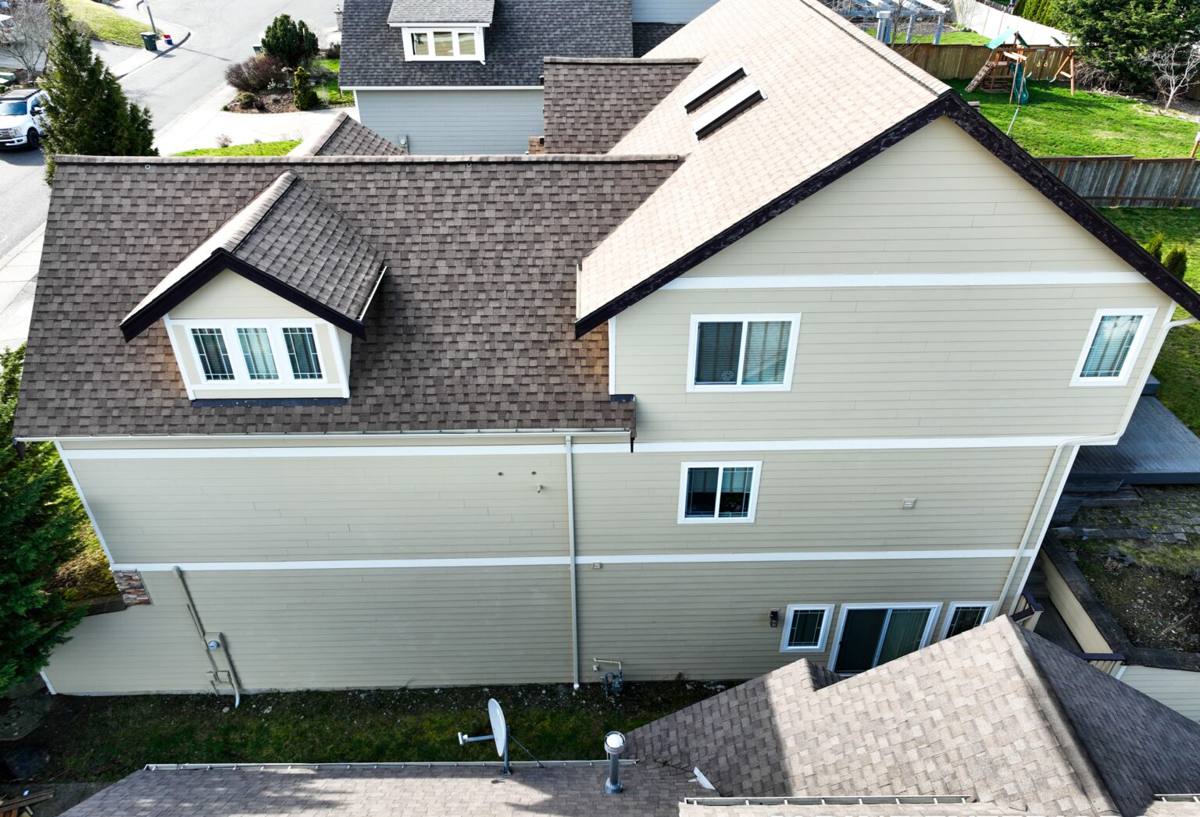
Signs a Sumas Roof Has Reached the End of Its Service Life
Most homeowners call about a leak, but by the time water is showing up inside the house, the roof has usually been failing quietly for a while. Look for these signs before it gets to that point:
- Granule loss heavy enough that you can see bare, shiny patches on shingles, or granules collecting in gutters
- Moss or algae colonies that keep coming back within a season or two of cleaning, especially on shaded slopes
- Shingles that are curling, cupping, or cracking at the edges
- Soft or spongy spots when walking the roof, which usually means the decking underneath has taken on moisture
- Daylight visible through the roof deck from inside the attic
- A roof that's had three or more patch repairs in the last five years — at that point, patching is often costing more than replacement would
- Asphalt shingles older than 20-25 years, regardless of how they look from the ground
Any one of these on its own might just call for a repair. Two or three together usually means it's time to talk about full replacement instead of chasing individual problem spots.
What a Correct New Roof Installation Actually Involves
"New roof" gets used loosely, but a properly installed one is a sequence of details, and skipping any of them is where roofs in a climate like ours fail early.
Full Tear-Off and Deck Inspection
We don't install over an existing layer of shingles. A full tear-off is the only way to actually inspect the decking underneath — and in a region with this much sustained moisture, hidden deck damage is common even on roofs that look fine from the outside. Any soft, delaminated, or water-stained plywood or sheathing gets replaced before anything new goes down. Installing new shingles over a compromised deck just hides the problem for a year or two.
Underlayment and Ice-and-Water Protection
Synthetic underlayment goes down across the full deck as the primary water barrier beneath the shingles. In vulnerable areas — eaves, valleys, and low-slope transitions — we add a self-adhering ice-and-water membrane. In Whatcom County that protection matters less for ice dams and more for wind-driven rain, which can push water sideways up under shingles during the region's harder storms.
Flashing at Every Transition
Chimneys, skylights, sidewalls, and roof valleys are where the overwhelming majority of leaks originate — not the open field of shingles. Correct flashing means new metal, properly stepped and sealed, at every one of these transitions, not a bead of caulk over old flashing to save a step.
Ventilation That Actually Balances
Intake at the eaves and exhaust at the ridge need to work together, not just exist independently. In a humid climate, a roof deck that can't breathe traps moisture from inside the attic against the underside of the sheathing, which accelerates rot and gives moss and mold an additional source of dampness beyond what's falling from the sky. We calculate intake and exhaust together as part of every installation, not as an afterthought once the shingles are on.
Choosing Roofing Materials for Sumas's Climate
There's no single "best" roofing material — the right choice depends on the home's roof pitch, shade exposure, and your budget and timeline. Here's how the common options compare for a wet, moss-prone climate like ours:
| Material | Typical Lifespan | Moss/Moisture Resistance | Relative Cost |
|---|---|---|---|
| 3-tab asphalt shingle | 15-20 years | Lower — thinner profile holds less algae-resistant granule coating | Lowest |
| Architectural (dimensional) asphalt shingle | 25-30 years | Better — thicker mat, often available with algae-resistant granules | Moderate |
| Standing seam metal | 40-50+ years | Best — smooth surface sheds moss and moisture, minimal organic buildup | Highest upfront |
| Cedar shake | 20-30 years with upkeep | Poor without diligent maintenance — organic material feeds moss growth | High, plus ongoing maintenance |
For most Sumas homes, we steer conversations toward architectural shingles with algae-resistant granules or metal roofing, not because other materials are inherently bad, but because they carry less maintenance burden in a climate that gives moss every advantage it needs. Cedar shake can still be the right call for homeowners who want that look and are committed to the upkeep — we'll walk you through the honest tradeoffs rather than push you toward one product.
Our New Roof Installation Process
- On-site inspection and measurement — we walk the roof and attic, check decking condition, ventilation, and flashing points, and take accurate measurements
- Material walkthrough and written quote — we explain the options that fit your roof and budget, with a clear, itemized estimate
- Scheduling around the weather — tear-offs are timed for dry windows whenever possible, since an open deck exposed to Whatcom County rain is a real risk we plan around, not ignore
- Tear-off and disposal — old roofing is removed down to the deck and hauled off the same job
- Deck repair — any damaged sheathing found during tear-off is replaced before underlayment goes down
- Installation — underlayment, ice-and-water membrane, flashing, ventilation components, and final roofing material, installed to manufacturer specification
- Site cleanup — a magnetic sweep for nails and full debris removal before we leave
- Final walkthrough — we go over the finished roof with you and answer any questions before closing out the job
Why a Crew That Already Works Sumas Matters
A roofing crew based in Lynden that regularly works Sumas and the surrounding Whatcom County communities isn't guessing at local conditions — they've seen how a given roof pitch and tree line combination behaves through a full wet season, and they build accordingly. That local familiarity shows up in practical ways: knowing which slopes on a typical Sumas lot need extra ventilation because of shade and tree cover, scheduling tear-offs around this area's actual weather patterns instead of a generic forecast, and being close enough to respond quickly if a question comes up after the job is done. It also means dealing with a crew who understands Whatcom County permitting and inspection requirements without a learning curve on your project.
Homeowner Checklist Before You Sign a Contract
- Get a full tear-off, not an overlay — confirm this in writing
- Ask what happens if the crew finds damaged decking, and how that's priced
- Confirm ventilation (intake and exhaust) is part of the scope, not just shingles
- Ask about flashing — is it being replaced, or reused from the old roof?
- Get the manufacturer warranty terms and the contractor's workmanship warranty in writing
- Confirm licensing, bonding, and insurance, and ask to see proof
- Ask how debris and disposal are handled, and whether a magnetic nail sweep is included
Keeping a New Sumas Roof Performing for Its Full Lifespan
A correctly installed roof still benefits from basic upkeep in this climate. Keep gutters clear so water isn't backing up under the eaves, especially where overhanging trees drop needles and debris. Have moss growth addressed early rather than left to spread — a light treatment on a young colony is a much smaller job than removing an established mat that's been lifting granules for two seasons. And if you notice a new stain on a ceiling or ventilation that seems blocked, get it looked at promptly; catching a small issue early is what keeps a well-installed roof performing for its full rated lifespan instead of needing early repair work.
If your Sumas home is due for a new roof, we're happy to take a look and give you a straightforward, no-pressure estimate — just fill out the form below.