 Lynden Roofing
 Why Wiser Lake Homes Ask About Siding Sooner Than You'd Expect
Homes around Wiser Lake deal with a combination of conditions that most siding products simply weren't built to handle for the long haul. You've got the lake itself, which keeps humidity higher at ground level than you'll find on a drier lot a few miles away. You've got mature tree canopy around much of the shoreline and the surrounding acreage, which means long stretches of shade where siding never fully dries out between rains. And you've got the broader Whatcom County climate on top of it — driving rain off the Salish Sea, salt-laden air that travels further inland than people expect, and a moss season that can run from fall through spring most years.
None of that is unusual for this part of Washington. But it adds up faster on a property with lake-adjacent moisture and shade than it does on an open, sun-exposed lot in town. We see it in the calls we get: siding that's ten or twelve years old and already showing the kind of wear that should take twenty.
What This Does to Siding Over Time
Sustained moisture is the enemy of almost every siding product, but the way it shows up depends on what the siding is made of. Wood-based products swell, delaminate at the edges, or let rot start at seams and fastener points. Vinyl doesn't rot, but it doesn't hold up to years of damp shade either — it can warp, and it does nothing to stop moisture from reaching the sheathing behind it if the water-resistive barrier and flashing weren't done right the first time. Moss and algae find a foothold anywhere organic material stays damp, and once established, they hold even more moisture against the wall.
What's Actually Failing When Siding Fails Here
When we inspect a home near Wiser Lake, we're rarely looking at one single cause. It's usually a combination:
- Moss and algae staining on north- and shade-facing walls, especially under tree cover or roof overhangs
- Soft or swollen spots at butt joints and bottom courses, where water sits longest
- Cupping or warping on wood-based or engineered wood siding that's absorbed and released moisture repeatedly
- Caulk failure at trim and window returns, letting bulk water behind the siding plane
- Fastener corrosion or staining, a sign moisture is reaching places it shouldn't
- Paint that's failing years ahead of schedule because the substrate underneath is holding moisture
Individually, most of these look cosmetic. Together, they usually mean water has been getting behind the siding for a while — and by the time it's visible from the outside, there's often sheathing or framing damage that costs a lot more to fix than the siding itself.
Why We Install Only James Hardie Fiber Cement
We made a decision a while back to standardize on James Hardie fiber cement siding and stop installing everything else — no LP SmartSide, no vinyl, no Cemplank or Allura, no primed spruce or cedar. That's not a marketing position, it's a maintenance-and-longevity call based on what actually holds up in this climate.
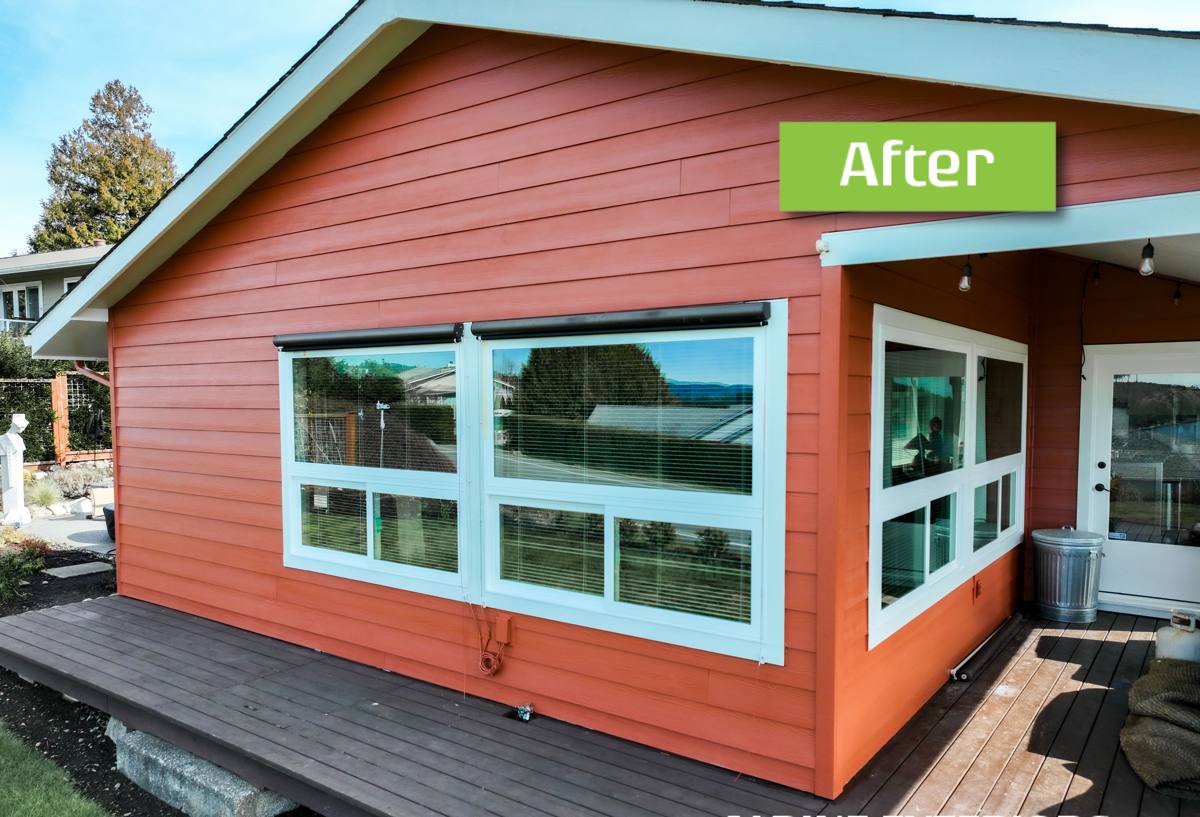
Fiber cement is non-combustible, which matters more every year as wildfire smoke and ember exposure become a bigger part of Pacific Northwest summers. It's also dimensionally stable in a way wood-based products aren't — it doesn't swell and shrink with every wet-dry cycle the way engineered wood or solid wood does, which is exactly the cycle a shaded, lake-adjacent lot puts siding through constantly. Hardie's ColorPlus factory finish is baked on under controlled conditions, so it resists the fading and chalking that field-applied paint goes through, and it holds up to moss and algae growth better than porous wood substrates.
None of this means other products are junk — vinyl is cheap and low-maintenance in a dry climate, and cedar can look great with diligent upkeep. But for a property that's going to sit in shade and moisture for months at a stretch, we don't think those trade-offs are worth it, and we'd rather tell a homeowner that up front than install something we know is going to need attention again in five years.
What a Correct Siding Replacement Actually Involves
Siding replacement done right is mostly about what happens before the new siding ever goes up. The finish material only performs as well as the assembly behind it.
Tear-Off and Inspection
We remove the old siding down to the sheathing and inspect for rot, soft spots, and any signs of past moisture intrusion — this is often the first real look anyone's gotten at what's been happening behind the wall. On a lake-proximity or shade-heavy property, this step matters more than usual, since hidden damage is more likely.
Water-Resistive Barrier and Flashing
A new weather-resistive barrier goes on correctly lapped, and flashing gets installed at every window, door, and penetration so water sheds outward instead of working its way in. This is the part of the job that determines whether the siding lasts 30 years or 12, and it's also the part that's invisible once the job is done — which is exactly why it needs to be done by a crew that won't cut corners on it.
Installation to Manufacturer Spec
James Hardie siding has specific fastening patterns, clearances, and joint treatment requirements. Installing it outside of spec — wrong nail spacing, insufficient clearance from grade or roofline, unsealed joints — is one of the most common ways a warranty gets voided and a job underperforms, regardless of how good the material is.
Checklist: What to Ask Any Contractor Before Siding Replacement
- Will you inspect and replace damaged sheathing before new siding goes on, not just cover it?
- What water-resistive barrier and flashing details will you use, specifically?
- Are your installers certified or specifically trained on the siding product you're installing?
- Will fastening and clearances follow the manufacturer's published installation spec?
- What does the warranty actually cover — material only, or labor too — and for how long?
James Hardie Product Lines for a Wiser Lake Property
James Hardie makes several siding profiles and engineers certain products for specific climate zones (their "HZ" system). Picking the right one comes down to your home's style and exposure, not just personal taste.
| Product | Best For | Notes for This Area |
|---|---|---|
| HardiePlank Lap Siding | Traditional horizontal lap look | Most common choice; wide range of textures and ColorPlus colors |
| HardiePanel Vertical Siding | Board-and-batten or modern vertical look | Works well for accent walls or gables, common on lake and cabin-style homes |
| HardieShingle | Shingle-style or Craftsman aesthetics | Higher labor time, strong look for a lake or wooded setting |
| HardieTrim | Fascia, corner boards, window trim | Pairs with any of the above for a finished, rot-resistant trim package |
Whatcom County falls within a moisture-heavy engineered climate zone in Hardie's HZ system, which is one more reason we don't substitute a generic or non-climate-engineered product on homes out this way.
Our Process, Start to Finish
We keep the process straightforward: an on-site inspection where we look at the current siding, sheathing condition, and any moisture history; a written estimate that spells out product, scope, and price with no vague allowances; a scheduled tear-off and install where we handle sheathing repair as part of the job rather than a change-order surprise; and a final walkthrough before we consider the job done. We don't push add-ons that aren't needed, and if a section of your home just needs targeted repair rather than a full replacement, we'll tell you that instead of upselling a full tear-off.
Cost Factors for Siding Replacement Near Wiser Lake
Every home is different, but the same handful of factors drive most of the cost variation we see on lake-area jobs:
| Factor | Why It Matters |
|---|---|
| Sheathing condition | Rot or moisture damage found during tear-off adds repair scope before new siding goes on |
| Home size and complexity | More corners, dormers, and trim detail means more labor per square foot |
| Product and profile choice | Lap vs. panel vs. shingle profiles carry different material and labor costs |
| Access and site conditions | Tree cover, slope, and lake-lot access can affect staging and scaffolding needs |
| Trim and detail package | Full HardieTrim replacement adds cost but extends the life of the whole system |
We don't publish blanket per-square-foot pricing because the range is genuinely wide depending on these factors — but we'll give you a specific, itemized number after we've actually looked at your home.
Why It Matters to Hire a Crew That Already Works This Area
A contractor who works Wiser Lake and the surrounding Lynden area regularly already knows what shaded, moisture-heavy lots do to siding and sheathing over time, and they've seen it before your job even starts. That means fewer surprises during tear-off, a better sense of where moss and moisture tend to concentrate on a given roofline or wall orientation, and a realistic read on how long a job will take given local weather patterns. It also means accountability — a local crew has a reputation in Whatcom County worth protecting, and they're not disappearing after the invoice clears.
Getting Started
If your siding is showing moss staining, soft spots, or paint failure — or it's simply old enough that you're wondering what's happening behind it — we're happy to take a look. We offer free, no-pressure estimates for homes in and around Wiser Lake, and there's no obligation to move forward. Use the form below to get in touch and we'll set up a time to come out.