 Lynden Roofing
 Why Maple Falls Homes Are Hard on Siding
Maple Falls sits up against the foothills east of Lynden, in a part of Whatcom County that sees more rain, more shade, and more sustained moisture than the lowland areas closer to town. Tree cover keeps homes cooler in summer, but it also means siding stays damp longer after storms, and it gives moss and algae the shaded, humid conditions they need to take hold. Add in the driving rain that blows sideways during Pacific frontal systems, and the moist marine air that moves through the county for much of the year, and you have a climate that punishes any siding material with a weak point.
Most siding doesn't fail all at once. It fails at the seams, at the bottom edge near grade, around window and door trim, and anywhere caulking or paint has started to let go. In a location like Maple Falls, where a wall can stay wet for days after a storm rolls through, those small failure points turn into rot, mold, and paint breakdown faster than they would on a drier, more exposed lot. Siding replacement here isn't just a cosmetic upgrade — it's about closing the gaps that this climate is specifically good at finding.
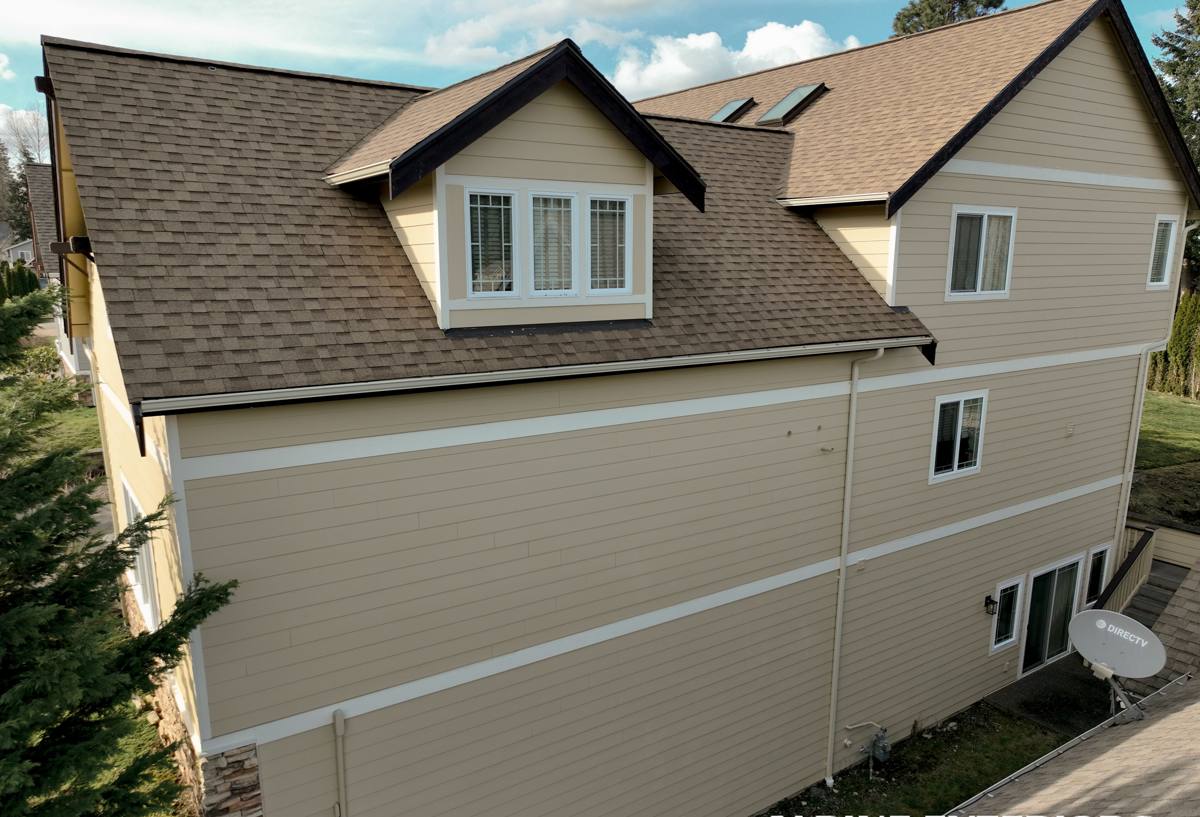
Signs Your Siding Has Reached the End of Its Life
Homeowners in Maple Falls typically call us for one of a few reasons. Knowing which category your home falls into helps set expectations for the scope of the job.
- Persistent moss and algae staining that comes back within a season or two of cleaning, especially on north-facing or shaded walls
- Soft or spongy spots when you press on the siding, particularly near the bottom courses or below window sills
- Paint that won't hold — peeling, bubbling, or chalking within a few years of a repaint, which usually points to moisture trapped behind the surface
- Visible warping, cupping, or separation at panel seams or lap joints
- Rising energy bills alongside drafts near exterior walls, which can mean the siding and the water-resistive barrier behind it are no longer doing their job
Any one of these can sometimes be spot-repaired. But when several show up together, or when the siding is original to a home built more than 20-25 years ago, full replacement is usually the more honest recommendation — patching a failing system just delays the larger cost.
Why We Only Install James Hardie Fiber Cement
Lynden Roofing Co made a deliberate decision to install James Hardie fiber cement siding exclusively, and we don't treat that as marketing — it's a standard we hold ourselves to because of what this climate does to the alternatives. Vinyl siding can warp and gap as it expands and contracts through Whatcom County's temperature swings, and once seams open up, driving rain finds its way behind the panels. Wood-based products like LP SmartSide, primed spruce, and cedar all rely on an intact factory or field-applied coating to keep moisture out; in a shaded, high-moisture environment like Maple Falls, any nick, scratch, or missed touch-up point becomes an entry point for rot far sooner than it would in a drier climate.
James Hardie fiber cement is engineered differently. It's a cement-based composite that doesn't absorb and swell with moisture the way wood-based products can, and it won't degrade from prolonged dampness the way vinyl seams can fail. Hardie's ColorPlus factory finish is baked on under controlled conditions rather than applied on-site, which means far more consistent coverage and a finish that's engineered to resist fading, chipping, and moisture intrusion. For a property that spends a good part of the year under damp shade, that difference matters more than it would on a home in full sun.
Built for This Region
James Hardie manufactures climate-specific product lines, including an HZ5 formulation engineered for regions with freeze-thaw cycles and sustained moisture exposure — conditions that describe Whatcom County's foothill communities well. We use the product line matched to this region rather than a generic version, because the engineering difference is the whole point.
What a Correct Siding Replacement Actually Involves
The material is only part of the equation. A siding job that looks right on installation day but fails in five years almost always failed at one of these steps, not because the siding itself was defective:
Tear-Off and Inspection
We remove the old siding down to the sheathing and inspect for rot, soft framing, or existing moisture damage. This is the point where problems that have been hidden for years finally get found and fixed — and it's also why an accurate quote often can't be finalized until the walls are opened up.
Water-Resistive Barrier and Flashing
A new weather-resistive barrier goes on before any siding, with proper overlap and sealed seams. Flashing at windows, doors, and any wall penetration is installed or replaced so water is directed out and down, never trapped behind the cladding. In a high-rainfall area, this layer often matters more to long-term performance than the siding itself.
Proper Fastening and Clearances
James Hardie siding has specific installation requirements — fastener spacing, gaps at butt joints, ground clearance, and clearance from roof lines and decks. Skipping these details is the single most common cause of premature failure on fiber cement siding, and it's also invisible to a homeowner until moisture problems show up years later.
Trim, Caulking, and Finish Work
Corners, trim boards, and joints get sealed with a product rated for the application, not whatever is on the truck. We finish with a full site cleanup and a walkthrough so you can see the completed work before we consider the job done.
Our Process for Maple Falls Projects
- On-site assessment — we walk the exterior with you, note problem areas, and give an honest read on whether repair or full replacement makes sense
- Written estimate — scope, product line, and pricing laid out clearly, with any conditions that could change the price (like hidden rot) explained up front
- Scheduling around weather — we plan tear-off and dry-in around forecast windows, since an open wall during a heavy rain event is the worst-case scenario we actively avoid
- Tear-off, repair, and dry-in — old siding removed, framing repaired as needed, new barrier and flashing installed the same day where possible
- Siding installation — James Hardie panels or lap siding installed to manufacturer specification
- Final walkthrough — we review the finished work with you and answer any questions before we call it complete
What Affects Cost on a Maple Falls Home
Every home is different, but the factors that move the price on a siding replacement in this area tend to follow a consistent pattern.
| Factor | Why It Matters Here |
|---|---|
| Extent of hidden rot or sheathing damage | Homes with long-term moisture exposure often need more sheathing replacement than expected once old siding comes off |
| Home size and wall complexity | Dormers, multiple gables, and cut-up wall lines take more labor and trim than a simple rectangular elevation |
| Access and site conditions | Sloped lots, tree cover, and limited driveway access — common around Maple Falls — can affect staging and scaffolding needs |
| Product line and finish | Panel vs. lap siding, and standard vs. premium ColorPlus finishes, carry different material costs |
| Trim and detail work | Homes with more corner boards, window trim, and architectural detail require more finish labor |
We don't quote from a distance for this reason — an accurate number requires seeing the actual walls, not just square footage.
Why Hiring a Crew That Already Works This Area Matters
A contractor who regularly works Whatcom County's foothill communities already knows what to expect before they show up: the moisture patterns, the moss growth on shaded elevations, the drainage quirks of sloped and wooded lots, and how weather windows in this part of the county tend to run compared to lowland Lynden. That familiarity shows up in smaller, practical ways — better scheduling around rain, more accurate first-look estimates, and installation details (like extra attention to flashing on shaded walls) that come from having seen how homes in this specific climate actually fail over time.
It also matters for accountability. A local crew that plans to keep working in your community has a direct interest in doing the job right the first time, since word travels fast in a smaller area. That's a different incentive structure than a crew passing through from out of the region for a one-off job.
Protecting Your Investment After Installation
James Hardie fiber cement is low-maintenance compared to wood-based alternatives, but "low-maintenance" isn't "no-maintenance," especially in a moss-prone climate. A short annual routine keeps a new installation performing the way it's designed to:
- Rinse siding gently once or twice a year to clear pollen, moss spores, and organic buildup before it takes hold
- Trim back trees and shrubs so siding gets airflow and isn't sitting in constant shade and dampness
- Check caulking at trim and joints annually and re-caulk any spots that have cracked or pulled away
- Keep gutters clear so overflow isn't running down the wall face
- Watch ground-level clearance — mulch, soil, or debris piled against the bottom edge of siding traps moisture against the material
These are the same practices that protect the transferable warranty James Hardie provides, and they take a fraction of the time that maintaining a wood-based or vinyl system typically requires.
Get a Straight Answer About Your Siding
If your Maple Falls home is showing moss, soft spots, failing paint, or siding that's simply reached the end of its service life, we're glad to take a look. We'll give you a straightforward read on whether repair or replacement makes sense, and if replacement is the right call, walk you through the James Hardie options that fit your home. Reach out below for a free, no-pressure estimate.