 Lynden Roofing
 Metal Roofing in Nooksack: Weather That Doesn't Let Up
Nooksack sits in the river valley community just outside Lynden, in the northern reach of Whatcom County near the Canadian border. It's farm country and quiet residential streets, not a waterfront town, but the same marine weather system that soaks the rest of this corner of Washington moves right up the valley here. Moist, salt-tinged air drifts in off the water, rain arrives sideways more often than it falls straight down, and mild year-round temperatures give moss a growing season that barely pauses. A roof in Nooksack does more work than a roof in a drier inland climate, and it shows in how fast an under-built roof starts failing.
More homeowners in this area are looking at metal roofing specifically because of that workload. Done right, a metal roof sheds moss and water better than almost anything else on the market and can outlast two or three shingle roofs over its service life. Done wrong — wrong fastener, wrong flashing metal, no allowance for panel movement — it can develop problems just as fast as a poorly installed shingle roof, sometimes faster. This page is about what "done right" actually means for a metal roof in this specific community, not metal roofing in general.
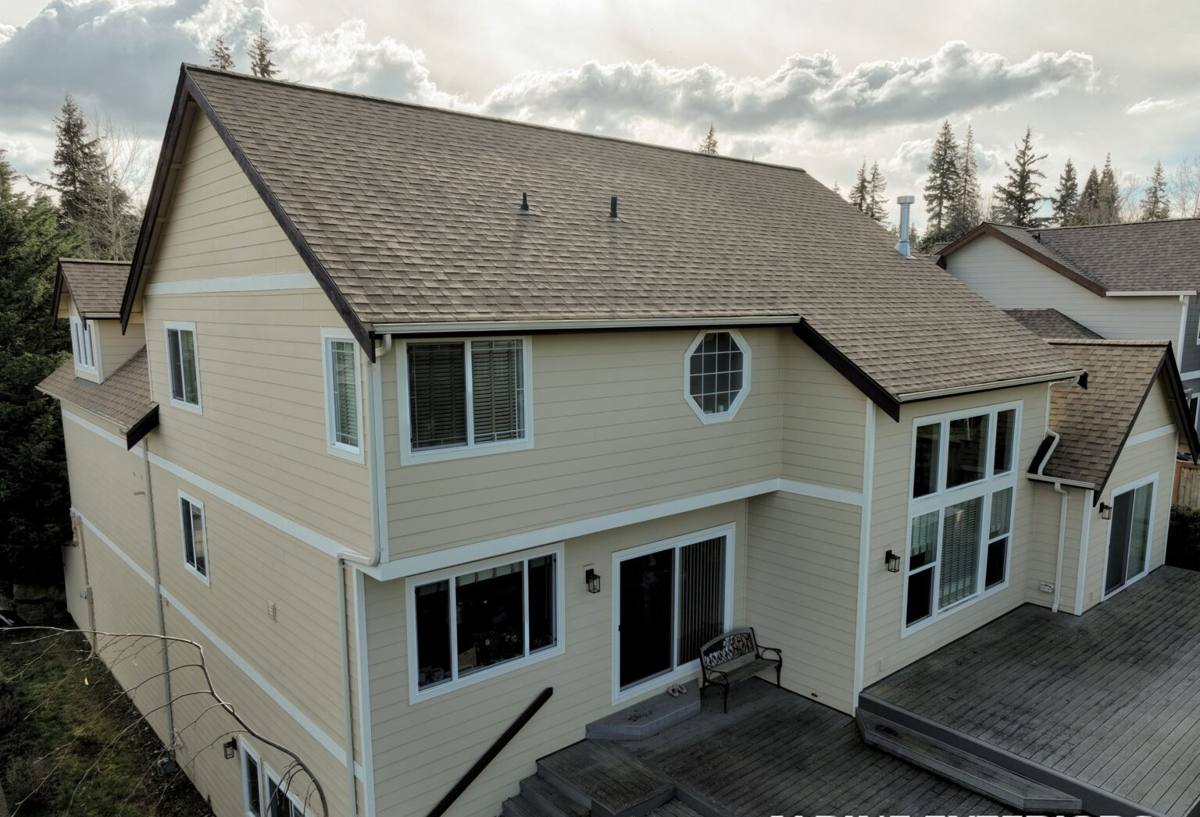
What This Climate Actually Does to a Metal Roof
Salt-Tinged Air Moving Up the Valley
Nooksack isn't sitting on the water the way some of our other service areas are, so it doesn't take the direct salt spray a beachfront roof does. But the same marine air mass moves inland and up the valley, carrying fine salt particulate that settles on any exposed metal over time. On a roof rated to last forty to sixty years, that slow, cumulative exposure matters, especially at fastener heads, cut panel edges, and anywhere a factory coating has been scratched or drilled through during install. Metal roofing done correctly here accounts for that from day one instead of assuming inland means immune.
Wind-Driven, Sideways Rain
Rain in this valley doesn't just fall — wind pushes it sideways and up under laps, trim, and anywhere a seam isn't properly overlapped or sealed. For a metal roof, that means panel lap direction, closure strips at ridges and eaves, and sealant at every penetration all have to be installed with wind-driven moisture in mind, not just a dry-day rainfall total. This is where a lot of the actual leak risk lives on a metal roof — not in the panel itself, but in the details around it.
A Moss Season That Barely Ends
Shaded roof slopes, tree-lined lots, and low-slope sections hold moisture longer than open, sun-exposed roofs, and over a few wet seasons that turns into moss. Metal's smooth, non-porous surface sheds moss and standing water far better than a shingle roof's textured surface, which is one of the biggest reasons homeowners here move toward it. But metal isn't moss-proof — organic debris still collects in valleys, at ridge caps, and in gutters, and a roof still needs attic or underside ventilation so trapped moisture doesn't condense against the panel from underneath.
Why Metal Roofing Makes Sense for Nooksack Homes
Metal isn't the automatic right answer for every roof or every budget, but it lines up well with what this valley's climate demands over the long run. It sheds the kind of sustained, wind-driven moisture this area gets better than a shingle surface. It resists moss buildup instead of holding water against itself the way an aging shingle roof does. And a properly installed metal roof simply lasts longer, which matters on a property where the roof is doing this much work every wet season for decades.
| Factor | Metal Roofing | Asphalt Shingle |
|---|---|---|
| Moss & moisture behavior | Sheds water and moss well due to smooth, non-porous surface | Absorbs moisture; moss and algae take hold faster on shaded slopes |
| Wind performance | High, when panels and fasteners are correctly rated and installed | Good with proper nailing, but more vulnerable to lifted edges over time |
| Typical lifespan here | 40-60 years | 20-30 years |
| Upfront cost | Higher | Lower |
| Long-term maintenance | Low; occasional fastener, sealant, and debris checks | Moderate; periodic moss removal and granule loss to watch |
The honest trade-off is upfront cost against decades of lower maintenance and fewer replacement cycles. For a homeowner planning to stay in a Nooksack property long-term, that math often favors metal. For a shorter time horizon or tighter budget, a well-installed shingle roof remains a reasonable choice — we'll walk through the real numbers for your specific roof rather than push one answer for every home.
Metal Roofing Systems: The Real Differences
"Metal roofing" isn't one product — the panel type and fastening method change how it performs against this climate's specific demands.
| System | How It's Fastened | Moss & Water Shedding | Salt-Air Corrosion Considerations |
|---|---|---|---|
| Standing seam (steel or aluminum) | Concealed clips, no exposed fasteners through the panel face | Excellent — smooth vertical seams shed water fast, no exposed fastener heads to hold moss | Best resistance; no exposed fastener heads to corrode over time |
| Exposed-fastener corrugated/ribbed panel | Screws driven directly through the panel face | Good, but fastener washers can degrade and become an entry point over time | Fastener quality matters most here — mismatched or low-grade fasteners fail first |
| Stone-coated steel shingle/tile panel | Fastened similarly to standing seam, with a textured coated surface | Good; textured surface sheds water well but holds slightly more debris than a smooth panel | Coating protects the steel base; edge cuts still need field-applied protection |
Standing seam tends to be our default recommendation for this area specifically because it has no exposed fasteners for salt-laden air to work on over the decades, but the right choice still depends on your roof's pitch, budget, and how the home looks with each profile. We'll walk you through actual samples rather than just a spec sheet.
What a Correctly Installed Metal Roof Requires
Most metal roofing problems we get called out to inspect didn't start with the panels — they started with shortcuts underneath or around them. On every metal roofing job, that means:
- Underlayment rated specifically for metal roofing — high-temperature synthetic or self-adhered membrane, not repurposed shingle felt
- Fasteners and clips matched to the panel material to avoid galvanic corrosion between dissimilar metals
- Fastening patterns and clip systems that allow the panel to expand and contract with temperature swings instead of fighting against it
- Flashing and closure strips at every valley, ridge, penetration, and roof-to-wall transition, in a compatible metal
- Ice-and-water shield at eaves and valleys where wind-driven rain and debris collect
- Attic or underside ventilation to prevent condensation from forming on the panel's underside
None of this is optional or an upgrade — it's the baseline for a metal roof that's actually built to last as long as the material is capable of lasting.
Why Mismatched Metal Is a Real Problem, Not a Sales Pitch
When two dissimilar metals stay in contact and wet, one corrodes faster to protect the other — a straightforward electrochemical reaction called galvanic corrosion. It shows up on real roofs as fasteners or flashing that fail years ahead of the panel itself, usually where a fastener, flashing detail, or gutter component was mismatched to the panel material during install. In a climate that stays damp as much as this one does, that reaction has plenty of moisture to work with. Matching every fastener, flashing, and accessory to the panel system isn't a premium option on our jobs — it's the standard, because the alternative is a callback in a few years for a problem that was avoidable on day one.
Our Process for a Nooksack Metal Roofing Project
- Inspection and assessment: We look at the existing roof structure, deck condition, pitch, shade exposure, and any prior moisture damage before recommending anything.
- Material and profile selection: We walk through panel options — standing seam, exposed-fastener, stone-coated — based on your budget, roof pitch, and the look you want.
- Tear-off and deck prep: Old roofing comes off, the deck gets inspected for rot or moisture damage, and any repairs happen before a single panel goes on.
- Underlayment and flashing: Metal-rated underlayment, ice-and-water shield at eaves and valleys, and flashing matched to the panel system get installed first.
- Panel installation: Panels go on with fastening and clip systems that allow for thermal movement, correct overlap direction against prevailing wind and rain, and properly sealed penetrations.
- Final walkthrough: We go over the finished roof with you, explain the warranty coverage on both material and workmanship, and clean up the site completely.
Common Mistakes We See on Poorly Installed Metal Roofs
Metal roofing is less forgiving of shortcuts than shingle roofing, because the mistakes tend to show up as active leaks or visible panel damage rather than a slow, quiet decline. The recurring issues we find on jobs done elsewhere:
- Flashing or fasteners made from a different metal than the panels, leading to galvanic corrosion at those exact points
- Panels fastened too tightly with no allowance for thermal expansion, causing waviness or "oil-canning" in the panel field
- Flashing details borrowed from shingle-roof practice instead of built for a metal panel system
- No ventilation plan, leading to underside condensation that gets mistaken for a roof leak
- Cut panel edges left unprotected, giving salt-laden moisture a place to start working on bare steel
Why a Crew That Already Works in Nooksack Matters
Metal roofing rewards installers who've actually done it repeatedly in this specific climate, not just occasionally. A crew that works Whatcom County roofs through every season knows which slopes in this valley hold shade and moss longest, how much wind-driven rain a given valley or eave actually takes in a typical winter, and which flashing details are worth the extra time on install day so you're not dealing with a callback two winters later. That kind of judgment doesn't come from a spec sheet — it comes from having stood on enough local roofs, in enough weather, to know where the real risk actually lives.
Maintenance: What a Metal Roof Here Actually Needs
One of the practical advantages of a correctly installed metal roof is how little ongoing maintenance it demands compared to shingles — but "little" isn't "none."
- A visual check once a year, ideally before the heaviest fall rains, and after any major windstorm
- Clearing debris from valleys, ridges, and gutters where organic material and moss spores tend to collect
- Checking fastener heads and sealant at penetrations periodically as the roof ages past the ten to fifteen year mark
- Watching for any signs of moss establishing at shaded valleys or low-slope sections and addressing it before it spreads
None of this requires a specialist visit every year, but a roof that's never looked at tends to develop small problems that would've been a five-minute fix into something bigger.
If you're weighing metal roofing for a Nooksack home, or you want a straightforward second opinion on a bid you already have, we're glad to take a look. Reach out using the form below for a free, no-pressure estimate — no upsell script, just an honest read on what your roof actually needs.