 Lynden Roofing
 What Nooksack's Climate Does to Siding
Nooksack sits inland from the Salish Sea, but the marine air still reaches it — carried up the Nooksack River valley on prevailing westerlies along with the salt-tinged moisture that defines Whatcom County weather. Combine that with the region's long wet season, and three forces work against a house's exterior at the same time: airborne salt that accelerates corrosion on fasteners and trim, driving rain that gets pushed sideways into laps and seams during winter storms, and shaded, damp conditions that let moss and algae take hold on north-facing walls for months at a stretch.
None of that is unusual for this part of Washington. But it means siding here has to do more than look good — it has to shed water reliably, resist swelling and rot where moisture sits longest, and hold up to repeated wet-dry cycling without the seams opening up. That's the standard we install to on every Nooksack-area job, and it's the reason we don't offer materials that can't consistently meet it.
Why We Only Install James Hardie Here
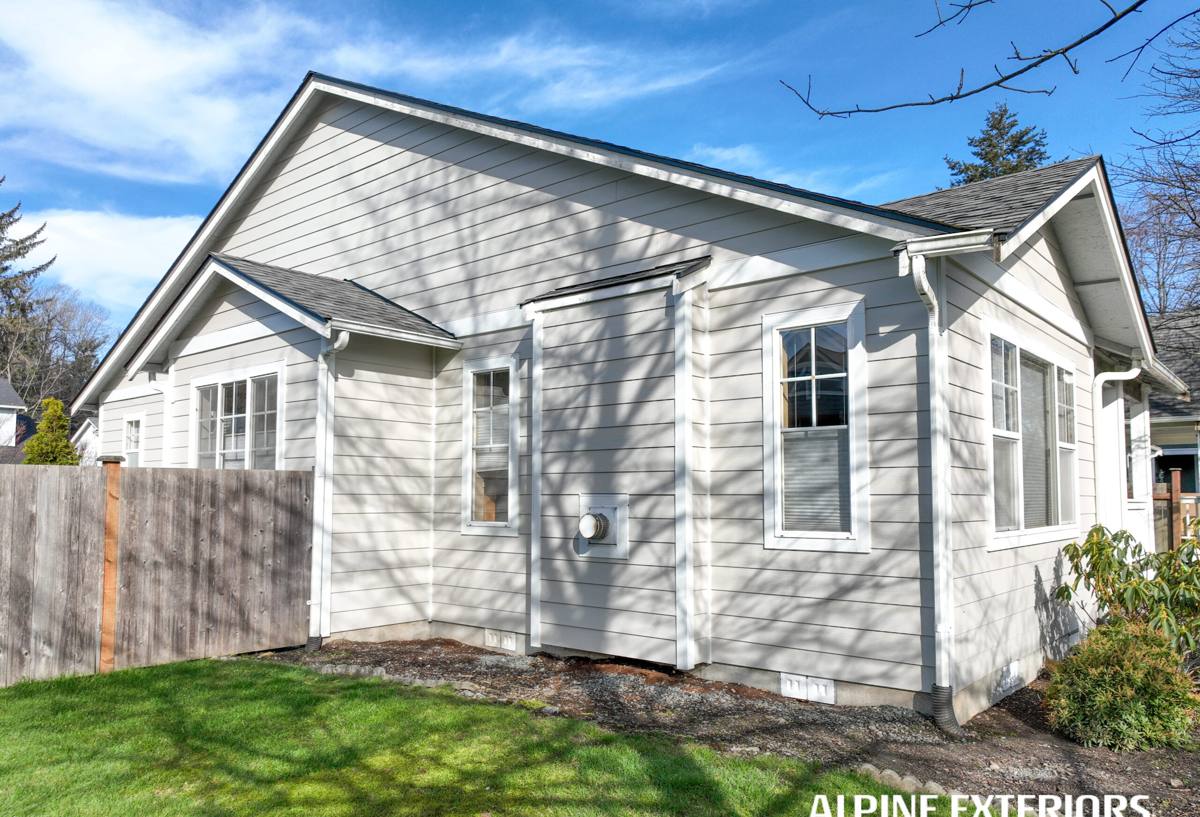
We install James Hardie fiber cement siding exclusively — no vinyl, no LP SmartSide, no Cemplank, no Allura, no primed spruce, no cedar. That's not a marketing angle; it's a decision we made after years of watching how different siding materials actually perform in this climate over time.
Vinyl expands and contracts with temperature swings and can crack or bow in a hard cold snap, and the seams and J-channels are exactly where wind-driven rain finds a way in behind the cladding. Wood-based products like LP SmartSide and primed spruce use engineered or solid wood cores that, no matter how well they're treated, remain organic material — cut edges and fastener penetrations are ongoing points of vulnerability in a climate this wet, and they need more frequent caulk and paint upkeep to stay ahead of moisture. Cedar is a beautiful, honest material, but it's a maintenance commitment: staining or sealing on a recurring cycle, with a real risk of rot and insect damage if that upkeep slips even one season behind.
James Hardie's fiber cement is cement, sand, and cellulose fiber — it doesn't rot, it isn't a food source for insects, and it doesn't swell and shrink the way wood does. It's also non-combustible, which matters more each year as wildfire smoke seasons stretch later into the Pacific Northwest calendar. Factory-applied ColorPlus finish means the color is baked on before the board ever reaches the jobsite, so it holds up to UV and moisture far longer than field-applied paint, and it's backed by a real, transferable warranty. For a house that has to stand up to salt-laced rain and months of shade every year, it's the product we're willing to put our name behind.
The HZ5 Engineering Advantage
James Hardie manufactures regional formulations of its siding, and the HZ5 line is engineered specifically for climates like ours — cold, wet winters with real freeze-thaw cycling. It's formulated to resist moisture intrusion and hold its dimensional stability better than a generic, one-size-fits-all fiber cement product would. When we quote a Nooksack job, HZ5 is the baseline, not an upgrade.
What a Correct Installation Actually Involves
Fiber cement siding is only as good as the installation behind it. Most siding failures we get called out to inspect aren't a product problem — they're a water-management problem introduced during installation. Getting it right in a climate this wet comes down to a handful of details that are easy to skip and expensive to skip later.
Weather Barrier and Flashing
Every wall needs a continuous, correctly lapped weather-resistive barrier underneath the siding, with flashing integrated at every window, door, and roof intersection so water is directed out and down, never trapped behind the cladding. Where trim boards meet siding, and where siding meets roofing or decks, flashing details decide whether that joint sheds water for thirty years or starts feeding rot in five.
Fastening and Clearances
James Hardie publishes specific fastener patterns, nailing schedules, and minimum clearances — siding held above grade, decks, roof lines, and horizontal surfaces so water and standing moisture can't wick up into the board ends. Cut edges get sealed. Fasteners are set to the manufacturer's spec, not overdriven or underdriven, because either mistake compromises the board's ability to move slightly with temperature changes without cracking.
Caulking and Joints
Butt joints and trim transitions get treated as water-management points, not just cosmetic seams. The wrong caulk, or caulk applied where the detail should instead be flashed, is a common shortcut that shows up as staining or soft trim a few winters later.
Our Process for Nooksack Homeowners
- On-site assessment. We walk the whole exterior, checking existing moisture damage, trim and flashing condition, and any areas — typically north and west-facing walls — already showing moss or algae growth.
- Written estimate. You get a clear scope: which Hardie product and profile, colors, trim details, and what tear-off or repair work is included, with no vague allowances.
- Prep and removal. Old siding comes off, the sheathing underneath gets inspected for rot or damage, and any needed repairs are addressed before anything new goes on.
- Weather barrier and flashing installation. This is the step that determines long-term performance, and we don't rush it.
- Hardie siding installation to manufacturer spec — correct fastening, clearances, and joint treatment throughout.
- Final walk-through with you before we consider the job done.
James Hardie Product Lines for This Area
Most Nooksack-area homes fall into one of a few Hardie product choices, depending on the look you want and the condition of the home:
| Product | Best For | Notes |
|---|---|---|
| HardiePlank lap siding | Traditional horizontal lap look, the most common choice on area homes | Available in multiple textures and exposures |
| HardiePanel vertical siding | Board-and-batten or modern accent sections | Often paired with lap siding on gables or entry features |
| HardieShingle siding | Shingle-style accents, gable ends | Gives a cedar shingle look without the maintenance |
| HardieTrim boards | Window, corner, and fascia trim | Matched or contrasting ColorPlus finishes |
All of it is available in ColorPlus factory finishes, which matter more here than in drier climates — a factory-cured finish resists the peeling and fading that field-applied paint is prone to under repeated damp-and-dry cycling.
Cost Factors on a Nooksack Siding Job
We don't publish flat prices because every house is different, but the real cost drivers on a siding project here are consistent. This gives you a sense of what actually moves the number up or down before you get a formal quote:
| Factor | Why It Matters |
|---|---|
| Home size and wall complexity | More corners, gables, and dormers mean more cutting, trim, and labor time |
| Existing damage | Rotted sheathing found during tear-off has to be repaired before new siding goes on |
| Product and profile choice | Lap, panel, and shingle styles carry different material and labor costs |
| Trim scope | Full trim replacement adds cost but ensures matched, warrantied materials throughout |
| Access and site conditions | Steep grades, tight lot lines, or landscaping can affect staging and labor time |
Why a Crew That Already Works Nooksack Matters
Siding installation isn't identical everywhere, and a crew that regularly works this part of Whatcom County has already seen how local conditions play out on real houses — which walls tend to hold moisture longest, how moss establishes itself on shaded siding, and which flashing details actually get tested by a hard winter storm coming down the valley. That's not something you learn from a manual; it's something you learn from doing the work here, season after season.
It also means straightforward logistics: material delivery, scheduling around our wet-season stretches, and being reachable if a question comes up after the job is done. You're not dealing with a crew that has to relearn the area's quirks on your house.
Living With Hardie Siding in a Damp, Mossy Climate
James Hardie siding is low-maintenance compared to wood or vinyl, but "low-maintenance" isn't "no-maintenance" — especially with the moss pressure this area sees. A little routine care keeps it looking right and performing the way it's designed to for decades:
- Rinse siding annually with a garden hose and soft brush — avoid high-pressure washing, which can force water behind laps and joints
- Trim back shrubs and trees so foliage isn't holding moisture against the wall or shading it into a permanent damp zone
- Check gutters and downspouts each fall so overflow isn't running down the siding face
- Watch north and west-facing walls for early moss or algae growth and address it before it spreads
- Re-caulk trim joints if you notice gaps opening up, rather than waiting for staining to appear
- Have flashing and trim inspected periodically, especially after a hard winter storm season
If your Nooksack home's siding is showing moss, staining, soft spots, or you're just planning ahead, we're happy to take a look and walk you through what we're seeing — no pressure, no obligation. Use the form below to request a free estimate.