 Lynden Roofing
 Why Decks in Nooksack Take a Beating
Nooksack sits inland from Bellingham Bay, but the same marine weather system that pushes salt-tinged air across Whatcom County still reaches this far east. Add in driving rain off the Pacific through fall and winter, and a moss season that can run from October clear into May, and you've got a climate that's genuinely hard on exterior wood structures. Decks take the worst of it because they're horizontal — every board is a small basin collecting water, pine needles, and moss spores instead of shedding them the way a wall or roof does.
Most deck problems we see in this area aren't cosmetic. They start underneath, where moisture sits against ledger boards, joists, and fastener connections long after the surface looks dry. By the time a homeowner notices soft decking or a board that flexes underfoot, the damage has usually been building for a season or two.
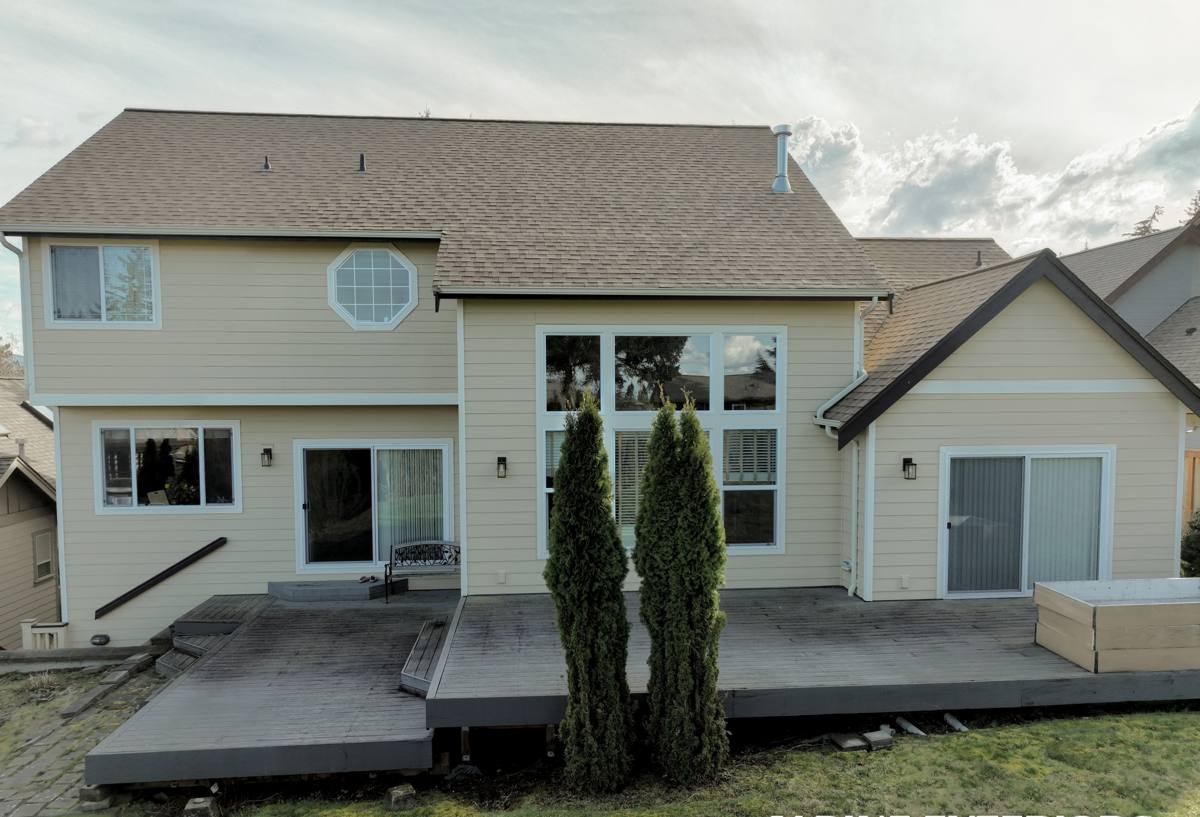
Signs Your Deck Needs a Real Repair
Not every deck problem is obvious from the top. Some of the most serious issues hide in connections and framing that never get looked at until something fails. Here's what we watch for on Nooksack decks specifically, given the moss and moisture load this area gets:
- Boards that feel spongy, spring back slowly, or sound hollow when tapped
- Green or black staining that keeps returning within weeks of cleaning
- Gaps opening up between boards, or fasteners backing out and standing proud
- Visible rust streaking from screws or joist hangers
- A ledger board (where the deck attaches to the house) that shows staining, gaps, or gives slightly when you push on the rim joist
- Railing posts that wobble more than a small amount at the top
- Standing water that takes more than a day to dry after rain, especially in shaded corners
Any one of these can be a simple fix. Several at once, especially near the ledger or support posts, usually means the repair needs to start with the frame, not the decking surface.
Why the Ledger Board Matters Most
The ledger is the board that ties the deck to the house, and it's the single most safety-critical connection on the whole structure. In this climate, moisture tends to collect right where the ledger meets the siding or rim joist, especially on older decks that were built without proper flashing. We check this connection on every repair call, even when the homeowner's concern is somewhere else entirely.
What a Correct Repair Actually Involves
A deck repair that only replaces the boards you can see is a temporary fix. A repair that holds up through another Whatcom County winter starts underneath and works outward:
- Structural inspection first. We check the ledger connection, joists, beams, posts, and footings before touching decking. If the frame is compromised, new boards on top just hide the problem.
- Address moisture pathways. Flashing, gaps, and drainage paths get corrected so water sheds away from the structure instead of pooling against it.
- Replace what's actually failed. Rotted or split framing members get sistered or replaced — not patched over. Fasteners that have corroded get swapped for the right hardware for the wood species and treatment.
- Rebuild the surface to match. Decking boards get replaced to match spacing and fastening patterns so the repaired section performs the same as the rest of the deck.
- Final check under load. We walk the whole deck, check railings and stairs, and confirm nothing else needs attention before calling the job done.
Repair or Replace? What Actually Decides It
Homeowners often ask us to just "fix what's broken," which is the right instinct — full deck replacement is rarely necessary. But there's a point where repair stops making sense. Here's how we walk through that decision on Nooksack jobs:
| Factor | Usually Points to Repair | Usually Points to Replace |
|---|---|---|
| Framing condition | Isolated rot at one joist or post | Widespread soft spots across multiple framing members |
| Ledger board | Solid, properly flashed | Rotted, unflashed, or improperly attached originally |
| Age of structure | Under 15-20 years, built to a reasonable standard | Original construction has multiple outdated or unsafe details |
| Decking material | A few damaged boards in an otherwise sound deck | Most boards showing the same wear at the same time |
| Footings/posts | Stable, no movement or settling | Shifting, undersized, or not set to current standards |
In practice, most calls we get from Nooksack homeowners end up as targeted structural repairs plus a partial deck board replacement — full tear-downs are the exception, not the rule.
How Our Process Works
We keep this straightforward because homeowners have usually already dealt with one vague quote before calling us:
- On-site inspection. We get under the deck, not just walk the top of it, and check the ledger, framing, and posts directly.
- Plain-language findings. You get a clear rundown of what's actually wrong, what's cosmetic, and what's structural — no upsell padding.
- A written scope and price range. You know what's included before work starts, not after.
- The repair itself. Most deck repairs in this area take one to a few days depending on the extent of framing work involved.
- A final walkthrough. We go over what was done and what to watch for going forward.
Materials: What Holds Up Here vs. What Doesn't
Whatcom County's damp, mossy climate is unforgiving of shortcuts in material choice. For repair work, we match materials to what performs well in this specific environment rather than defaulting to whatever's cheapest:
| Material | Where It Fits | Trade-off to Know |
|---|---|---|
| Pressure-treated framing lumber | Joists, beams, ledger repairs | Needs proper fastener compatibility to avoid accelerated corrosion |
| Cedar decking | Repairs matching existing cedar decks | Requires more regular cleaning and sealing to resist moss and graying |
| Composite decking | Sections getting a full board replacement | Higher upfront cost, but far less moss buildup and no re-sealing |
| Stainless or coated structural hardware | Any framing or ledger connection | Costs more than standard hardware, but it's not optional in this climate — it's what keeps a repair from failing again in a few years |
We don't push one decking product over another as a rule — that decision is mostly about budget and maintenance appetite. Where we don't compromise is on the structural hardware and framing lumber, because that's what determines whether a repair actually lasts through Whatcom County winters.
Fasteners: The Detail Homeowners Never Think About
A huge share of "mystery" deck failures we find come down to mismatched fasteners — standard steel screws in treated lumber, for example, corrode far faster than the wood around them fails. Getting this right is a small line item that has an outsized effect on how long a repair holds up.
Why a Crew That Already Works Nooksack Makes a Difference
Deck repair isn't complicated in theory, but doing it right in this specific climate means knowing what actually fails here versus what fails in a drier region. A crew that regularly works Nooksack and the surrounding Lynden area already knows:
- Which ledger and flashing details tend to fail first in decks built to older local practices
- How fast moss reestablishes on north- and east-facing sections that stay shaded most of the day
- What framing lumber and fastener combinations actually hold up through a full wet season here, not just on paper
- Realistic timelines around the rainy months, so repairs aren't rushed or delayed unnecessarily
That local pattern recognition is the difference between a repair that gets reopened in two years and one that doesn't.
After the Repair: Keeping Moss and Moisture From Coming Back
A good repair buys you time, but a little upkeep protects the investment. For Nooksack decks specifically, we tell homeowners to stay ahead of these:
- Sweep debris and needles off the deck regularly through fall — trapped organic material is what feeds moss growth
- Rinse or lightly scrub visible moss before it spreads, rather than waiting for a deep clean once a year
- Check that gaps between boards stay clear so water can drain instead of pooling
- Re-seal or re-stain wood decking on the schedule the product calls for — skipping a cycle is how small moisture problems turn into rot
- Glance under the deck once a year for new staining or soft spots near the ledger, especially after a hard winter
If your deck has soft boards, staining that won't clean off, or just feels a little less solid than it used to, it's worth getting a straight answer before winter rain finds the weak spot for you. We offer free, no-pressure estimates for Nooksack homeowners — use the form below to get a time on the calendar.