 Lynden Roofing
 Why Everson Homes Take a Different Kind of Beating
Everson sits along the Nooksack River just northeast of Lynden, in a stretch of Whatcom County where the weather doesn't do things halfway. Homes here deal with a combination that's harder on exterior siding than most people realize: salt-laden air drifting in off the Strait of Georgia and Bellingham Bay, long stretches of driving, wind-blown rain rather than gentle drizzle, and a moss season that can stretch from October well into April. Add in the humidity that settles into low-lying areas near the river, and you've got a climate that will find every weak point in a siding system within a few years — not decades.
That combination matters because it doesn't just affect how siding looks. It affects how it performs. Wind-driven rain gets pushed sideways into laps, seams, and trim joints that would stay dry in a calmer climate. Salt air accelerates corrosion on fasteners and metal flashing. And moss doesn't just grow on roofs — given a shaded north wall and a few years of neglect, it takes hold on siding too, trapping moisture against the wall assembly long after the rain has stopped.
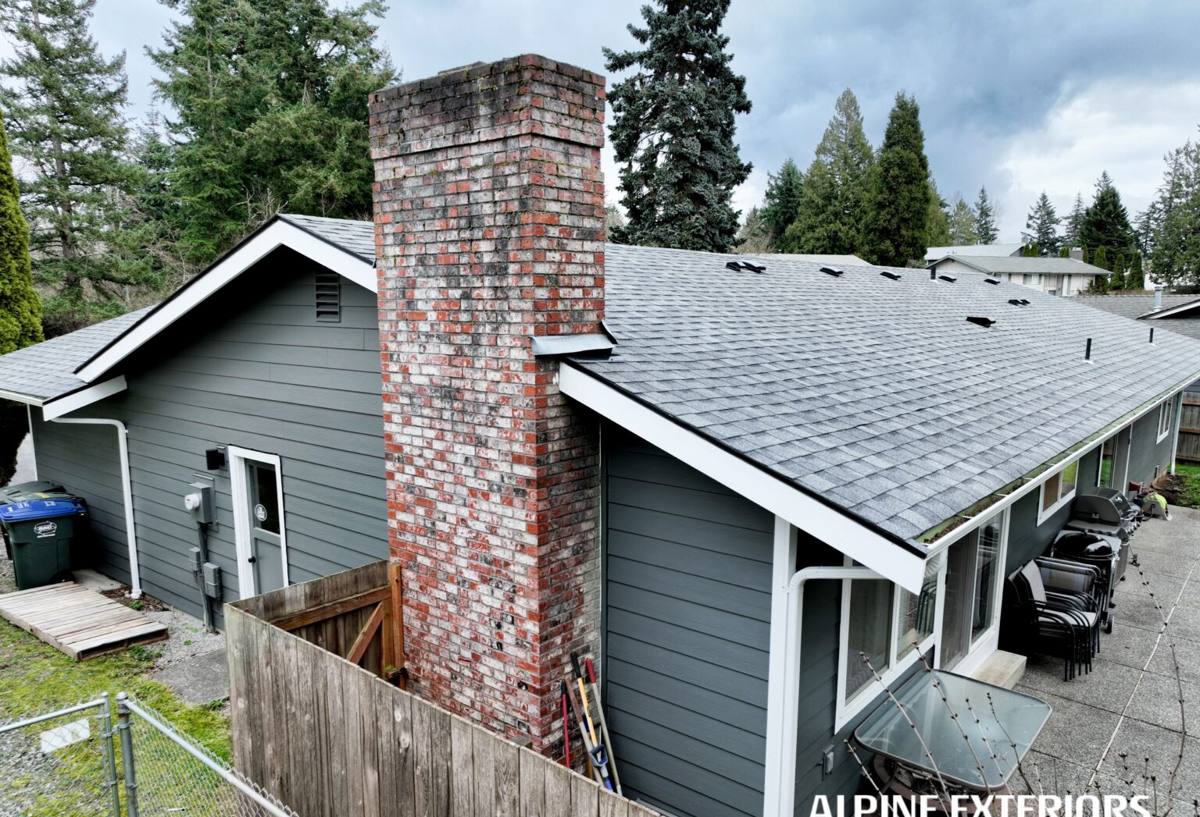
What Siding in Everson Actually Needs to Do
A siding installation here isn't just a cosmetic upgrade. It's a weather barrier that has to perform in specific ways:
- Shed wind-driven rain without letting it track behind the panels at laps and seams
- Resist moisture absorption so the substrate underneath stays dry through a wet Whatcom County winter
- Hold a factory finish that doesn't chalk, fade, or peel under repeated wet-dry cycles
- Discourage moss and algae growth on shaded elevations, especially north- and west-facing walls near tree cover
- Stand up to salt exposure without the fastener corrosion that leads to streaking and loosened panels
This is exactly the reasoning behind our decision to install only James Hardie fiber cement siding. Fiber cement doesn't absorb water the way wood-based or wood-derived products can, it doesn't provide the same food source for moss and mildew that some materials do, and Hardie's ColorPlus factory finish is baked on and warrantied specifically against the kind of fading and peeling this climate causes. We don't install vinyl, LP SmartSide, Cemplank, Allura, primed spruce, or cedar — not because those products can't work anywhere, but because we've standardized on the one system we're confident will hold up to an Everson winter without excuses.
What a Correct Installation Involves
Siding is only as good as what's behind it. A huge share of the siding failures we get called out to inspect in this area aren't failures of the siding material itself — they're failures of the installation underneath it. Getting it right means:
Weather-Resistive Barrier and Flashing
Every wall gets a proper weather-resistive barrier, correctly lapped shingle-style so water sheds downward and outward, never into the wall. Flashing goes in at every window, door, and horizontal trim transition — the exact spots where wind-driven rain gets pushed sideways and tries to find a way in. This is the step that separates a siding job that lasts twenty-plus years from one that starts showing rot behind the wall in five.
Rain Screen and Drainage Gap
Given how much rain this area sees, we install with a drainage gap behind the siding wherever the wall assembly calls for it, so any moisture that does get past the outer layer has somewhere to go besides sitting against the sheathing.
Fastening to Spec
James Hardie has specific fastener patterns, penetration depths, and clearance requirements — and they vary by product line and exposure. Corrosion-resistant fasteners matter even more here given the salt air; using the wrong fastener type is a common shortcut that shows up as rust streaking within a couple of winters.
Clearances and Gaps
Hardie siding needs a minimum clearance from roof lines, decks, and grade, and gaps at trim and penetrations sized correctly and sealed with the right sealant. Get this wrong and you've built in a moisture trap on day one.
Our Installation Process
| Step | What Happens |
|---|---|
| 1. On-site assessment | We walk the exterior, check current siding and sheathing condition, note problem elevations (especially shaded, moss-prone walls) and moisture entry points |
| 2. Product and color selection | Choose the Hardie product line and ColorPlus color that fits the home and exposure — different elevations may call for different HZ engineering |
| 3. Tear-off and inspection | Remove old siding, inspect sheathing for hidden rot or moisture damage before anything new goes up |
| 4. Repair and prep | Replace any compromised sheathing, correct flashing details, install weather-resistive barrier |
| 5. Installation | Install Hardie siding and trim to manufacturer fastening and clearance specs |
| 6. Final detailing | Caulk, paint touch-up on cut edges, final walkthrough |
Signs an Everson Home Needs New Siding Soon
Some warning signs are easy to spot from the ground; others take a closer look. Homeowners in and around Everson and Lynden should watch for:
- Soft or spongy spots when you press on the siding, especially near the bottom courses or under windows
- Persistent moss or algae staining on north- and west-facing walls that comes back within a season of cleaning
- Paint that's peeling, bubbling, or chalking heavily rather than just fading evenly
- Visible gaps, warping, or cupping at panel seams
- Rust streaking around fasteners or trim
- Higher-than-expected heating bills, which can point to a wall assembly no longer keeping moisture and air where they belong
None of these are emergencies on their own, but they're all signals worth having looked at before the underlying sheathing takes damage.
James Hardie: Why It's the Only System We Put on Homes
James Hardie fiber cement is engineered specifically for regional climate zones — the HZ5 product line used in this part of Washington is built around resisting moisture and freeze-thaw cycling rather than the drier, hotter conditions other HZ variants are tuned for. It's non-combustible, which matters for wildfire-adjacent risk and insurance considerations even in a wet climate. The ColorPlus factory finish is baked on under controlled conditions, which is a meaningfully different process than field-applied paint, and it comes with its own warranty coverage against fading and peeling. Combined with Hardie's transferable product warranty, it's a system we can stand behind for the long haul rather than something that looks good for a season and then becomes a maintenance project.
We've looked at the alternatives — vinyl, LP SmartSide, Cemplank, Allura, primed spruce, cedar — and each has real strengths in the right application. But for the specific combination of salt air, sustained wind-driven rain, and moss pressure that Everson and greater Lynden deal with every year, fiber cement from Hardie is the one system we're confident installing without hedging.
Why Local Experience Matters for This Job
Siding installation looks similar on paper everywhere, but the details that actually matter — how deep to set fasteners given the salt exposure here, which elevations need extra attention for moss and shade, how to detail flashing for wind-driven rain rather than just vertical rainfall — come from having done the work in this specific area, not from a general manual. A crew that regularly works Everson and Lynden homes already knows which walls tend to hold moisture, which older homes in the area have sheathing issues worth checking for, and how the Nooksack River lowland humidity behaves differently than a drier inland site just a few miles away.
That local pattern recognition is what keeps a siding job from becoming a callback. It's also why we'd rather walk a property in person and look at the actual conditions than quote a job sight unseen.
Questions Worth Asking Any Siding Contractor
- Do you install to the manufacturer's written fastening and clearance specifications, or your own shortcuts?
- What's your approach to flashing at windows, doors, and trim transitions?
- Do you inspect and repair sheathing before installing new siding, or install over whatever's there?
- What warranty covers the material, and what warranty covers your labor?
- Have you worked on homes in this specific area, and do you know its common trouble spots?
Maintenance After a Proper Installation
A correctly installed Hardie siding system is low-maintenance, not no-maintenance. A little attention keeps it performing for the long run:
- Rinse shaded, moss-prone elevations once or twice a year, particularly after the wet season
- Keep gutters clear so overflow doesn't run down the wall face
- Trim back vegetation and tree cover that keeps walls shaded and damp
- Have caulking and trim joints checked every few years and resealed if needed
- Address any impact damage or cracked panels promptly rather than letting moisture get behind them
Cost Factors to Expect
| Factor | Why It Affects Price |
|---|---|
| Home size and wall complexity | More corners, gables, and trim detail means more labor and cut waste |
| Sheathing condition | Hidden rot found during tear-off adds repair work before new siding goes up |
| Product line and finish | Different Hardie profiles and ColorPlus colors carry different material costs |
| Access and site conditions | Multi-story walls, tight lot lines, or landscaping obstacles affect labor time |
| Removal and disposal | Tearing off and hauling away old siding adds to project scope |
Because so much of the real cost depends on what's actually happening behind the existing siding, we don't hand out ballpark numbers over the phone — an in-person look tells us far more than guesswork would.
If your Everson or Lynden home is showing signs of wear, or you're planning ahead before the next wet season sets in, we're happy to walk the property and give you a straightforward, no-pressure estimate. Use the form below to get started.