 Lynden Roofing
 Siding Built for Deming's Particular Climate
Deming sits in the Nooksack River valley a few miles east of Lynden, tucked closer to the tree-covered foothills that lead up toward Mount Baker. That setting gives it a slightly different exposure than the open farmland around Lynden proper: more mature tree canopy, more shade on north- and east-facing walls, and a river-valley humidity that lingers even on days when the rest of Whatcom County has dried out. Layer that on top of the marine air and driving rain that move through this whole corner of Washington, and you get a climate that's genuinely tough on exterior siding, just in a slightly different way than it is a few miles down the road.
We install James Hardie fiber cement siding, exclusively, for homes in Deming and across Whatcom County. This page isn't a generic siding pitch — it's specifically about what Deming's combination of tree cover, river moisture, and regional marine climate means for a siding job, what a correct Hardie installation looks like here, and why a crew that already works this area does that job differently than one showing up for the first time.
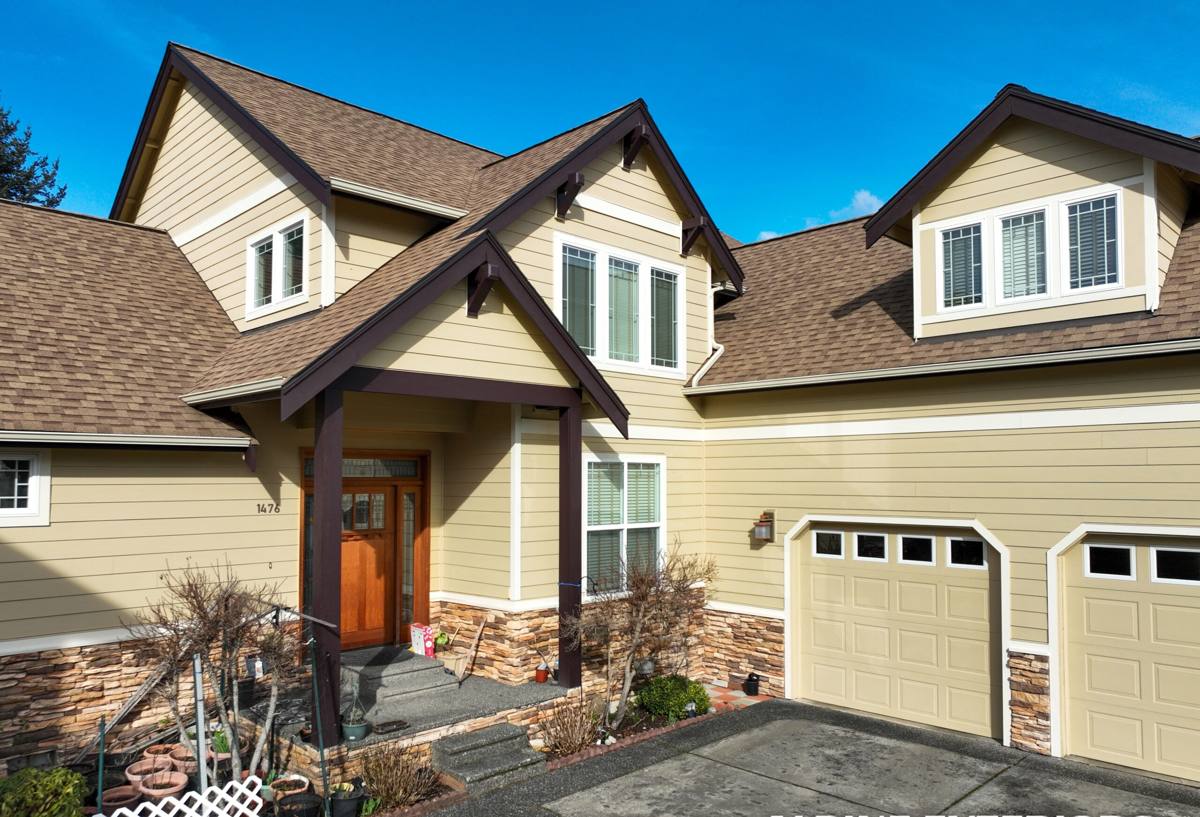
What Deming's Climate Actually Does to a House
Salt Air Reaching Inland
Deming isn't waterfront, but Whatcom County's marine air moves inland across the whole region, and salt-laden moisture in that air still reaches homes well away from the shoreline. Over years, that exposure accelerates corrosion on fasteners, flashing, and trim hardware, and it degrades lower-quality factory or field-applied finishes faster than a truly dry inland climate would. It's a slower, quieter form of wear than storm damage, but it adds up the same way over a decade or two.
Driving Rain Off the Foothills
Rain in this part of the county rarely falls straight down. Wind pushes it sideways into lap joints, under trim, and into any seam where flashing or caulking isn't detailed correctly, and the foothill terrain around Deming can funnel wind in ways that differ from the flatter, more open ground closer to Lynden. That's a harder test on a siding system's water management than a simple annual rainfall number suggests, and it's one of the main reasons installation quality matters as much as the material itself.
A Long, Tree-Shaded Moss Season
Deming's heavier tree cover means more shade on more walls, for more of the year, than a lot of open-lot homes in Lynden or Ferndale see. Combine that shade with steady river-valley moisture and mild temperatures, and you get moss and mildew growth that can run nearly year-round on the shaded sides of a house. Organic growth on a siding surface isn't just a cosmetic problem — it traps moisture against the wall behind it, and that trapped moisture is where a lot of long-term rot and finish failure actually starts.
Why James Hardie Is the Right Fit for This Area
We standardized on James Hardie fiber cement, and only James Hardie, after years of seeing how different siding materials actually performed on tear-offs and service calls across Whatcom County. For a shaded, moisture-heavy setting like Deming, the case is even more direct than it is elsewhere in the county.
- Inorganic core: Fiber cement doesn't have a wood-based or foam core that can absorb water, swell, or rot the way organic and engineered wood siding can when it's shaded and damp most of the year.
- Non-combustible: A fiber cement core doesn't feed a fire, which matters in a wooded, tree-lined setting where defensible space and material choice both come up in insurance conversations.
- ColorPlus factory finish: The color coat is baked on in a controlled factory setting, in multiple layers, rather than brushed on in the field. That holds up better against both salt-air degradation and the tannin staining and mildew that tree-shaded walls tend to develop.
- Climate-engineered HZ5 formulation: Hardie builds different product lines for different climate zones. The HZ5 line is engineered for regions with sustained moisture and freeze-thaw cycling, which fits Deming's river-valley winters better than a product engineered primarily for hot, dry markets.
- Dimensional stability: Fiber cement doesn't swell, cup, or warp the way engineered wood products can after repeated wetting and drying cycles through a wet season.
We don't install LP SmartSide, vinyl siding, Cemplank, Allura, primed spruce, or cedar. Each of those has a legitimate place in the broader market, and homeowners who've chosen them aren't wrong to have done so. But on a shaded, moisture-heavy lot like a lot of Deming properties, we've made a professional call: we'd rather stand fully behind one system than offer a cheaper option that quietly shifts long-term maintenance risk onto the homeowner.
Why Vinyl and Engineered Wood Fall Short Here Specifically
Vinyl siding expands and contracts with temperature swings, and its lapped, non-sealed seams aren't built to shed sideways-driven rain the way this area regularly delivers it. It also depends on airflow behind the panel to dry out, which is harder to guarantee on a shaded wall that never gets a full afternoon of sun. Engineered wood products use a treated wood-fiber core that depends on an intact factory coating and fully sealed field cuts to keep moisture out — a reasonable ask in a dry climate, but a much bigger maintenance burden on a house that stays damp and shaded most of the year.
What a Correct Hardie Installation Involves
Fiber cement's long-term performance depends heavily on installation quality. The material itself resists rot and fire, but a rushed or out-of-spec install can undercut all of that. This is the baseline we hold every Deming job to, not an upsell:
| Installation Detail | Why It Matters in Deming |
|---|---|
| Manufacturer-specified clearances from grade, roofline, and deck surfaces | Keeps splash-back and standing moisture off the board edge, especially on shaded, slow-drying walls |
| Correct fastener type, spacing, and depth | Prevents cracking and keeps the water-resistive barrier behind the siding intact |
| Properly lapped flashing at windows, doors, and roof-to-wall transitions | Directs wind-driven rain away from seams instead of letting it track into the wall assembly |
| Factory-cut edges used wherever possible, field cuts sealed to spec | Preserves the ColorPlus finish's protection at every cut edge |
| Rain screen or drainage plane behind the siding | Lets moisture that gets past the surface drain and dry rather than sitting against tree-shaded walls |
We send manufacturer-certified installers to every job rather than treating fiber cement as a drop-in swap for whatever a crew is used to hanging. On a house with a lot of shade and consistent moisture, the difference between correct and merely adequate detailing shows up sooner, not later.
Our Process for a Deming Siding Job
- Walk the property. We look at existing siding condition, sheathing exposure, roofline and grade clearances, and how sun and shade actually move across the walls through the day, not just at the time of the estimate.
- Give a straight assessment. If there's hidden moisture damage or rot behind existing siding, we tell you before tear-off starts, not as a surprise change order once the walls are already open.
- Plan the water management details. Flashing, clearances, and drainage plane get worked out for your specific home before a single board is cut, rather than improvised on install day.
- Install to Hardie's spec. Certified installers handle fastening, flashing, and edge sealing according to manufacturer requirements, not shortcuts that happen to look fine on day one.
- Walk the finished job with you. We go over the completed siding, the warranty paperwork, and basic care so you know what to expect and what would actually be a problem worth calling us about.
Signs a Deming Home May Need New Siding
- Moss or dark staining that returns quickly after cleaning, especially on shaded or tree-lined walls
- Soft, spongy, or bowing siding, particularly low on the wall or around window trim
- Peeling paint or visible warping concentrated on north- or east-facing walls
- Cracked or missing caulk at seams, corners, and trim joints
- Visible gaps or rust staining around fasteners and flashing
- A musty smell or visible interior staining near exterior walls, which can point to moisture already past the siding
Cost Factors for Siding in Deming
| Factor | What Drives It | Deming-Specific Consideration |
|---|---|---|
| Tear-off vs. overlay | Condition of existing siding and sheathing | Shaded walls with a history of moss are more likely to need sheathing repair once opened up |
| Home size and trim complexity | Square footage, number of corners, windows, and architectural detail | Wooded lots often have more elevation and trim complexity where landscaping meets the house |
| Access and site conditions | Driveway length, staging area, tree clearance | Mature tree cover common in Deming can affect equipment access and scheduling around limbs or root zones |
| Product line and finish color | HZ5 lap, panel, or shingle profiles; ColorPlus color selection | Darker ColorPlus finishes can help visually with tannin or moss staining between cleanings on shaded walls |
Exact numbers depend on the specific home, which is why we walk the property before quoting rather than working off a generic price sheet.
Why a Crew That Already Works Deming Matters
A contractor who only occasionally works out this way treats every Deming job as a one-off. A crew that regularly works Deming, and the rest of Whatcom County alongside it, has already seen how shade patterns, river-valley moisture, and wind-driven rain behave on real houses here over full seasons, not just on a spec sheet. That shows up in small but real decisions: which walls get extra flashing attention, where a drainage plane matters most, and which lots need a longer look at tree clearance and drying time before a tear-off schedule gets set. It also means less guesswork about how a given Deming property compares to a similar-looking home closer to Lynden, where the sun and wind exposure can be meaningfully different even a few miles apart.
Get a Free, No-Pressure Estimate
If your Deming home needs new siding, or you're not sure whether what's on the walls now still has good years left in it, we're glad to take a look and give you a straightforward answer. Reach out using the form below to schedule a free, no-pressure estimate.