 Lynden Roofing
 Siding Replacement in Custer: A Job We Know From the Inside
Custer isn't just another stop on the route for us — it's home base. That means the salt air, the sideways rain, and the moss that build up on siding here aren't things we studied on a spec sheet; they're what we deal with on our own properties and on job sites within a few minutes' drive, every season of the year. When a homeowner in Custer calls about a full siding replacement, we're not estimating a climate we've read about. We're describing conditions we've watched wear on real walls for years.
This page is about one job, done right, in one place: a full siding replacement for a Custer home. Not a repaint, not a patch job, and not a general overview of every exterior service we offer — just what local houses actually need from a re-side given this corner of Whatcom County's weather, what a correct installation involves, how the process runs from first call to final walkthrough, and why it matters that the crew doing the work already lives here.
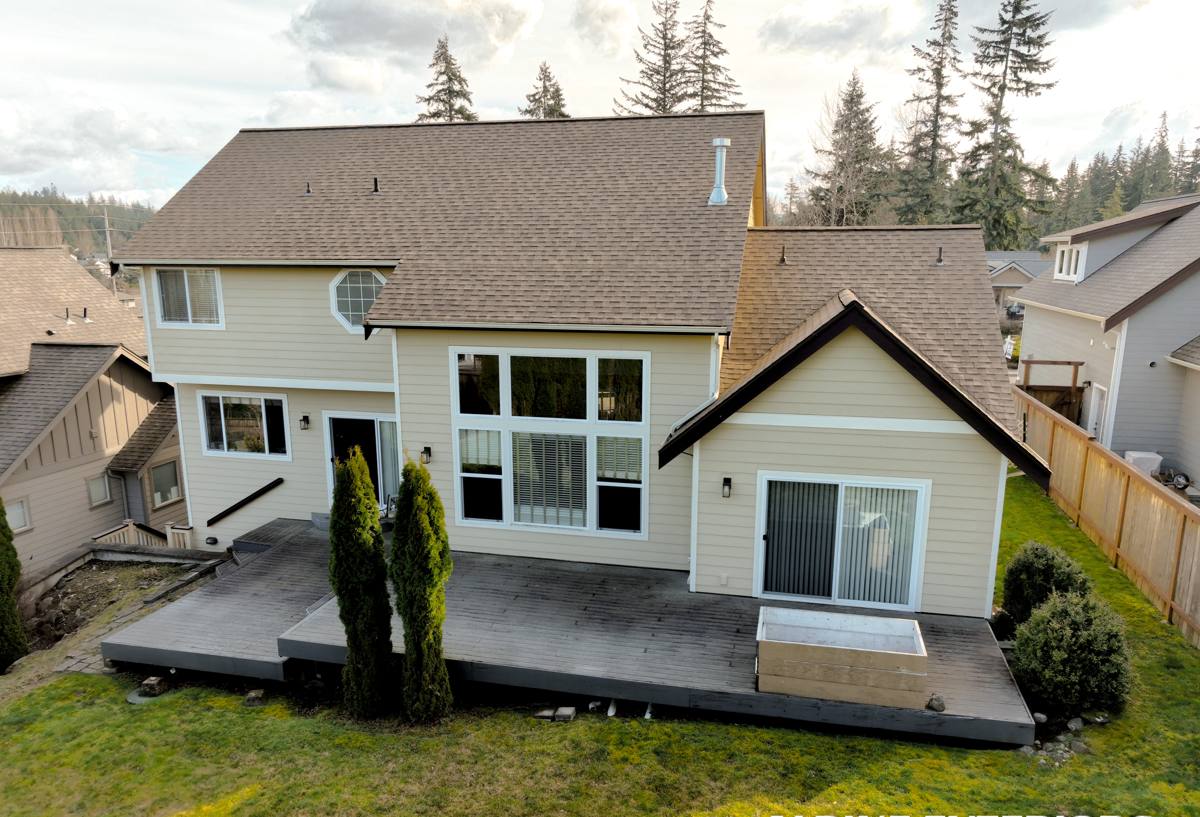
What Salt Air, Driving Rain, and a Long Moss Season Do to Siding Here
Three conditions do most of the damage to Custer siding over time, and none of them are dramatic on their own. It's the years of steady exposure that eventually catch up with a wall that wasn't detailed correctly the first time.
Salt Air Near the Border
Custer sits close enough to the water and the Canadian border that salt-laden air reaches most properties in town, not only the ones with a water view. Over time, that air works on fastener heads, flashing, and any factory finish that isn't built to hold up under sustained salt exposure. A replacement that doesn't account for this ages faster than the homeowner was told to expect.
Wind-Driven, Sideways Rain
Rain here spends a good part of the year moving sideways, not straight down. That matters enormously for a siding replacement, because wind-driven rain finds its way into lap joints, trim seams, and window flashing that a calmer climate's installation standards wouldn't need to worry about as much. The materials and the install details both have to assume this is normal weather, not an occasional storm.
A Moss Season That Barely Breaks
Mild temperatures and near-constant moisture give moss and mildew a growing season that runs most of the year on shaded or north-facing walls. A siding material with any surface porosity becomes a growth surface eventually, and organic growth on siding traps moisture against the wall behind it — which is where a lot of the real, structural siding problems we find on tear-offs actually start.
Signs a Custer Home Is Ready for a Full Siding Replacement
Not every siding problem calls for a full re-side. These are the signs that usually mean patching has run its course:
- Moss or dark staining that returns within weeks of being cleaned, especially on shaded walls
- Soft, spongy, or crumbling siding, particularly low on the wall or around window and door trim
- Multiple areas of cracked, warped, or missing panels rather than one isolated spot
- Paint or finish failing across large sections rather than a single weathered board
- Musty odors or staining on interior walls that back up to exterior siding
- Rot or soft sheathing discovered behind siding during a repair attempt
- Siding older than 20-25 years with no documented replacement or major repair
- Rising energy bills alongside visible gaps, warping, or drafts at the wall line
Repair, Partial Replacement, or Full Re-Side?
This is a real decision, not a formality, and we walk through it honestly with every Custer homeowner rather than defaulting to the biggest scope of work. A few boards damaged by a single storm, on siding that's otherwise sound, is usually a legitimate repair. Damage concentrated on one elevation — often the wall that takes the most wind-driven rain or the least sun — can sometimes be handled as a partial re-side if the remaining siding is still structurally solid and a reasonable color and profile match is available.
A full replacement becomes the honest recommendation once damage shows up in multiple areas, once sheathing rot turns up behind more than an isolated section, or once the existing material is old enough that patching it just delays a bigger job by a few years while moisture keeps working on what's underneath. We'd rather tell a homeowner a repair is enough than talk them into a full re-side they don't need yet — and we'll also tell you plainly when patching is just postponing the inevitable.
Why Every Replacement We Do Is James Hardie Fiber Cement
We install one siding system on every replacement job: James Hardie fiber cement. We don't offer vinyl, LP SmartSide, Cemplank, Allura, primed spruce, or cedar, and that's a professional standard built from years of service calls in this exact climate, not a supplier arrangement or a sales angle.
- Non-combustible core: Fiber cement doesn't feed a fire the way wood-based products can, which matters for both safety and insurance conversations.
- Factory-applied ColorPlus finish: Baked on under controlled conditions rather than field-painted, so it holds color and adhesion longer against salt air and constant moisture.
- Climate-engineered HZ5 line: Built for regions with sustained moisture and freeze-thaw cycling, which describes Custer's winters accurately.
- Dimensional stability: It doesn't swell, cup, or warp the way engineered wood can after repeated wet-weather cycles.
- A strong, transferable warranty: Backed at the manufacturer level, provided the installation follows Hardie's published spec — which is exactly what we install to as our baseline.
Other products have real advantages for other homeowners in other climates. Our call is specific to what we've seen hold up, and what fails early, on Custer walls.
What Correct Siding Replacement Involves, Step by Step
Walkthrough and Estimate
Every job starts with an actual look at the house — the current siding's condition, any visible moisture signs, and how sun, shade, and wind exposure differ across each wall. That walkthrough, not a flat per-square-foot number, is what the estimate is built on.
Tear-Off and Substrate Inspection
Once the old siding comes off, we check the sheathing underneath before anything new goes up. Covering damaged sheathing with new siding just buries a problem that keeps getting worse behind the wall — we'd rather find and address it here than have it resurface in a few years as a much bigger repair.
Weather-Resistive Barrier and Flashing
Given how much siding failure in this area traces back to water getting behind the cladding rather than through it, the house wrap, window flashing, and every penetration get careful, deliberate attention at this stage. It's the step that's easiest to rush and hardest to check once the siding is up, so we don't treat it as optional.
Installation to Manufacturer Spec
Hardie's warranty depends on following its published installation specifications — correct fastener type, spacing, and placement; proper clearances above grade, decks, and rooflines; and sealed, properly detailed field cuts. That spec is our starting point on every job, not an upgrade we charge extra for.
Final Walkthrough
We walk the finished job with the homeowner, cover basic care and maintenance expectations, and confirm the work matches what was estimated before we call it done.
What Drives the Cost of a Siding Replacement in Custer
| Factor | Why It Matters for a Custer Replacement |
|---|---|
| Home size and number of stories | More surface area and taller walls mean more material, labor, and access equipment |
| Tear-off vs. overlay | A full tear-off allows sheathing inspection, which matters most on homes with a history of trapped moisture |
| Substrate or sheathing repair | Rot found once old siding is off is common enough here that we budget for the possibility rather than assume a clean tear-off |
| Trim and detail complexity | Windows, corners, and rooflines all need careful flashing given how much wind-driven rain the area gets |
| Product line and color | Hardie's HZ5 boards and ColorPlus finishes vary in price by profile and color selection |
| Site exposure and access | Wind exposure, tree cover, and how easily equipment can reach each wall all affect labor time |
These are general drivers, not a quote. Every Custer property sits a little differently relative to wind and water exposure, and two homes on similar lots can need very different scopes once old siding actually comes off — which is why we walk the property before putting a real number on the work.
Why Hiring a Crew Already Based in Custer Matters
Plenty of contractors will drive out for a bid. Fewer are here every week, in every season, watching how the same weather that's about to hit your walls has already treated dozens of others nearby. Working out of Custer means we see which wall orientations stay wet longest, which install-day shortcuts turn into callbacks two winters later, and which details are worth the extra time before the siding ever goes up — not from a training manual, but from tear-offs we've done a few miles from where we live. It also means that if a warranty question or a maintenance issue comes up years down the road, it's a call to a crew that's still working in the same town, not one that's moved on to the next region.
If your Custer home is due for a siding replacement, we're glad to come take a look and give you a straightforward, no-pressure assessment of what it needs and why. Reach out using the form below to schedule a free estimate.