 Lynden Roofing
 Decks in Custer Take a Different Kind of Beating
Custer sits close enough to the water and open farmland that its decks deal with a mix most inland Whatcom County homes don't face in the same combination: salt-tinged air moving in off the Strait, long stretches of driving rain from fall through spring, and a moss season that can run eight months or more if a deck sits shaded or under trees. None of these alone is unusual for Northwest decks. Together, on a daily basis, they shorten the working life of the wrong materials and expose the weak points of a deck that wasn't detailed correctly the first time.
We're not talking about a deck that fails outright after a few years — most don't. What we see instead is slow, quiet damage: fastener corrosion nobody notices until a board lifts, ledger flashing that's been letting water track into the rim joist for a couple of winters, or decking that's technically still standing but has gone soft, gray, and slick with moss in the shaded corners. By the time it looks bad, the structure underneath has usually been dealing with moisture a lot longer than the surface lets on.
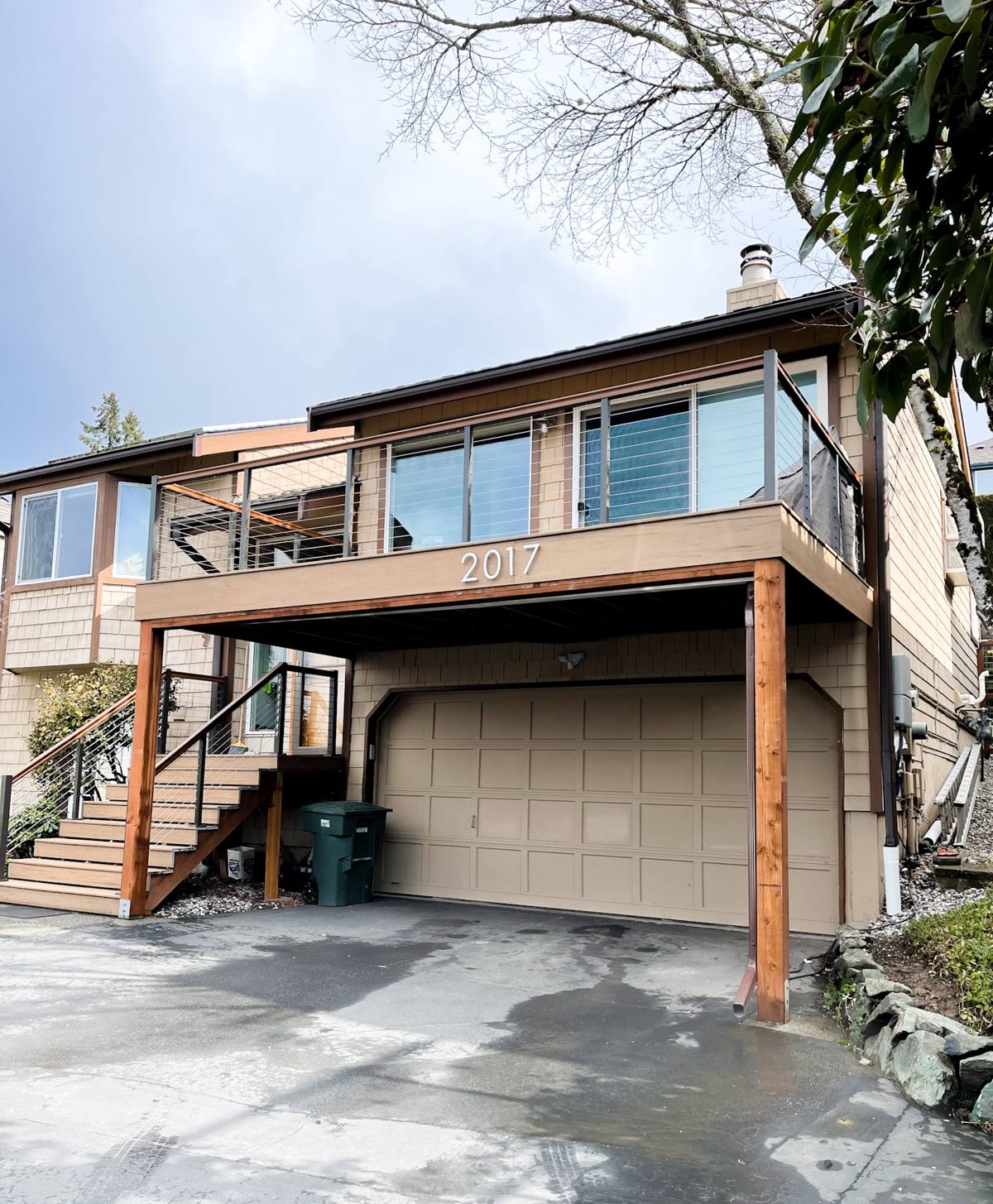
What Custer's Climate Actually Does to a Deck
Salt Air and Metal Fasteners
Coastal and near-coastal air in this part of Whatcom County carries enough salt to accelerate corrosion on standard fasteners, brackets, and hardware. Screws and joist hangers rated for general exterior use can start showing rust streaks and pitting years before their inland equivalents, and corroded fasteners lose holding strength long before they look obviously bad. This matters most at structural connections — ledger bolts, joist hangers, post bases — where a weakened fastener isn't cosmetic, it's a load-bearing problem.
Driving Rain and Water Intrusion
Custer gets its share of wind-driven rain, and wind-driven rain doesn't behave like a gentle vertical shower. It gets pushed sideways and upward into gaps that would stay dry in calmer weather — behind ledger boards, under poorly lapped flashing, into end grain that isn't sealed. Once water gets behind a ledger board or into a joist end, it doesn't dry out quickly in our climate, and rot sets in from the inside where you can't see it until the damage is advanced.
Moss, Shade, and Slow Drying
Decks that sit under tree cover or on the shaded side of a house in Custer can stay damp for days after a storm passes. That's exactly the environment moss and algae need to establish, and once they take hold on decking or stair treads, they hold moisture against the wood surface and create a genuine slip hazard, especially on stairs and any sloped transition. A deck that's fighting moss every year is also a deck that's staying wetter than it should, which speeds up everything else on this list.
Signs Your Custer Deck Needs Replacement, Not Just Repair
- Soft, spongy, or springy spots in the decking or around the perimeter
- Visible rot, dark staining, or crumbling wood at the ledger board or post bases
- Rust stains bleeding from fastener heads or hardware
- Persistent moss or algae that comes back within weeks of cleaning, especially on stairs
- Railings or posts that flex or feel loose when pushed
- Gaps opening up between boards, or boards cupping and twisting
- A ledger board separating from the house or showing a gap you can see daylight through
- Structure that's more than 20-25 years old and has never had the framing inspected
A few of these on their own might mean a repair is enough. Several together, or anything involving the ledger connection or main structural framing, usually means it's time to talk replacement rather than patching around the problem again.
What a Correct Deck Replacement Involves Here
Starting With the Ledger and Flashing
The single most common point of failure we find on older decks in this area is the ledger board connection to the house — the spot where the deck attaches to the structure. If the flashing there was installed wrong, or missing altogether, water has likely been getting behind it for years. A correct replacement means proper ledger flashing, correctly lapped with the house's water-resistive barrier, and structural fasteners sized and spaced for the actual load — not just whatever was on hand.
Framing Built for This Climate
Given the moisture load Custer sees, we favor pressure-treated or naturally decay-resistant framing lumber with fasteners and hardware rated for use with modern treated lumber, which is more corrosion-prone to standard steel than older treatment formulas were. Joist hangers, post bases, and structural screws all need to match that chemistry, not just be "outdoor rated" in a general sense.
Decking Material Choices
Homeowners usually land in one of two camps: real wood, or composite/PVC decking. Both can perform well here if installed correctly, and both have real trade-offs worth understanding before you choose.
| Factor | Wood Decking | Composite / PVC Decking |
|---|---|---|
| Upfront cost | Lower | Higher |
| Maintenance | Regular cleaning, sealing/staining every 1-3 years | Periodic washing, no sealing or staining required |
| Moss/algae resistance | Lower — porous surface holds moisture | Higher, though shaded areas still need cleaning |
| Appearance over time | Grays and weathers unless maintained | Holds color consistently for many years |
| Repairability | Individual boards easy to replace | Board replacement possible but color-matching aged boards can be harder |
| Typical lifespan | 15-25 years with upkeep | 25-30+ years, varies by product warranty |
We don't push one over the other as a rule — we lay out what each one means for your specific site conditions, especially how much shade and moisture exposure the deck actually gets, and let you make the call based on maintenance appetite and budget.
Railings, Stairs, and Code
Railing height, baluster spacing, and stair geometry are governed by building code, and older decks in this area were often built before current code or without a permit at all. A full replacement is the right time to bring all of that up to current standard — it's not optional cosmetic work, it's what keeps a railing from failing when someone leans on it.
How Our Process Works
1. On-Site Assessment
We walk the existing deck with you, check the ledger connection, probe framing for soft spots, and look at drainage and sun/shade exposure specific to your lot. This tells us whether you're actually looking at a repair or a full replacement, and it shapes the material and framing recommendations that follow.
2. Straightforward Proposal
You get a written scope covering demolition, framing, decking material, railings, hardware, and permitting where required — no vague line items. If there are decision points, like wood versus composite, we lay out the real cost and maintenance difference rather than steering you toward the higher-margin option.
3. Demolition and Structural Work First
Old decking, framing, and any compromised ledger flashing come out before anything new goes in. We don't build a new deck surface over old, questionable framing — that just hides the next problem under a fresh coat of composite.
4. Ledger, Framing, and Flashing Done Right
This is the step that determines whether your new deck lasts 10 years or 30. Ledger flashing gets properly integrated with the house's water barrier, framing hardware matches the lumber treatment, and fasteners are sized for the actual structural load, not the minimum that will pass a quick glance.
5. Decking, Railings, and Finish Details
Decking goes down with proper spacing for drainage and seasonal movement, railings are built to current code, and any stairs get the tread depth and rise consistency that keeps them safe to use in wet, low-light conditions — a real factor for anyone using deck stairs in the dark during a Whatcom County winter.
6. Final Walkthrough
We walk the finished deck with you, point out anything you should know about maintenance for the specific material you chose, and make sure you're clear on what upkeep — if any — it needs going forward.
Maintenance That Actually Matters in Custer
- Clean decking and stairs of moss and algae buildup at least once a year, more often in heavy shade
- Check the ledger flashing area annually for any sign of water staining or gaps
- Keep gutters and downspouts near the deck clear so runoff isn't draining onto or under it
- Re-seal or re-stain wood decking on the schedule the product calls for — don't wait until it's visibly gray
- Trim back vegetation that's shading the deck and keeping it wet longer than it needs to be
- Check railings and stair stringers for looseness once a year, especially after a hard winter
None of this is complicated, but skipping it is exactly how a well-built deck ends up needing early repairs in a climate like this one.
Why a Crew That Already Works Custer Matters
A lot of deck problems we get called out for aren't from bad materials — they're from a deck built to a generic spec that didn't account for where it actually sits. A crew working decks across the whole region without local familiarity might not think twice about standard flashing details or standard fastener grades, because in a drier or more inland climate those choices hold up fine. In Custer, with salt air and sustained wet weather in the mix, those same "standard" choices are often exactly where problems start.
Working in and around Lynden and Whatcom County day in and day out means we're not guessing at how a deck holds up here — we're the ones who get called back when a design decision doesn't account for the conditions. That shapes what we recommend before the project starts, not just what we fix after it fails.
Get a Straightforward Deck Estimate
If your deck in Custer is showing its age — soft spots, rust stains, stubborn moss, or a ledger connection you're not sure about — we'll come take a look and give you an honest read on repair versus replacement. The estimate is free, there's no pressure attached to it, and you'll get a clear explanation of what we find and why we're recommending it. Use the form below to get started.