 Lynden Roofing
 Composite Decking Built for the Abbotsford, BC Climate
Abbotsford sits in the Fraser Valley just across the line from Whatcom County, and it shares the same weather pattern our crew deals with every day: long stretches of driving rain, damp air off the coast, and a moss season that seems to start earlier every year. A deck built here doesn't just need to look good on a dry August afternoon — it needs to hold up through eight or nine months of wet weather without rotting, warping, or turning into a slip hazard. Composite decking, installed correctly, is one of the most reliable ways to get a low-maintenance outdoor space that actually survives this climate.
We're not going to pretend every composite product or every install method is the same. There's a right way to frame, fasten, and finish a composite deck for a wet climate, and there's a way that looks fine for the first year or two before problems show up underneath. This page covers what Abbotsford homeowners should know before hiring anyone for a composite deck project.
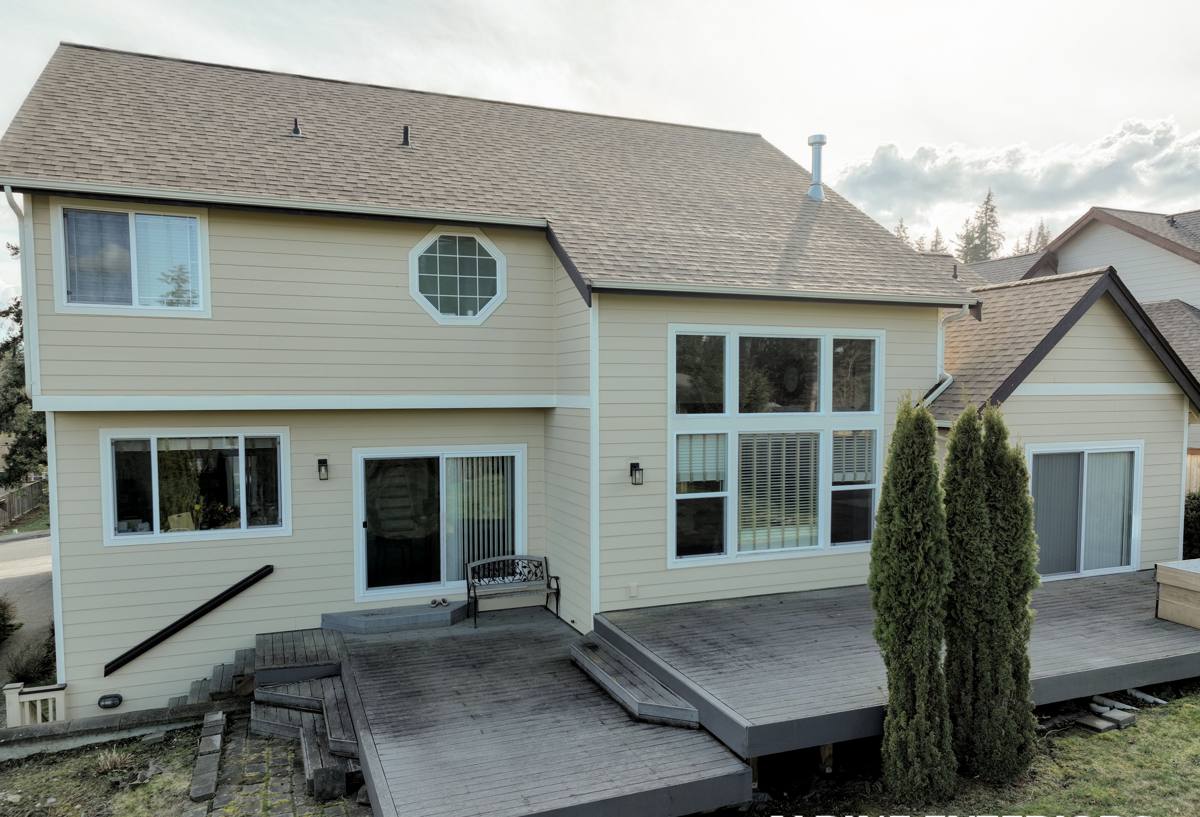
What Rain, Salt Air, and Moss Season Actually Do to a Deck
Composite boards themselves resist rot far better than wood, but the deck as a system is only as good as its weakest part. In this region, three things cause most of the problems we see on decks of any material.
Standing Water and Trapped Moisture
Driving rain doesn't just fall straight down — wind pushes it under boards, against ledger connections, and into any gap in the framing. If a deck doesn't have a proper drainage slope and ventilated space underneath, water sits. Composite boards won't rot from this the way wood does, but the framing underneath, the fasteners, and the ledger flashing absolutely can.
Moss and Algae
A long moss season means anything shaded, north-facing, or under trees stays damp for weeks at a time. Moss and algae growth on a deck surface isn't just cosmetic — it's slippery, and on boards with the wrong surface texture it can be difficult to fully remove without damaging the finish.
Freeze-Thaw Cycling
Whatcom County and the Fraser Valley both see enough freeze-thaw swings each winter to stress any fastener or connection point that wasn't installed with movement in mind. Composite expands and contracts with temperature more than wood does, so gapping and fastening details matter more, not less.
Composite, Wood, or PVC — What Actually Holds Up Here
Homeowners often ask us to just tell them which material is "best." The honest answer is that it depends on budget, how much upkeep you want to do, and how the space is used. Here's how the three most common options compare for a wet coastal climate like this one.
| Material | Moisture Resistance | Maintenance | Typical Lifespan | Upfront Cost |
|---|---|---|---|---|
| Pressure-treated wood | Moderate — needs sealing | Annual cleaning, sealing/staining every 2–3 years | 10–15 years | Lowest |
| Composite (capped) | High — won't rot or absorb water | Occasional wash, no sealing/staining | 25–30+ years | Mid to upper |
| PVC / cellular vinyl | Highest — fully synthetic | Occasional wash | 25–30+ years | Highest |
Capped composite is the sweet spot for most of the homes we work on here: it holds up to the rain and moss without the ongoing sealing schedule wood demands, and it costs less than full PVC while performing almost as well against moisture.
What a Correct Composite Deck Installation Actually Involves
The board itself is only part of the equation. A composite deck that's installed the right way for this climate includes several details that don't show once the project is finished, but determine whether it holds up for the next 20 years.
- Joist tape on every framing member — even with composite decking, exposed wood framing underneath needs protection from moisture wicking up through fastener holes.
- Proper drainage slope away from the house, so water doesn't pool against the ledger board or foundation.
- Adequate ventilation space underneath the deck so moisture can escape instead of getting trapped.
- Hidden fastener systems designed for the specific board profile, spaced to account for composite's thermal expansion.
- Correct ledger flashing where the deck attaches to the house — this is the single most common source of hidden water damage on any deck.
- Board gapping set for our seasonal temperature swings, not a generic spec sheet number.
Skip any one of these and the deck can still look fine on install day. The problems show up two or three winters later, usually as a soft spot in the framing or a fastener that's worked loose.
Picking the Right Composite Board for This Climate
Capped vs. Uncapped
Capped composite has a protective outer shell bonded to the core, which resists moisture absorption and staining far better than older-generation uncapped composite. For a climate with this much rainfall and moss exposure, we generally steer homeowners toward capped boards — the price difference is usually worth it over the life of the deck.
Surface Texture and Color
Deeply grained or heavily textured surfaces can trap moisture and organic debris in shaded areas, making moss more likely to take hold. Lighter colors show pollen and moss growth less than very dark boards, which also run hotter in direct sun. We'll talk through your specific yard — sun exposure, tree cover, orientation — before recommending a color and texture.
Grooved vs. Solid-Edge Boards
Grooved-edge boards work with hidden fastener systems for a clean, screw-free surface, which also means fewer penetration points for water to find. Solid-edge boards are typically face-screwed and better suited to picture-frame edges or stair treads.
What Affects the Cost of a Composite Deck
Every deck project is different, but the same handful of factors drive most of the price variation we see on jobs in this area.
| Factor | Why It Matters |
|---|---|
| Deck size and shape | More linear feet of framing, boards, and fastening; complex shapes add labor |
| Condition of existing structure | A full tear-off and reframe costs more than building on sound existing framing |
| Board tier | Entry-level capped composite vs. premium capped or PVC changes material cost significantly |
| Railing system | Composite or aluminum railing adds cost over basic wood or cable options |
| Stairs and landings | Each set of stairs adds framing, fascia, and board work |
| Site access | Second-story decks or tight lot access can add labor time |
We'll always give you a broad, honest range up front rather than a number that's designed to sound good and then grows once work starts.
Our Process, Start to Finish
- Site visit and measurements — we look at sun exposure, drainage, existing framing condition, and how you actually use the space.
- Structural assessment — if you're replacing an old deck, we check whether the ledger, posts, and footings are sound before deciding what can be reused.
- Material selection — we walk you through board tiers, colors, and railing options based on your budget and your yard's specific exposure.
- Written estimate — a clear scope of work with no vague allowances buried in the fine print.
- Permitting — we handle the paperwork required for your jurisdiction before any framing work begins.
- Installation — framing, flashing, ventilation, and board work done in the order that protects the structure long-term, not just the order that's fastest.
- Final walkthrough — we go over the finished deck with you, including basic care, before we consider the job done.
Maintenance Composite Decking Actually Needs Here
One of the biggest reasons homeowners switch to composite is less upkeep — but "less maintenance" doesn't mean "no maintenance," especially with our moss season. A little seasonal attention keeps a composite deck looking and performing the way it should for decades.
- Sweep off leaves, needles, and other organic debris regularly, especially in shaded or wooded areas — trapped debris holds moisture against the board surface.
- Rinse the deck surface once or twice a year with a garden hose or low-pressure wash to prevent moss and algae from establishing.
- Keep nearby gutters and downspouts clear so overflow isn't dumping extra water directly onto the deck.
- Check railing posts and stair connections annually for any movement, especially after a hard winter.
- Trim back overhanging branches to reduce shade and debris buildup on the deck surface.
- Address any moss growth promptly with a mild cleaner made for composite — don't let it sit and stain the board surface.
Why Hire a Crew That Already Works Abbotsford, BC
Decking looks straightforward on paper, but the details that matter — drainage, ventilation, fastening for thermal movement, flashing at the house — are exactly the things that separate a deck that lasts three decades from one that needs framing repairs in year five. A crew that already works homes in Abbotsford and throughout Whatcom County has seen how this specific climate treats decks over time, not just how a board performs on a spec sheet from a drier region.
We also know what permitting and inspection expect in this area, which keeps projects from stalling out on paperwork. And because we're local, we're available for the walkthrough, the follow-up question, or the rare warranty issue — not a call center hours away.
If you're considering a new composite deck or replacing an aging one, we're happy to take a look and give you a straight, no-pressure estimate. Use the form below to get started.