 Lynden Roofing
 Why Blaine's Marine Climate Wears Out Windows Faster
Blaine sits right on the water at the far northern edge of Whatcom County, and that location cuts both ways. The same marine air that keeps winters relatively mild also carries salt spray, near-constant humidity, and wind-driven rain off the water for much of the year. Add in the long gray stretch from fall through spring when moss and algae take hold on anything that stays damp, and you have a climate that is genuinely harder on windows than most of the country deals with.
Older aluminum-frame windows and worn wood sashes show it first. Salt-laden air speeds up corrosion on metal hardware and frames, wind-driven rain finds any gap in flashing or caulking that's started to fail, and fogging between panes is a near-universal sign that a factory seal has already given out. None of this means windows in Blaine need to be exotic or over-built. It means the frame material, glass package, and installation details all need to be chosen for this specific coastal climate, not a generic one.
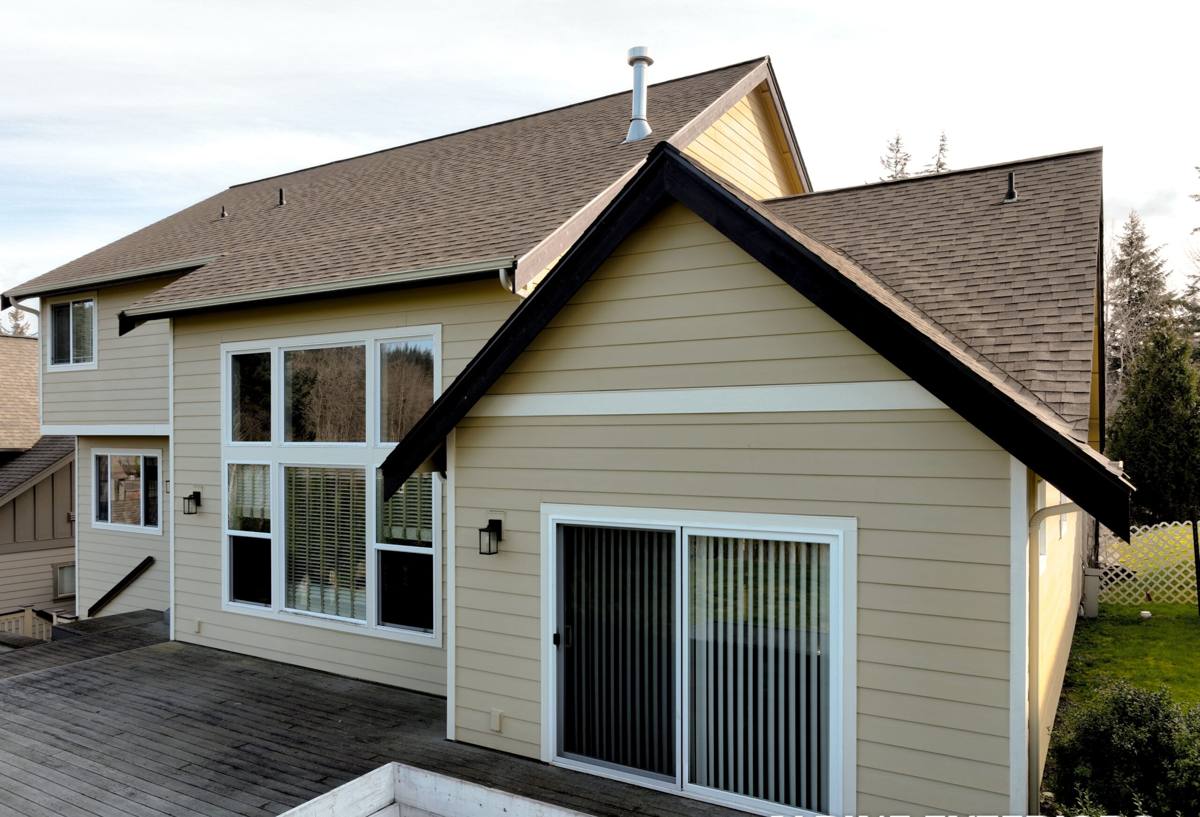
What "Energy-Efficient" Actually Means Here
Frame Material
The frame is doing more work than most homeowners realize. In a coastal, high-moisture climate it has to resist swelling, rot, and corrosion while still sealing tightly enough to stop drafts. That's why we steer most Blaine homeowners toward vinyl or fiberglass frames rather than bare aluminum or unclad wood, and we'll walk through why below.
Glass Package
Double-pane glass with a low-E coating and an argon-filled gap is the baseline we recommend for this area. The low-E coating reflects radiant heat back into the room in winter and blocks it in summer, which matters more here than people expect because of how much gray, low-angle sun this region gets for half the year. Triple-pane glass is worth discussing for north-facing rooms or homes with more direct wind exposure, but it's not automatic on every job — we'll tell you honestly when the added cost is worth it and when it isn't.
Weatherproofing at the Opening
A high-efficiency window installed into a poorly flashed rough opening will still leak air and water. In Blaine's climate, the flashing, sill pan, and sealant details around the window matter as much as the window itself — sometimes more.
Signs Your Current Windows Are Costing You Money
Most homeowners don't replace windows because of one dramatic failure. It's usually a slow accumulation of small problems that finally add up. Watch for:
- Fogging or a milky haze between the panes — the seal has failed and the insulating gas is gone
- Visible condensation on the inside of the glass during cold, damp weeks
- A noticeable draft when you hold your hand near the frame on a windy day
- Wood sashes that feel soft, spongy, or show dark staining at the corners
- Hardware — locks, cranks, hinges — that's pitted, sticky, or corroded
- Moss or dark streaking building up on the sill or frame between cleanings
- Rooms that are noticeably harder to heat or cool than the rest of the house
Any one of these is worth a look. Several together usually mean the windows are past the point where caulk and weatherstripping will fix the problem.
Comparing Frame Materials for a Coastal Whatcom County Home
| Frame Material | How It Handles Salt Air & Moisture | Maintenance | Typical Trade-Offs |
|---|---|---|---|
| Vinyl | Won't corrode or rot; handles humidity well | Low — occasional cleaning | Can't be repainted; quality varies a lot by manufacturer |
| Fiberglass | Very stable in temperature swings and moisture; strong seal retention | Low | Higher upfront cost than vinyl |
| Wood-clad | Good if the cladding is fully intact; interior wood still needs protection from indoor humidity | Moderate to high | Any crack in the exterior cladding lets moisture into the wood core |
| Bare Aluminum | Poor — corrodes in salt air and conducts cold, increasing condensation risk | High | We generally don't recommend it for this climate |
We're not going to tell you a product is "bad" — every material above has a legitimate use somewhere. But for a home exposed to Blaine's salt air and driving rain, bare aluminum's corrosion risk and poor thermal performance make it a hard sell, and wood-clad only makes sense if you're committed to keeping an eye on the cladding for the life of the window. Vinyl and fiberglass are where most of our Blaine installs land, and we'll talk through the real difference between them for your specific home rather than pushing one by default.
The Installation Detail That Matters More Than the Brand
We've said it twice already because it's the part homeowners underestimate most: in a climate with sustained wind-driven rain, how the window is installed determines whether it stays dry far more than which brand is on the label. A correct install includes a sloped sill pan so any water that gets past the glass drains back out instead of pooling, properly lapped flashing tape that sheds water downward at every layer, and sealant placed so it doesn't trap moisture inside the wall cavity. Skip any one of those steps and even a premium window can end up with rot in the framing around it within a few years — hidden behind trim where you won't see it until it's expensive.
This is also why we look at the whole opening, not just the window unit. If we find soft sheathing, failed old flashing, or signs of past water intrusion when we pull the old window, we'll show you what we're seeing and talk through the repair before the new window goes in. Installing a new window over a wet, compromised opening just locks the problem inside the wall.
Our Process, Start to Finish
- On-site assessment. We look at your current windows, the condition of the openings, sun exposure, and which rooms are hardest to heat or cool.
- Honest recommendation. We'll tell you which frame material and glass package fit your home and budget — and where you can save money without sacrificing performance.
- Written estimate. Clear pricing, no pressure, no expiring "today only" discounts.
- Careful removal. Old windows come out without damaging surrounding siding or trim any more than necessary.
- Opening inspection and repair. Any rot, failed flashing, or moisture damage gets addressed before the new window is set.
- Installation with proper flashing and sealing. Sill pans, flashing tape, and sealant applied in the right order for this climate.
- Interior and exterior finish work. Trim, caulking, and touch-up so the job looks finished, not just functional.
- Walkthrough and cleanup. We show you the finished work and clear the site of debris and old units.
Questions Worth Asking Before You Hire Anyone
Window replacement is one of those jobs where the installer matters as much as the product. Before you sign anything, it's fair to ask:
- Are you licensed and insured to work in Washington, and can I see proof?
- Who actually installs the windows — your own crew, or a subcontractor?
- What's the plan if you find rot or water damage once the old window is out?
- What does the manufacturer's warranty cover, and what does your workmanship warranty cover separately?
- Can you walk me through how you'll flash and seal the opening, specifically?
- Do you have experience working on homes in this area's marine climate?
A contractor who answers these clearly and specifically, without dodging the flashing and moisture questions, is one worth trusting with your home.
Why Local Experience in Blaine Matters
A crew that regularly works this stretch of Whatcom County already knows what salt air does to hardware over time, how far wind-driven rain can push moisture into a wall assembly, and why moss season means details like drainage and sealant placement can't be an afterthought. That's not something you can fully substitute with a product spec sheet. It shows up in small decisions — how flashing is lapped, which sealant holds up in sustained damp cold, how an opening is prepped before the window ever goes in — and those decisions are what separate a window that performs for decades from one that needs attention again in five years.
As a roofing and exterior contractor, we also look at your windows in the context of the rest of the building envelope — roofline, siding, and trim — rather than as an isolated product install. That matters when water management around one part of the house affects another.
What Energy-Efficient Windows Typically Cost
Pricing depends on frame material, glass package, window size and style, and how much repair work the opening needs once the old window is out. Rather than quote a number that won't mean much without seeing your home, here's what tends to move the price up or down:
| Cost Factor | Tends to Increase Cost | Tends to Keep Cost Down |
|---|---|---|
| Frame material | Fiberglass, wood-clad | Vinyl |
| Glass package | Triple-pane, specialty coatings | Standard double-pane low-E |
| Opening condition | Rot or moisture damage requiring repair | Sound, dry framing |
| Window style | Large picture windows, custom shapes, casements | Standard double-hung or slider sizes |
| Access & site conditions | Second story, tight access, extensive trim work | Ground-level, straightforward access |
We'd rather walk your home and give you real numbers than guess in the abstract. Broad ranges without seeing the actual openings tend to be more misleading than helpful.
Ready When You Are
If your windows are drafty, fogged, or just past their prime, we're happy to come take a look and give you a straight answer about what's actually needed — no pressure, no upsell. Use the form below to request a free estimate, and we'll get back to you to schedule a time that works.