 Lynden Roofing
 Why Birch Bay Roofs Age Differently Than Roofs Inland
Birch Bay sits right on the water, and that changes what a roof has to deal with year-round. Salt-laden air corrodes exposed metal faster than it does even a few miles inland — fasteners, flashing, and vent hoods that would last two decades in Lynden proper can start showing rust and pitting well before that near the beach. Add in wind-driven rain coming off the water, which pushes moisture sideways and up under shingle edges instead of just falling straight down, and you've got a roof system that gets tested in ways a standard installation isn't always built for.
Then there's moss. Whatcom County's long wet season gives moss and algae months at a time to get a foothold on north-facing slopes and anywhere shade lingers, and Birch Bay's tree cover and marine humidity make it worse. Moss holds moisture against the roofing material, works into shingle tabs, and lifts nail lines over time. None of this means a roof in Birch Bay needs anything exotic — it means it needs to be replaced correctly, with the right materials and the right detailing at the edges, valleys, and penetrations, by people who've seen what actually fails out here.
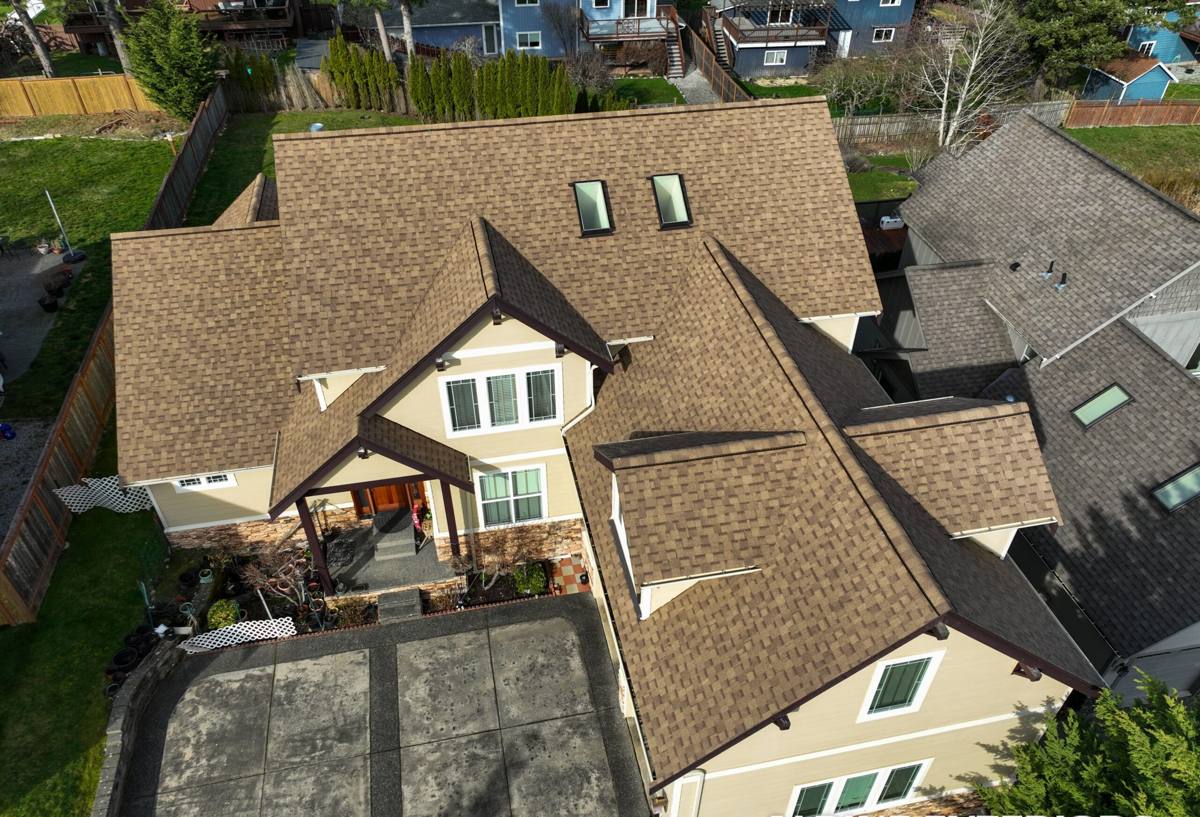
Signs You're Looking at Replacement, Not Another Repair
Most homeowners call us after a leak, but the leak is usually the last symptom, not the first. A roof nearing the end of its life in this climate tends to show a pattern before it fails outright:
- Granule loss heavy enough that you're finding grit in gutters every time it rains
- Shingles that are curling, cupping, or cracking, especially on the south and west-facing slopes that take the most sun and weather
- Soft or spongy spots underfoot, which usually means the decking underneath has taken on moisture
- Moss that keeps coming back within a season or two of cleaning, even after treatment
- Rust streaking from flashing, vents, or fasteners — a clear sign salt air has gotten to the metal
- Daylight visible through the roof deck from inside the attic, or damp insulation
One or two of these might point to a targeted repair. Several together, especially combined with a roof that's already past 18-20 years old, usually means repair costs start approaching replacement costs anyway — and a patch on a roof that's failing broadly just buys a little time before the next call.
What a Correct Roof Replacement Actually Involves
A roof replacement done right in Birch Bay is more than swapping old shingles for new ones on top of the same deck. The steps that actually determine how long the new roof lasts happen before a single shingle goes down.
Tear-Off and Deck Inspection
We remove the old roofing down to the deck rather than layering over it. That's the only way to actually see the plywood or plank decking underneath — and in a marine climate, hidden rot from slow leaks around old flashing is common enough that skipping this step is how homeowners end up with soft spots two years after a "new" roof. Any damaged decking gets replaced before anything else happens.
Underlayment and Ice-and-Water Barrier
Given how much wind-driven rain Birch Bay sees, we pay particular attention to underlayment quality and coverage at eaves, valleys, and around any penetration — pipes, skylights, chimneys. Wind-driven rain finds gaps that straight-down rain never would, so this layer matters more here than it does in drier or more sheltered parts of the county.
Flashing and Metal Components
Because salt air accelerates corrosion, we're deliberate about the flashing and fastener materials we use on homes closer to the water, favoring metals and coatings that hold up better against salt exposure than the minimum-grade options. This is a professional judgment call based on the site's exposure, not a one-size-fits-all upgrade — a home tucked back from the water with tree cover doesn't need the same spec as one with an open water view.
Ventilation
Proper intake and exhaust ventilation keeps the attic space dry and temperature-regulated, which does two things: it extends the life of the new roofing material from underneath, and it reduces the moisture buildup that feeds moss and algae growth on the surface. A roof can be installed perfectly on top and still underperform if the attic underneath is trapping humidity.
Choosing the Right Material for a Water-Adjacent Home
Most Birch Bay roof replacements we do are architectural asphalt composition shingle — it's a good match for the Pacific Northwest budget-to-performance ratio, and modern algae-resistant (AR) shingles specifically address the moss and algae problem with copper or zinc granules built into the product. Metal roofing is a solid option too, particularly for homeowners planning to stay long-term, though it comes with a higher upfront cost and needs the right fastener and coating spec near salt air to avoid the corrosion issues that give cheaper metal installations a bad reputation.
| Factor | Architectural Asphalt Shingle | Standing Seam Metal |
|---|---|---|
| Typical lifespan (this climate) | 20-30 years | 40-50+ years |
| Moss/algae resistance | Good with AR-rated shingle | Excellent — little for moss to grip |
| Salt air durability | Good; fastener/flashing spec matters most | Very good with marine-grade fasteners and coating |
| Upfront cost | Lower | Higher |
| Repair/patch simplicity | Straightforward, widely available materials | More specialized labor if damaged |
We don't push one material over another as a default — the right call depends on how long you're planning to stay in the home, your budget, and how exposed the specific roof is to wind and salt. We'll walk through the honest trade-offs for your house rather than steering you toward whatever's easiest to install.
How We Approach a Birch Bay Replacement
- On-site inspection of the current roof, decking condition where visible, attic ventilation, and the home's specific wind/salt exposure
- A written estimate that spells out material choice, tear-off scope, and any decking or flashing upgrades we recommend and why
- Scheduling that accounts for Whatcom County's wet season — we watch the forecast closely and won't open a roof up to a multi-day system
- Tear-off, deck repair as needed, underlayment, flashing, and shingle or metal installation
- Final walk-through covering ventilation, gutters, and cleanup, including magnetic sweep for stray fasteners around the property
Preparing Your Property Before We Arrive
A little prep on your end makes the job go faster and protects your property during tear-off:
- Move vehicles out of the driveway and away from the house for the duration of the job
- Take down wall art, mirrors, or shelving inside that could shake loose from hammering vibration
- Clear patio furniture, grills, and planters from around the perimeter of the house
- Let us know about any pets that startle easily with noise, so we can plan around them
- Flag any known trouble spots — a chronic leak location, a soft spot you've felt underfoot, a room that's harder to heat — so we look at them specifically
Why Local Experience in Birch Bay Matters
A roofing crew that's worked plenty of homes near Birch Bay's shoreline already knows which flashing details tend to fail first in wind-driven rain, which fastener grades hold up against salt exposure, and how aggressively moss comes back on shaded north slopes in this specific stretch of Whatcom County. That's different knowledge than what a crew coming from a dry inland market brings with them. It also means we're familiar with Whatcom County permitting requirements and can get a replacement scheduled and inspected without the process becoming its own project.
Being local also means we're not disappearing after the invoice clears. If something needs a look two years down the road, we're still working in the area and can get back out to your property without a long drive or a scheduling gap.
What to Expect on Timeline and Weather
Most single-family roof replacements in this size range take one to three days of active work, weather permitting. Whatcom County's wet season runs long, so we build in flexibility and won't start a tear-off if a multi-day rain system is moving in — an open roof deck and driving rain don't mix. We'd rather push a start date a few days than risk water getting into your home during the job.
If your roof is showing its age, or you just want an honest read on how much life it has left, we're happy to take a look. We offer free, no-pressure estimates for Birch Bay homeowners — use the form below to get one scheduled.