 Lynden Roofing
 Building Decks for Birch Bay's Coastal Conditions
Birch Bay sits right up against the water, and that changes what a deck has to survive. A deck built to a generic inland spec — the kind you'd see in a big-box how-to guide — will start showing problems in Birch Bay years before it should. Salt-laden air corrodes hardware, driving rain off the water finds every gap in the flashing, and the damp, shaded conditions common along the bay keep moss and algae growing most of the year. None of that is a reason to avoid building a deck here. It's a reason to build it correctly the first time, with materials and details chosen for this specific stretch of Whatcom County coastline rather than for a catalog average.
This page covers what actually matters for a Birch Bay deck: material selection, fasteners, framing details, footings, and the maintenance a coastal deck needs that an inland deck doesn't.
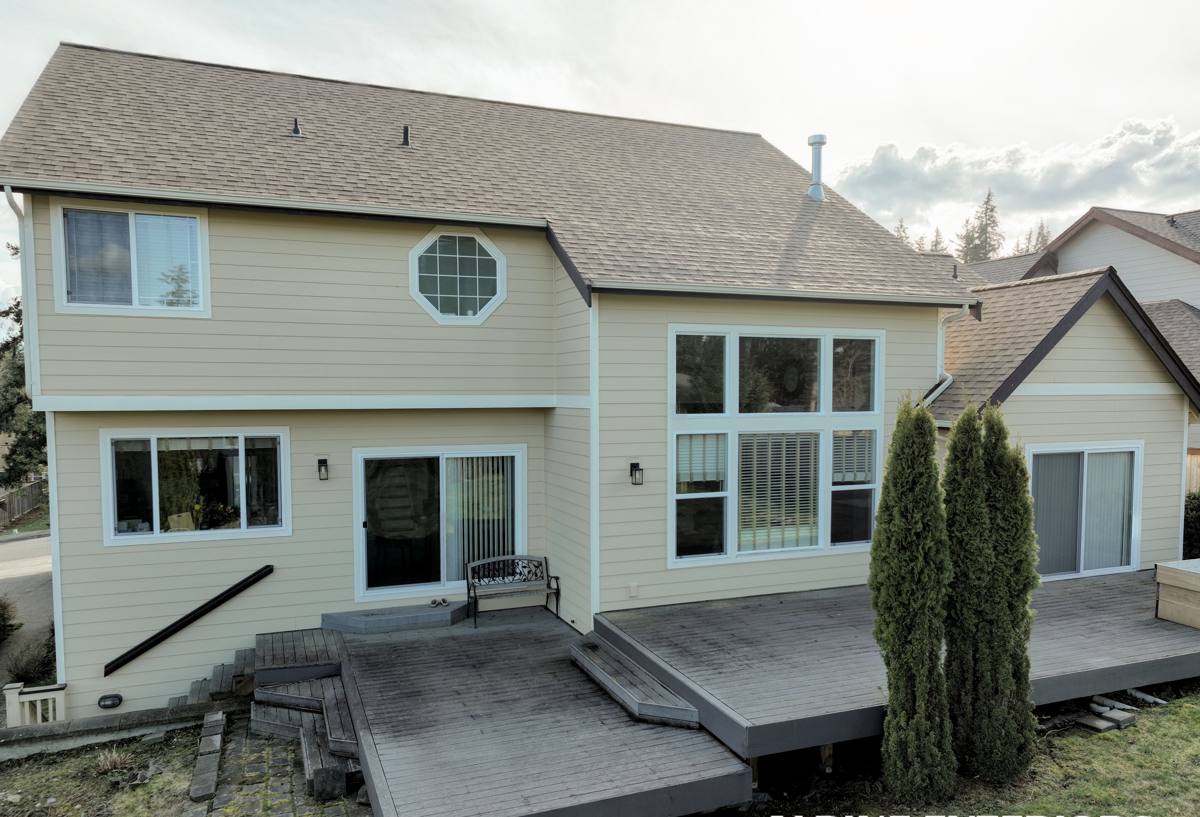
What Salt Air and Driving Rain Do to a Deck
Salt-Air Corrosion
Airborne salt is conductive and hygroscopic — it holds moisture against metal and accelerates rust in ways plain humidity doesn't. Standard electro-galvanized screws, joist hangers, and nails that hold up fine twenty miles inland can start rusting within a season or two this close to the water. Once a fastener starts to corrode, it weakens, stains the surrounding wood or decking, and eventually needs to be replaced — which usually means pulling apart part of the deck to get at it.
Moisture and Driving Rain
Wind off the bay pushes rain sideways, not just straight down. That means water reaches surfaces a calm-weather deck design assumes are protected — ledger connections, the tops of posts, the undersides of rail caps. Any gap in flashing or any joint that relies on caulk alone instead of proper lapped water-shedding details will let water in over time, and trapped moisture is what causes rot, not occasional rain itself.
Moss Season
Whatcom County's wet, mild winters and the extra dampness near the bay add up to a long moss and algae season on any horizontal wood surface that doesn't get much sun. Moss holds moisture against decking boards, and on wood decking it can make the surface slick and speed up surface decay. It's manageable, but it has to be planned for — both in board selection and in how the deck is oriented and ventilated underneath.
Choosing the Right Decking Material for Birch Bay
There's no single "best" decking material — the right choice depends on how much upkeep you want to do and what you're willing to spend up front versus over time. Here's how the common options actually perform in a salt-air, high-moisture environment like Birch Bay:
| Material | Coastal Performance | Maintenance | Trade-offs |
|---|---|---|---|
| Pressure-treated wood | Good if properly fastened and finished; treatment resists rot but not moss/algae growth on the surface | Needs cleaning and re-staining or sealing every 1-3 years | Lowest material cost; most labor over the life of the deck |
| Western red cedar | Naturally rot- and insect-resistant; still needs regular finishing near salt air to hold its color and surface | Cleaning plus oil or stain every 1-2 years for appearance | Higher cost than PT wood; ages to gray if left unfinished, which some owners like and some don't |
| Composite decking | Doesn't rot or absorb moisture into the board itself; still needs correct fastening and airflow underneath to control moss | Periodic washing; no staining or sealing required | Higher upfront cost; board and fastener systems vary a lot by manufacturer |
We don't push one material on every homeowner. What we do insist on, regardless of what you choose, is proper fastening, proper spacing for drainage and airflow, and a framing structure underneath that's built to the same coastal standard as the decking on top — because a beautiful composite deck on rusting hardware or a rotting frame is still a deck that fails early.
Framing and Fasteners Built for the Coast
Hardware You Don't See
The hardware inside a deck — joist hangers, structural screws, post bases — matters more for longevity than the decking on top, because it's harder to inspect and replace once the deck is built. In a salt-air environment, we specify stainless steel or heavy-duty coated fasteners rated for corrosive exposure rather than standard-grade hardware. It costs more up front. It's also the single biggest factor in whether a deck's structure is still sound in fifteen years or needs to be torn apart and rebuilt in eight.
Ledger Board Flashing
Where a deck attaches to the house is the most common point of water damage on any deck, coastal or not — and it's worse here because of the driving rain. A correct ledger connection uses proper flashing that laps over the house's water-resistive barrier and directs water out and away from the wall, not a bead of caulk relying on staying intact forever. This is one of the details that separates a deck that lasts from one that quietly rots the rim joist and wall framing behind it.
Footings and Structure in Coastal Soil
Soil conditions near the bay can vary from sandy to heavier and poorly draining, sometimes within the same yard, and that affects how footings are sized and set. Footings need to be dug to the correct depth for frost and bearing, and posts need a base connection that keeps the wood off standing water rather than sitting in it. We evaluate the specific site rather than assuming one footing spec works for every Birch Bay lot — a deck on a slope toward the water needs different handling than one on level, well-drained ground.
Our Process for a Birch Bay Deck Build
Design and Site Visit
We start on site, not over the phone. We look at sun exposure, prevailing wind and rain direction, drainage, and how the deck will connect to the house before we talk materials or layout. A deck design that ignores which direction the weather comes from is starting with a disadvantage it never fully makes up for.
Permitting
Most new decks require a building permit, and requirements can depend on the deck's height, size, and attachment to the house. We handle the permitting process as part of the job so you're not the one tracking down requirements or waiting on inspections without knowing what's next.
Build and Inspection
We frame to the structural spec first — footings, posts, beams, joists, and the ledger connection — before decking ever goes down, because that's the part that's expensive and disruptive to fix later. Inspections happen at the appropriate stages, and we walk the finished deck with you before calling the job done.
Deck Maintenance Checklist for Salt Air Homes
A well-built deck in Birch Bay still needs more upkeep than the same deck would need further inland. This is a realistic list, not a sales pitch for extra services:
- Sweep debris and standing moss off the deck surface regularly, especially in shaded areas and through fall and winter
- Rinse salt residue off railings and surfaces a few times a year, particularly after storms with onshore wind
- Check visible fasteners and hardware annually for early rust or staining
- Keep gutters and downspouts near the deck clear so runoff isn't draining onto or under it
- Re-stain or reseal wood decking on the schedule appropriate to the product — don't wait until it's visibly gray and dry
- Confirm airflow underneath the deck isn't blocked by plantings or storage, since trapped moisture under a deck feeds both rot and moss
Why a Local Whatcom County Crew Matters
Anyone can build a deck that looks right in the photos on install day. What matters is whether it still looks and performs right in five or ten years of Whatcom County winters. A crew that regularly works Birch Bay and the surrounding coastline already knows which fastener grades hold up here, how the local permitting process runs, and which framing details actually stop water rather than just looking finished. That experience shows up in the parts of the deck you don't see once it's built — the hardware, the flashing, the footings — which is exactly where a coastal deck either holds up or doesn't.
If you're planning a new deck or replacing one that hasn't held up to the bay air, we're happy to take a look and give you a straightforward, no-pressure estimate. Use the form below to get in touch and we'll go from there.