 Lynden Roofing
 Siding Replacement for Aldergrove, BC Homes
Aldergrove sits just across the border crossing from Lynden, close enough that our crew treats it as part of our regular service area rather than a special trip. Homes here face the same weather pattern we deal with on the Whatcom County side: long stretches of wet weather, salt-tinged air moving in off the Strait and Sound, and a moss season that can run most of the year. Siding takes the brunt of that exposure, and when it starts failing, it fails from problems you often can't see until you look closely or the damage has already spread behind the surface.
This page is about one job — full siding replacement — done right for homes in this specific area.
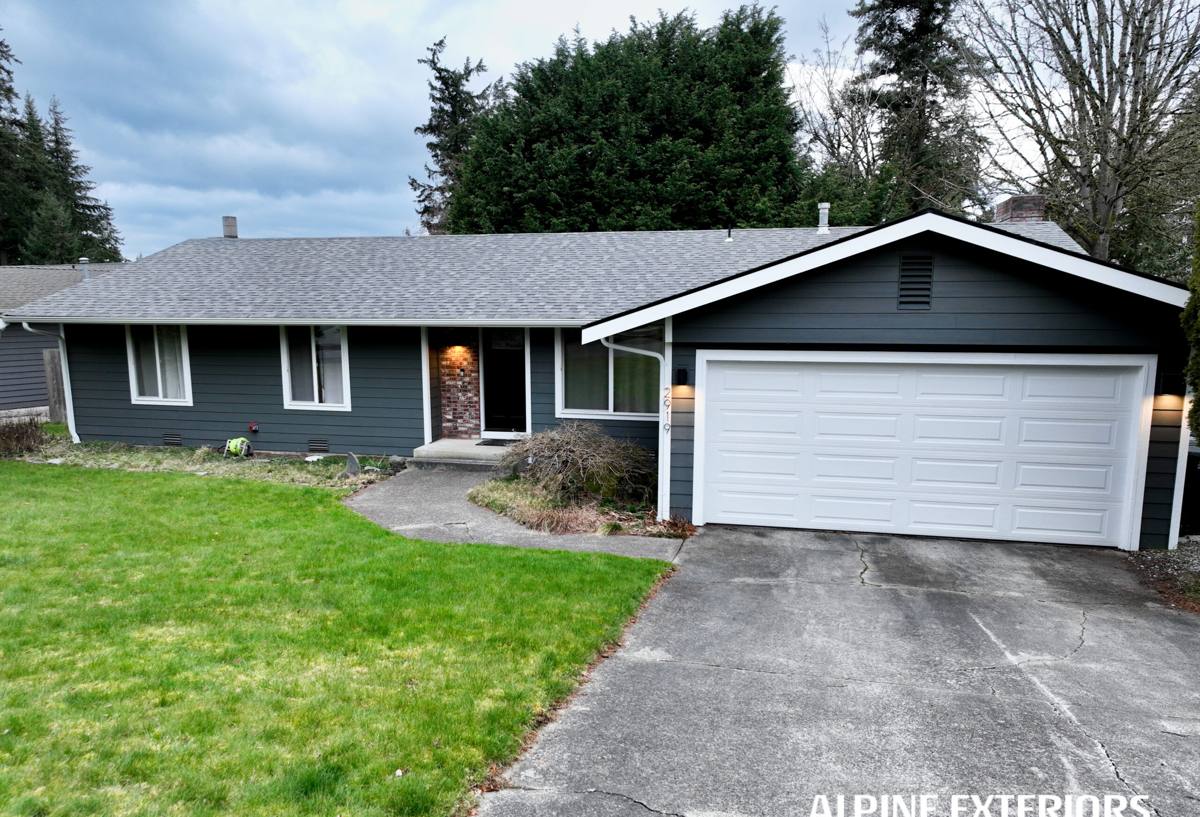
Why This Climate Is Hard on Siding
Three things wear siding down faster here than in drier parts of the country.
Salt Air
Even inland from the water, the Pacific Northwest's marine air carries moisture and salt content that accelerates corrosion on fasteners, trim, and any metal flashing components. Over years, that corrosion works from the inside out — a fastener head can look fine on the surface while the shank underneath has already weakened.
Driving Rain
This region doesn't just get rain, it gets wind-driven rain that pushes water sideways into laps, seams, and butt joints rather than letting it run straight down. Siding systems that aren't detailed for that — proper overlaps, correctly flashed penetrations, a functioning water-resistive barrier behind the cladding — end up taking on moisture they were never designed to handle.
Moss and Organic Growth
Shaded north and west walls, tree cover, and near-constant dampness give moss, algae, and mildew a long growing season. Once organic growth establishes itself on a wall, it holds moisture against the siding surface, which is exactly the condition that causes rot in wood-based products and coating breakdown in others.
Signs a Home Needs Replacement, Not Repair
Not every siding problem calls for a full tear-off. But there's a point where patching stops making sense — where the cost and disruption of repeated repairs exceeds the cost of doing it once, correctly. Homeowners in Aldergrove typically reach that point when they see:
- Soft or spongy spots when you press on the siding, especially near the bottom courses and around windows
- Visible warping, buckling, or panels that have pulled away from the wall
- Persistent moss or dark staining that comes back within weeks of cleaning
- Paint or finish that's failing across large sections rather than isolated spots
- Cracking concentrated at butt joints, corners, or anywhere fasteners were driven
- Interior clues — musty smell, peeling interior paint, or soft drywall near exterior walls
If you're only seeing one or two of these in a limited area, a repair may still be reasonable. Widespread signs, or any indication that moisture has reached the wall assembly behind the siding, usually means it's time to talk about full replacement.
Why We Install Only James Hardie Fiber Cement
We don't install vinyl, LP SmartSide, Cemplank, Allura, primed spruce, or cedar. That's not a marketing position — it's a decision we made after years of seeing which products actually hold up to this specific climate and which ones create recurring problems for homeowners.
Wood-based products, including engineered wood, depend on an intact factory coating to keep moisture out. Once that coating is compromised — by a scratch, a poorly sealed cut edge, or years of moss holding water against the surface — the substrate underneath is organic material that can swell, rot, or delaminate. Vinyl handles moisture fine but is a thin, flexible material that can warp in temperature swings and shows its seams and fastener pattern more visibly over time. Other fiber cement brands vary in formulation, factory finish quality, and warranty structure, and we've standardized on the one system we're confident performing to spec, year after year, in exactly this kind of weather.
James Hardie fiber cement is non-combustible, doesn't rot, and holds its factory-applied ColorPlus finish far longer than field-applied paint. It's engineered specifically for climate zones like ours through the HZ5 product line, and it carries a strong transferable warranty that matters if you ever sell the home.
How the Main Options Compare in This Climate
| Material | Moisture Resistance | Moss/Algae Resistance | Maintenance | Typical Lifespan Here |
|---|---|---|---|---|
| James Hardie fiber cement | Excellent — cement-based, doesn't absorb and swell | Good — factory finish resists staining better than field paint | Occasional wash; no repainting for many years | 30+ years with correct install |
| Vinyl | Good against bulk water, but seams and gaps allow moisture behind panels | Fair — grime and moss show on textured surfaces | Low, but panels can warp and are hard to color-match if replaced | 15–25 years |
| Wood/engineered wood (LP SmartSide, cedar) | Poor once coating fails — substrate can swell or rot | Poor — organic substrate feeds growth | Regular repainting/sealing required | 10–20 years, often less with recurring moisture exposure |
What Correct Siding Replacement Actually Involves
The siding itself is only part of the job. Most premature siding failures we see trace back to what's behind it, not the product on the surface.
Full Tear-Off and Wall Inspection
We remove the old siding down to the sheathing so we can actually see the wall — check for rot, soft framing, or existing water damage that needs to be addressed before anything new goes up. Covering over a compromised wall with new siding just hides the problem for another few years.
Water-Resistive Barrier
A correctly installed, properly lapped water-resistive barrier is what actually keeps wind-driven rain out of the wall assembly. Seams get taped, penetrations get flashed, and everything drains down and out rather than trapping water behind the cladding.
Flashing at Every Vulnerable Point
Windows, doors, decks, and roof-to-wall intersections are where most leaks start. Each needs flashing detailed to shed water outward, not just caulk covering a gap — caulk fails, flashing doesn't.
Fastening to Manufacturer Spec
James Hardie has specific fastening requirements — the right nail type, spacing, and depth. Overdriven or underdriven fasteners are one of the most common installation mistakes we see on other crews' work, and they compromise the whole system's performance in wind and rain.
Proper Clearances
Siding needs clearance from grade, roof lines, and decks so water can't wick up into the material or pool against the bottom edge — a detail that matters even more in a climate where things rarely fully dry out between rain events.
Our Process for Aldergrove Projects
Working across the border adds a logistics step, but it doesn't change how we approach the job. We handle material delivery and scheduling so crossing the border isn't something the homeowner has to think about. Beyond that, the process is the same one we use on every home:
- On-site assessment — we walk the exterior, check for the failure signs above, and look at what's driving the need for replacement
- Written estimate with a clear scope — what's being removed, what's being inspected underneath, and what's going back up
- Scheduling around weather windows, since tear-off exposes the wall and we don't want it open during a stretch of driving rain
- Tear-off, wall inspection, and any needed sheathing or framing repair before new material goes up
- Water-resistive barrier, flashing, and James Hardie installation to manufacturer spec
- Final walkthrough so you know exactly what was done and what maintenance, if any, to expect
Product Lines and Colors Suited to This Weather
James Hardie's HZ5 product line is engineered for the Pacific Northwest's wet, moderate climate specifically — it's not a one-size-fits-all product shipped the same way to every region of the country. The ColorPlus factory finish process bakes color on under controlled conditions, which holds up better against UV and moisture cycling than paint applied on-site after installation. That matters here specifically because repainting siding on a home exposed to constant damp and moss growth is a maintenance burden most homeowners would rather not repeat every several years.
We'll walk through profile options — lap siding, board-and-batten style, shingle-style accents — and color choices during the estimate, matched to what suits the home and holds up to the specific exposure of its walls (a shaded north wall with heavy moss risk may call for a different approach than a sun-exposed south face).
After Installation: What Upkeep Actually Looks Like
One of the real advantages of fiber cement in this climate is how little ongoing maintenance it demands compared to wood-based siding. That said, "low maintenance" isn't "no maintenance." A simple yearly routine keeps it performing the way it's designed to:
- Rinse the siding down once a year, more often on shaded or moss-prone walls, using a garden hose and soft brush rather than a pressure washer
- Keep gutters clear so overflow doesn't run down the wall face
- Trim back vegetation and tree limbs that keep a wall surface shaded and damp
- Check caulking around windows and trim annually and re-caulk where it's cracked or pulled away
- Walk the exterior after major storms and note any impact damage or loose trim early, before it becomes a bigger repair
Why a Crew That Already Works Aldergrove Matters
Any contractor can quote a siding job. What's harder to fake is familiarity with how a specific area's weather and building conditions actually play out over time — which wall orientations grow moss fastest, how driving rain moves across a typical lot here, what condition older siding tends to be in when it's finally torn off. Because Lynden and Aldergrove share essentially the same climate and are minutes apart across the border crossing, our crew isn't learning the area on your project. We already know what to expect before we pull the first piece of old siding off the wall.
That familiarity also means straightforward scheduling and logistics — no guesswork about material delivery timing or coordinating a crew that's unfamiliar with working across the border. It's a normal part of how we operate.
If your Aldergrove home is showing signs its siding is past the point of patching, we're happy to take a look and walk you through what we're seeing, with no pressure to move forward. Reach out using the form below for a free estimate.