 Lynden Roofing
 New Roof Installation for Aldergrove Homes, From a Crew That Already Works This Border
Aldergrove sits just north of the Lynden border crossing, close enough that a lot of local contractors treat the line as more of a formality than a real divide in how homes get built and maintained. The truth is that houses in Aldergrove face almost identical weather to homes ten minutes south in Whatcom County: the same wet Pacific air moving up the Fraser Valley, the same long stretch of overcast, moisture-heavy months, and the same moss and algae pressure on anything with a north-facing slope or heavy tree cover. A roof that's built for this corridor needs to handle all of it, not just the parts that happen to fall on one side of the border.
We install new roofs in Aldergrove, BC as a straightforward extension of the same work we do throughout Whatcom County. Same materials knowledge, same attention to ventilation and moisture control, same crew standards. This page is about what a correctly installed new roof actually needs to do in this specific area, and how our process gets a homeowner there without surprises.
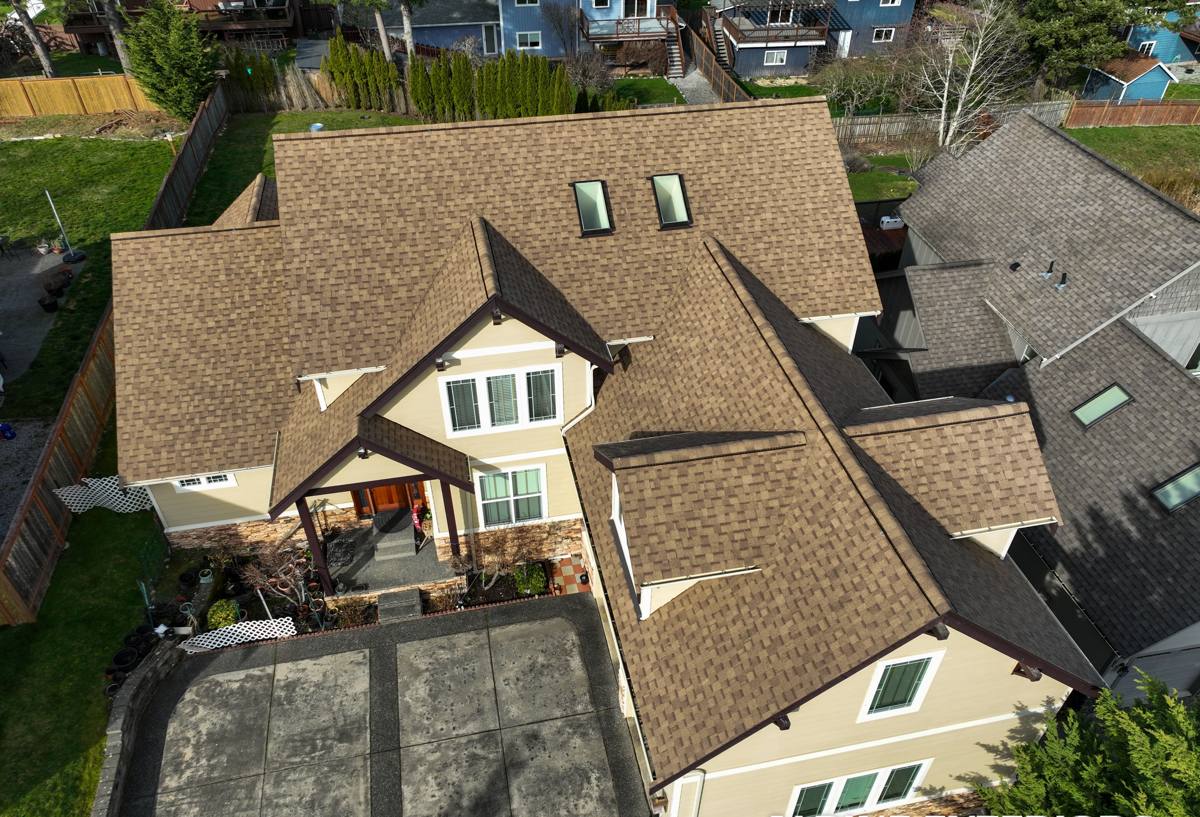
What This Climate Actually Does to a Roof
Aldergrove and Lynden both sit in a transitional zone between the drier Fraser Valley interior and the wetter coastal influence pulled in off the Strait of Georgia and Puget Sound. That mix produces a specific set of stresses that a new roof has to be designed around, not just patched against later.
Driving Rain and Wind-Driven Moisture
This region doesn't just get rain — it gets rain pushed sideways by wind often enough that standard lap coverage alone isn't a safe bet. Water finds its way under shingles or panels at edges, valleys, and penetrations when underlayment and flashing details are treated as an afterthought. A roof built for this area needs synthetic underlayment with real lap and fastening discipline, and ice-and-water shield style membrane at every valley, eave, and roof-to-wall transition — not just where code minimums require it.
Salt Air and Metal Corrosion
Proximity to coastal air means metal components — flashing, fasteners, drip edge, vents — take on corrosion risk faster than they would further inland. Bare or poorly coated metal in this environment will show rust streaking and pitting years before it should. We spec corrosion-resistant metal and fastener packages specifically because we've seen what cheaper hardware looks like after a handful of wet seasons here.
A Long Moss and Algae Season
Because this area holds moisture and shade for a large part of the year, moss and algae growth isn't a cosmetic afterthought — it's a structural concern. Moss holds water against the roof surface, lifts shingle edges as it grows, and accelerates granule loss. Roofs with heavy tree cover or north-facing slopes are especially exposed. New installation is the best point to get ahead of this with the right underlayment, ventilation, and shingle choice, rather than fighting it every year after the fact.
What a Correct New Roof Installation Includes
A new roof is more than shingles nailed to plywood. In this climate, the components underneath and around the visible surface matter as much as the surface itself.
- Tear-off and deck inspection: removal of the old roofing down to the deck, with every sheet of sheathing checked for rot, delamination, or soft spots before anything new goes down.
- Deck repair as needed: replacing compromised sheathing rather than roofing over it — a step that gets skipped by crews trying to save time, and one that causes problems years later.
- Ice-and-water membrane at vulnerable points: valleys, eaves, skylights, chimneys, and any roof-to-wall intersection, sized generously for the amount of driving rain this area sees.
- Full synthetic underlayment: a continuous, properly lapped moisture barrier across the entire deck, not spot-applied.
- Corrosion-resistant flashing and fasteners: metal that's rated to hold up against salt-influenced air rather than standard-grade hardware.
- Balanced attic ventilation: intake at the eaves and exhaust at the ridge, sized to the attic volume, so trapped moisture doesn't condense on the underside of the deck.
- Manufacturer-correct shingle or panel installation: nailing pattern, exposure, and starter course done to spec, since warranty coverage depends on it.
- Final walk-through: checking valleys, penetrations, and edges before we call the job done, not just from the ground.
Ventilation: The Step That Gets Skipped Most Often
Of everything on that list, ventilation is the one homeowners are least likely to have thought about and the one most likely to cause problems if it's wrong. In a climate this wet, an attic that can't move air properly traps moisture. That moisture condenses on the underside of the roof deck, feeds mold and rot, and shortens the life of insulation — all invisible until someone opens the attic hatch and finds a problem that's been building for years.
Correct ventilation means intake and exhaust work together: soffit vents pulling fresh air in low, ridge or roof vents letting warm, moist air out high, sized to actually move the volume of air in that specific attic. We check this on every new roof install in Aldergrove and the surrounding area, because retrofitting ventilation after the fact is far more disruptive and expensive than getting it right during installation.
Material Comparison for This Climate
| Material | Moisture & Moss Resistance | Typical Lifespan | Best Fit |
|---|---|---|---|
| Standard 3-tab asphalt shingle | Lower — thinner mat, more granule loss over time | 15–20 years | Budget-focused projects, shorter hold periods |
| Architectural (laminate) asphalt shingle | Good, especially with algae-resistant granules | 25–30 years | Most Aldergrove homes — the common-sense default |
| Metal roofing (standing seam or panel) | Very good — sheds moss and water fast, minimal maintenance | 40–50+ years | Homeowners planning long-term ownership, higher upfront budget |
| Cedar shake | Requires ongoing maintenance to manage moisture and moss | Varies widely with upkeep | Homeowners committed to regular maintenance and a specific look |
We'll walk through these trade-offs honestly during an estimate. There's no single "best" material — there's a best material for the specific roof, the slope, the tree cover, and how long the homeowner plans to stay in the house.
Why Roofing Experience Specific to This Area Matters
A roofer who mostly works drier inland climates can install a technically correct roof and still miss the details that matter here — under-sizing valley membrane, skipping corrosion-rated hardware because it costs a little more, or not accounting for how much shade and moss a particular slope will hold. None of that shows up as a problem on day one. It shows up two or three wet seasons later.
We work Aldergrove regularly because it's a natural extension of our Whatcom County service area, not a special trip. That means we already know what this specific stretch of the Fraser Valley and northern Whatcom corridor does to a roof over time, and we build accordingly — from underlayment choice to fastener spec to how much ventilation an attic actually needs.
Our Installation Process, Start to Finish
- On-site assessment: we look at the current roof, the deck condition where accessible, attic ventilation, slope, and tree exposure — not just square footage.
- Written estimate: a clear breakdown of material options, scope, and cost factors, so there's no guessing at what's included.
- Scheduling around weather: in a climate this wet, timing the tear-off and dry-in matters — we plan installation to minimize the window where the deck is exposed.
- Tear-off and deck inspection: old roofing removed, deck checked and repaired as needed before anything new goes on.
- Underlayment and flashing: membrane and synthetic underlayment installed first, with extra attention at valleys, eaves, and penetrations.
- Roofing material installation: installed to manufacturer spec so warranty coverage is intact.
- Ventilation check and correction: intake and exhaust balanced for the attic's actual needs.
- Final inspection and cleanup: a walk of the finished roof, plus site cleanup, including magnetic sweep for stray fasteners.
Cost Factors Homeowners Should Understand
Every new roof estimate depends on a handful of variables, and understanding them up front makes the estimate easier to evaluate:
- Roof size and complexity: more valleys, dormers, and penetrations mean more labor and material at those detail points.
- Deck condition: hidden rot or delamination found during tear-off adds cost, but skipping repair to save money creates bigger problems later.
- Material choice: asphalt, metal, and cedar carry different upfront costs and different long-term maintenance demands, as shown in the comparison above.
- Ventilation upgrades: if the current attic ventilation is inadequate, correcting it adds a modest cost now versus a larger cost from moisture damage later.
- Access and slope: steep or hard-to-access roofs take longer and require additional safety measures.
We keep estimates honest — broad ranges based on real scope, not a lowball number designed to get a foot in the door and grow once work starts.
Signs a New Roof Is the Right Call, Not a Repair
Not every roofing problem in Aldergrove needs full replacement. But there are signs that point clearly toward a new roof rather than another round of patching:
- Granule loss heavy enough to see bald patches or granules collecting in gutters
- Shingles curling, cracking, or lifting across multiple areas of the roof, not just one spot
- Persistent moss growth that returns within a season of cleaning
- Daylight visible through the roof deck from inside the attic
- Repeated leaks in different locations rather than one isolated failure point
- A roof already at or past its material's expected service life
If a roof shows one or two of these, a targeted repair may still make sense. If several are present at once, replacement is usually the more cost-effective path, since repeated repairs on an aging roof rarely add up to less than one correctly done installation.
Let's Look at Your Roof
If you're in Aldergrove and thinking about a new roof, we're glad to come take a look and walk you through what your specific roof needs — no pressure, no inflated scope. Fill out the form below for a free estimate.