 Lynden Roofing
 Siding Repair in Acme: A Different Set of Conditions Than Downtown Lynden
Acme sits back from the open farmland that surrounds most of Lynden, tucked into the wooded valley country that runs along the Nooksack drainage toward the foothills. That difference in setting matters more than most homeowners realize. Out on the flats, wind and sun keep siding surfaces drying out between storms. Back in the valley, tree cover, shade, and still air mean moisture sits on exterior walls far longer after every rain. Add in the marine-influenced air that moves through Whatcom County off the Salish Sea, carrying a fine load of salt and moisture even well inland, and you get a climate that is genuinely harder on siding than it looks from the road.
We work on homes throughout the Lynden area, and Acme calls for a different eye than a house on an open corner lot in town. Lower sun exposure, more standing shade, and driving rain that gets pushed sideways into walls by valley wind patterns all shorten the service life of siding that wasn't built or installed for it. This page is about what that means for siding repair specifically — what fails first, what a proper repair actually involves, and how we approach these jobs when we're called out to Acme.
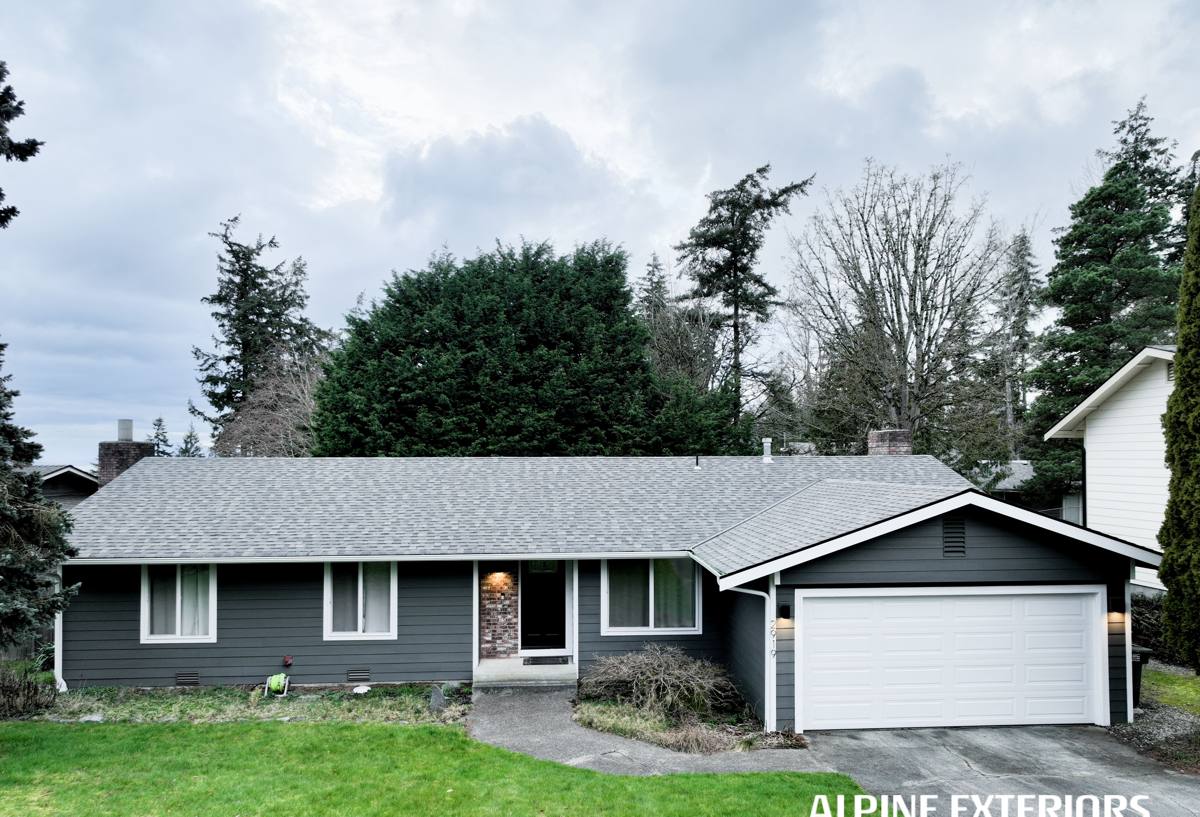
Why Acme's Climate Is Hard on Siding
Moss and Mildew Get a Long Runway
Whatcom County's moss season isn't a few weeks — it's most of the year. In shaded, tree-lined settings like much of Acme, north-facing walls and anything tucked under overhangs or near landscaping can stay damp for days after a storm passes. Moss doesn't just look bad; it holds water directly against the siding surface, and on absorbent materials that moisture works its way into seams, fastener holes, and butt joints where paint or factory finish has worn thin.
Driving Rain Finds the Gaps
Wind-driven rain off the Sound doesn't fall straight down — it's pushed sideways into walls, and valley terrain around Acme can funnel and intensify that wind in ways open flatland doesn't experience the same way. That means siding laps, corner trim, and window and door flashing take a harder hit than the "average" rainfall numbers for the region would suggest. Any repair that doesn't account for wind-driven water — not just gravity-fed water — tends to fail again within a season or two.
Salt-Laden Air Accelerates Everything
Even away from the immediate coastline, salt-bearing marine air moves through Whatcom County regularly. On metal fasteners, flashing, and trim, that salt content speeds up corrosion. On wood-based siding products, it interacts with the near-constant moisture to accelerate rot at seams and end cuts far faster than a drier inland climate would allow.
What Siding Damage Looks Like on Acme Homes
Because of the conditions above, the failure patterns we see on Acme service calls tend to follow a consistent set of signs:
- Dark green or black staining concentrated on shaded, north- or east-facing walls and under roof overhangs
- Soft or spongy spots where you can press a fingertip into the siding, usually near the bottom courses or around window trim
- Paint that's bubbling, peeling, or chalking well before it should, especially on horizontal lap seams
- Visible gaps or separation at butt joints and corner boards where caulking has failed
- Warping, cupping, or bowing on lap siding boards, particularly on sun-shaded elevations
- Rust streaking below nail heads or metal flashing
- A musty smell near exterior walls inside the home, which often points to moisture that's already gotten past the siding
Any one of these on its own might be minor. Several showing up together, especially on the same wall, usually means moisture has been getting behind the siding for a while — which changes the repair from a patch job to something that needs a real assessment of what's happening underneath.
How Different Siding Materials Hold Up to Repair in This Climate
What a home is currently sided with changes what a "repair" even looks like. Some materials patch cleanly and predictably. Others don't, and that's a big part of why we're honest with Acme homeowners up front about what to expect.
| Material | Behavior in Acme's Damp, Shaded Conditions | Repair Considerations |
|---|---|---|
| Cedar / primed wood | Absorbs moisture readily; prone to rot at seams and end grain, especially in shade | Rotted sections often extend further than visible; patches rarely match weathered wood color |
| Vinyl | Doesn't rot, but becomes brittle with age and UV exposure; moss grows on the surface film | Cracks and warps are hard to patch invisibly; exact color/profile matches get harder to find as products age out |
| LP SmartSide (engineered wood) | Resists cracking better than solid wood but is still wood-based, so edge moisture intrusion remains a risk if caulking or paint fails | Repairs depend heavily on sealing cut edges correctly; skipped detail work shows up as failures within a year or two |
| James Hardie fiber cement | Non-combustible and dimensionally stable; doesn't absorb and swell the way wood-based products do | Patches and replacement boards blend cleanly when color-matched, and correctly installed sections aren't the weak point in a repair |
We only install and repair with James Hardie fiber cement siding — we don't install vinyl, LP SmartSide, Cemplank, Allura, primed spruce, or cedar. When we're called to a home in Acme that has one of those other materials, we'll still give you an honest read on the repair itself; we just won't be the crew re-siding the whole wall in a product we've chosen not to install, and we'll explain why.
What a Correct Siding Repair Actually Involves
A siding repair that actually holds up in Acme's climate is not just "replace the bad board and caulk the edges." Done right, it involves several steps that are easy to skip and easy for a homeowner to never notice were skipped:
1. Find the Real Source of the Damage
Damaged siding is often a symptom, not the cause. Failed flashing above a window, a gutter that's overflowing onto a wall, or a grading issue that keeps a foundation line wet can all cause siding damage that will simply return if only the siding itself gets replaced.
2. Check What's Behind the Siding
Any repair on a wall with soft spots or staining should include opening up the area enough to check the water-resistive barrier and sheathing underneath. If moisture has reached the sheathing, that needs to be dealt with before new siding goes back on — otherwise you're covering up a problem instead of fixing it.
3. Match Material and Fastening Correctly
Patch boards need to match the profile, exposure, and fastening pattern of the existing siding, and fasteners need to be corrosion-resistant given the salt content in the air here. Mismatched profiles or the wrong fastener spacing show up immediately and also create new points where water can get in.
4. Rebuild Flashing and Sealant Details
Every seam, joint, and penetration is a place where water either sheds off the wall or gets trapped behind it. Flashing at windows, doors, and butt joints has to be lapped correctly — sealant is a backup, not the primary defense.
5. Repaint or Match Finish
On factory-finished products, a repair should use color-matched material so the patch doesn't stand out as an obvious repair years later. On field-painted materials, the repaired section needs to be primed and finished to match, not left exposed.
Our Process for Acme Siding Repair Calls
When we get a call from Acme, the process is straightforward:
- On-site inspection. We look at the affected area, check surrounding walls for the same conditions, and probe any soft or stained sections to see how far the damage extends.
- Honest diagnosis. We'll tell you plainly whether this is a contained repair, a larger section that needs replacing, or a sign the whole elevation is due for new siding — and why.
- Written scope and estimate. You get a clear description of what's being repaired, what materials are used, and what the work costs before anything starts.
- Repair or replacement, done to spec. We address the underlying cause first, then rebuild the wall assembly — sheathing, barrier, flashing, and siding — correctly, not just cosmetically.
- Final walkthrough. We go over the completed work with you so you know exactly what was done and what to keep an eye on going forward.
Repair vs. Replacement: When Patching Isn't Enough
Not every damaged section needs a full re-side, but in a climate like this one, patching the wrong situation just delays a bigger job. A few factors tend to tip the decision:
| Factor | Favors Repair | Favors Replacement |
|---|---|---|
| Extent of damage | Isolated to one or two boards or a small area | Spread across multiple courses or several walls |
| Sheathing condition | Dry, sound sheathing behind the damaged section | Soft or discolored sheathing found during inspection |
| Age of existing siding | Siding is otherwise in good shape and not near end of life | Siding is old, chalking, or already showing wear elsewhere |
| Material match | Matching material and profile are still available | Product is discontinued or no longer manufactured |
| Recurring failure | First time this area has had a problem | Same wall or area has needed repair before |
Why James Hardie Is What We Repair and Rebuild With
We standardized on James Hardie fiber cement for a specific reason: it holds up to exactly the conditions Acme deals with. It's non-combustible, it doesn't swell or rot the way wood-based products can when they stay damp, and it's engineered specifically for Pacific Northwest moisture through Hardie's HZ5 product line. The factory-applied ColorPlus finish also means repaired sections can be matched without a repaint, and it carries a strong transferable warranty when installed to spec. That's the standard we hold every repair and replacement to — not because other products don't have their strengths, but because we've made a professional decision about what we're willing to put our name behind on homes in this climate.
Checklist: Signs Your Acme Home May Need a Siding Repair Inspection
- Persistent moss or algae staining on one or more walls that doesn't wash off easily
- Soft, spongy, or bubbling siding anywhere on the exterior
- Visible gaps, cracks, or separation at seams and corners
- Peeling paint or finish failure well before you'd expect it
- Interior signs like musty odors, staining, or soft drywall near exterior walls
- Higher-than-expected heating bills, which can point to moisture-compromised insulation behind siding
- Any repair that was done previously but is failing again in the same spot
Why a Crew That Already Works in Acme Makes a Difference
Siding repair in a valley community like Acme isn't the same job as siding repair on an open lot in downtown Lynden, and a crew that treats it that way tends to miss things — under-diagnosing moss and moisture problems, under-detailing flashing for wind-driven rain, or simply not budgeting enough time for the shaded, harder-to-dry conditions common in this area. Working regularly in and around Lynden and its surrounding communities means we already understand how the local terrain and tree cover change what a wall needs, and we bring that knowledge to every inspection instead of treating every siding repair as generic.
If you're seeing moss buildup, soft spots, or paint failure on your Acme home, we're happy to take a look and give you a straight answer about what's actually going on — no pressure, no upsell. Reach out for a free estimate using the form below.