 Lynden Roofing
 Acme's Setting Makes Siding Work Harder Than It Looks
Acme sits in the tree-covered valleys southeast of Lynden, tucked closer to the foothills than to open farmland. That setting is part of what makes the area beautiful, and it's also exactly what wears siding out faster than homeowners expect. Heavy tree cover means more shade, more standing humidity, and slower drying after every rain. Whatcom County as a whole sits in the path of moisture-loaded marine air pushing in off the Salish Sea, and that air doesn't stop at the water's edge — it rides inland on wind and weather systems, adding to the driving rain and long wet seasons that already define this part of Washington. For a home in Acme, that combination of shade, humidity, and wind-driven rain is a tougher test for exterior materials than a house sitting out in full sun and open air.
This page is about one thing: what it takes to do a James Hardie fiber cement siding job right on a home in this specific area, and why the climate here changes some of the decisions a crew has to make.
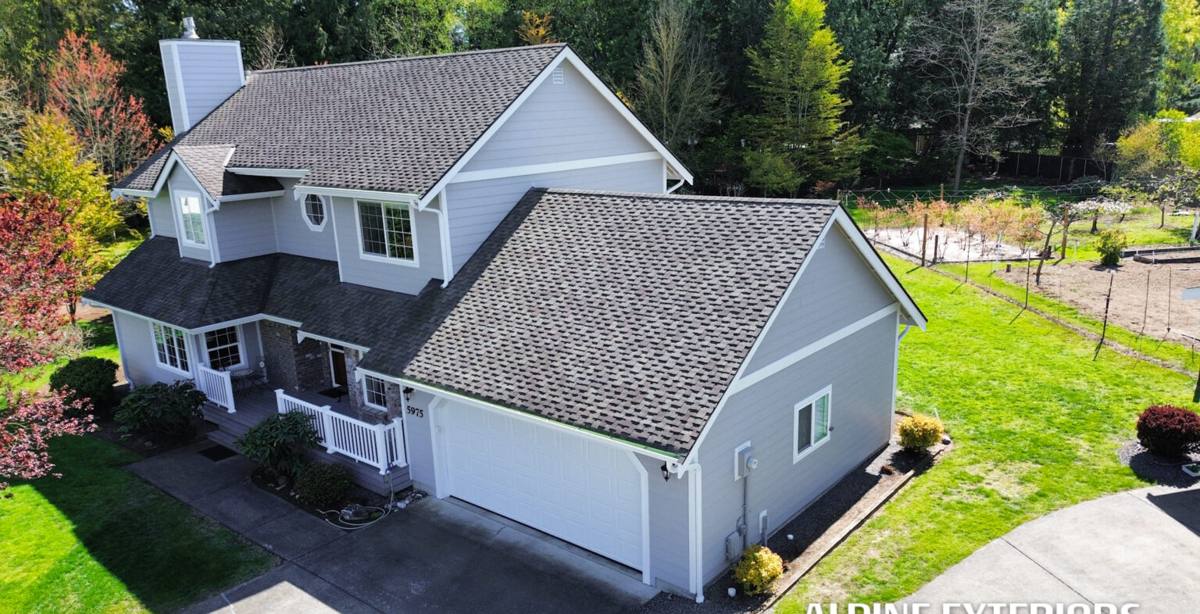
What This Climate Actually Does to a Wall System
Driving Rain and Wind-Driven Moisture
Rain that falls straight down is fairly easy for any siding to shed. Rain that's pushed sideways by wind — which is the normal pattern here for much of the year — finds every seam, lap, and fastener point a siding system has. Over years, that repeated wind-driven moisture is what separates a wall assembly that was installed correctly from one that was just nailed up to look right on day one. The siding material matters, but the flashing, the weather-resistive barrier behind it, and the gaps left at joints matter just as much.
Shade, Humidity, and the Long Moss Season
Homes tucked under tree cover, like many in and around Acme, don't get the same drying time that an open, sun-exposed lot gets after a storm. Moisture sits longer on north-facing walls, under eaves, and anywhere airflow is blocked by landscaping or neighboring trees. That extended dampness is exactly what moss, algae, and mildew need to take hold, and once they're established on a wall surface they hold even more moisture against it. A siding product that can't stand up to sustained damp contact — or a paint finish that starts chalking and losing adhesion after a few wet seasons — will show problems here faster than it would in a drier climate.
Why We Only Install James Hardie Fiber Cement
We made a deliberate decision as a company: we install James Hardie fiber cement siding, and nothing else. Not vinyl, not LP SmartSide, not Cemplank or Allura, not primed spruce or cedar. That's not a marketing line — it's a standard we hold to because of what we've seen these products do, or fail to do, in exactly this kind of climate.
Vinyl siding is affordable and low-maintenance in the sense that it doesn't need paint, but it's a thin plastic product that can warp, crack, or fade with UV and temperature swings, and it does nothing to slow a fire. Wood-based engineered sidings like LP SmartSide use real wood strand technology that's come a long way, but wood-based products are still fundamentally organic material, and organic material in a shaded, damp climate is fighting an uphill battle against rot and moisture absorption at cut edges. Primed spruce and raw cedar require diligent, ongoing maintenance — repainting, caulking, and inspection — that most homeowners don't keep up with on the schedule the material actually needs.
James Hardie fiber cement is a cement-based composite, not wood and not plastic. It doesn't feed fire, it doesn't swell and rot the way wood-based products can, and it holds a factory-applied finish (ColorPlus Technology) that's baked on and warranted, rather than a coat of paint applied on-site that starts breaking down the moment it's exposed to weather. Hardie also engineers specific product lines for specific climates — the HZ5 line is built for regions like ours that see a lot of moisture and temperature swings, rather than the HZ10 line built for hot, dry climates. That climate-specific engineering is a real, practical difference, not a marketing detail.
What a Correct Installation Involves
The siding board itself is only part of the job. Most siding failures we get called out to inspect — regardless of brand — trace back to installation shortcuts, not the material. A correct James Hardie install on an Acme home involves several things that aren't visible once the job is finished but determine how the wall performs for the next several decades.
Weather-Resistive Barrier and Flashing
Behind every board is a water-resistive barrier that has to be installed continuously and lapped correctly, with flashing integrated at every window, door, and penetration. This is the layer that actually keeps wind-driven rain out of the wall cavity if any moisture gets past the siding surface itself — which, over enough years and enough storms, it eventually will at some point on any home.
Fastening, Clearances, and Joint Treatment
Hardie publishes specific fastening patterns, minimum clearances from grade, decks, and roof lines, and joint-treatment requirements for a reason: those specs are what the product warranty is actually built on. Nailing patterns that are too sparse, boards installed too tight against a deck surface, or joints that aren't properly caulked and gapped are the kind of shortcuts that don't show up as a problem until a few wet seasons in — right about the time moss and standing moisture start finding those weak points.
Factory Finish vs. Field Touch-Up
ColorPlus finishes are engineered to resist fading and are backed by a separate finish warranty, but that only holds up if cut edges are properly primed and sealed and touch-up is done with the matched ColorPlus product, not generic exterior paint. Skipping this step is a small shortcut that quietly voids part of what you're paying for.
| Climate Condition | What It Does to a Poorly Built Wall | How Hardie + Correct Install Responds |
|---|---|---|
| Wind-driven, driving rain | Forces water past gaps at seams, trim, and fastener points into the wall cavity | Continuous weather-resistive barrier and integrated flashing route water back out before it reaches sheathing |
| Prolonged shade and humidity | Slows drying, keeps organic materials damp for extended stretches | Non-combustible fiber cement doesn't absorb and swell the way wood-based products can |
| Moss and algae growth | Holds moisture against the wall surface, accelerates finish breakdown | Factory-baked ColorPlus finish resists the chalking and adhesion loss that field-applied paint suffers first |
| Repeated freeze-thaw and wet-dry cycling | Cracks caulking, loosens fasteners, opens joints over time | Correct clearances and joint treatment give the assembly room to move without opening water paths |
Signs an Acme Home's Current Siding Is Already Struggling
Before any tear-off starts, it helps to know what you're actually looking at. Some of these signs are urgent, some are just early warnings worth addressing before winter:
- Soft or spongy spots when you press on the siding, especially near the bottom courses or under windows
- Visible moss or dark streaking that keeps returning within a season of being cleaned off
- Paint that's chalking, peeling, or bubbling, particularly on shaded or north-facing walls
- Warped, bowed, or separating boards, most common with wood-based or vinyl products
- Caulking that's cracked, shrunk, or pulling away from trim and joints
- Musty smell or visible staining on interior walls that share an exterior wall with the affected area
- Fastener heads showing through the surface or streaking with rust
Any one of these on its own might just need attention. Several together, especially on a home with shaded or tree-covered walls, usually means moisture has been getting past the surface for a while.
How the Job Runs, Start to Finish
Every home is different, but the sequence of a proper siding replacement doesn't change:
- We walk the property with you, look at the current siding, trim, and any problem areas you've noticed, and talk through what's actually driving the need for new siding.
- We give you a written estimate that spells out product line, color, and scope — no vague allowances.
- Tear-off removes the old siding down to the sheathing so we can actually inspect what's underneath, rather than siding over hidden rot.
- Any damaged sheathing or framing gets repaired before anything new goes back up — this is the step that gets skipped by crews trying to move fast, and it's the one that matters most.
- Weather-resistive barrier and flashing go in first, installed to manufacturer spec at every window, door, and penetration.
- James Hardie boards go up with correct fastening, clearances, and joint treatment, followed by trim and caulking.
- Final walkthrough with you, so you know what was done and what maintenance, if any, to expect going forward.
Why a Crew That Already Works in Acme Matters
A lot of siding problems in this area aren't about the product at all — they're about a crew that installed to a generic spec without accounting for how much shade a lot gets, how close the tree line sits to a wall, or how long moisture actually lingers on a given elevation before it dries. A contractor who's already worked jobs in and around Acme has a feel for which walls need extra attention to clearances and drainage and which don't, rather than treating every home the same way a crew from outside the region might.
There's also a practical side to this: local familiarity means fewer surprises with permitting, easier scheduling around this area's weather windows, and a crew that isn't learning the terrain on your dime.
Living With Hardie Siding in This Climate
One of the real advantages of fiber cement over wood-based or vinyl alternatives is how little ongoing maintenance it asks for once it's installed correctly. It won't rot, it won't need repainting on the schedule wood does, and it's not going to warp or crack from temperature swings the way vinyl can. That said, "low-maintenance" isn't "no-maintenance," especially in a shaded, moss-prone setting like Acme. A periodic rinse to keep organic growth from establishing, a visual check of caulking and trim every year or two, and prompt attention to any landscaping that's shading a wall more than it used to are all it really takes to get the full lifespan out of the system.
If your siding is showing any of the signs above, or you're just planning ahead for a replacement, we're happy to come take a look. The estimate is free, there's no pressure attached to it, and you'll get a straight answer about what your home actually needs.