 Lynden Roofing
 Birch Bay's Marine Climate Is Harder on Siding Than Most Homeowners Realize
Birch Bay sits right on the water, and that changes what siding has to deal with day in and day out. Homes a few miles inland in Whatcom County get plenty of rain, but Birch Bay adds salt-laden air, near-constant onshore wind, and driving rain that hits walls at an angle instead of falling straight down. Add in a long, gray moss season that stretches from fall through spring, and you've got a combination that ages weak siding fast and exposes bad installation work even faster.
None of this means Birch Bay is a bad place to own a home near the water — it just means the siding on that home is doing more work than siding on a similar house set back from the shoreline. Salt air is mildly corrosive to exposed metal, wind-driven rain finds gaps that would never be a problem in calmer conditions, and constant dampness gives moss and algae a head start on any surface that holds moisture. A siding replacement done for Birch Bay needs to be planned around those realities, not just swapped in as a generic upgrade.
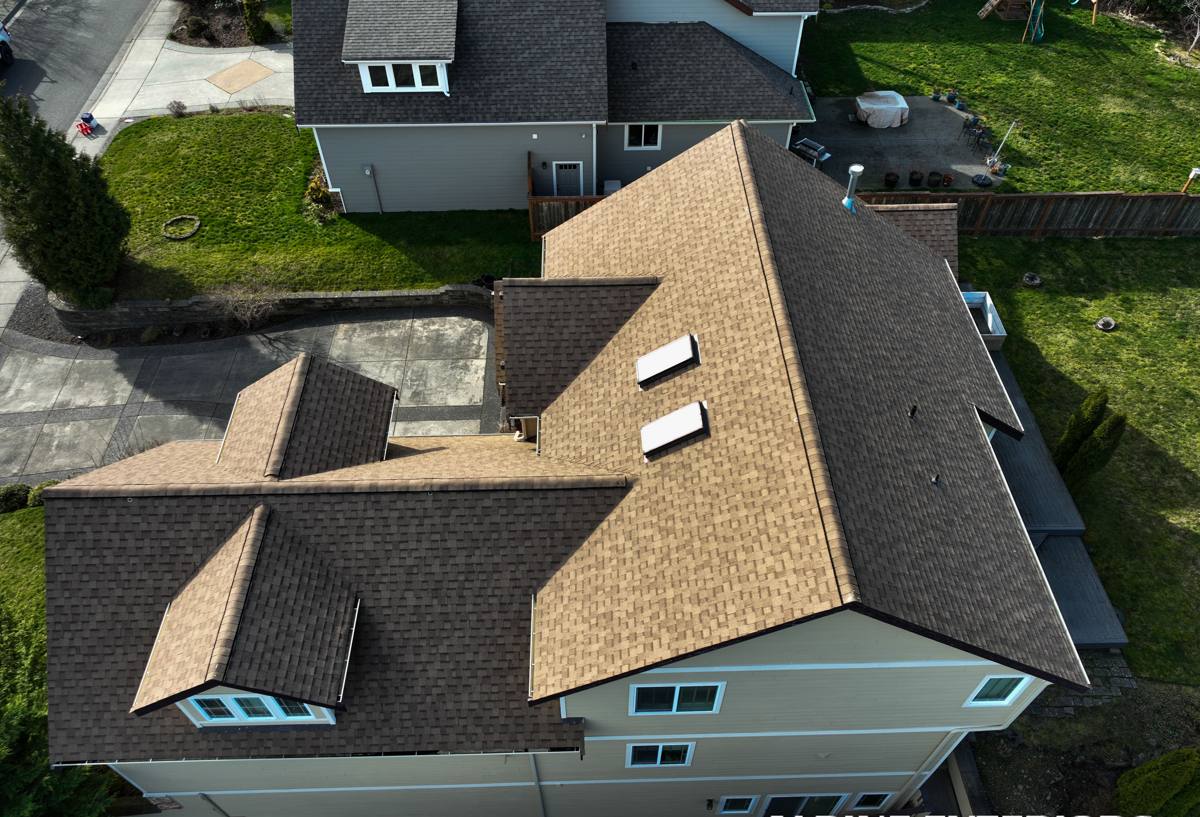
What Birch Bay Homes Actually Need From New Siding
Moisture Control Matters More Here Than Inland
Wind-driven rain doesn't just run down a wall — it gets pushed sideways and even upward under an eave in a strong gust off the water. That means every seam, joint, and penetration (hose bibs, light fixtures, vents) needs to be flashed and sealed as if water will actually reach it, because on a Birch Bay home, it will. A continuous, correctly lapped water-resistive barrier behind the siding, with proper flashing at windows, doors, and trim, is not optional here — it's the difference between siding that looks fine and sheathing that's quietly rotting behind it.
Fasteners and Hardware Take the First Hit From Salt Air
Salt air is tough on anything exposed metal — fasteners, flashing, and trim accessories included. Using corrosion-resistant fastener types and metals rated for coastal exposure isn't a luxury upgrade on a Birch Bay job, it's basic due diligence. Cutting corners here shows up as rust streaks and loosening trim within a few years, long before the siding itself would ever need attention.
The Finish Has to Handle Constant Damp Without Feeding Moss
A long moss season means anything with texture or a porous painted surface gives algae and moss a place to grab hold. A factory-applied finish that resists moisture absorption at the surface, rather than relying on field-applied paint to do that job, holds up noticeably better through a Birch Bay winter.
Why We Install Only James Hardie Fiber Cement Siding
We made a standing decision as a company to install James Hardie fiber cement exclusively — not vinyl, not LP SmartSide, not cedar or primed spruce. That's not a marketing position, it's a professional judgment call based on what holds up on homes exposed to Pacific Northwest coastal conditions like Birch Bay's. Hardie's fiber cement is non-combustible, comes with a factory-applied ColorPlus finish instead of relying on field paint, and is engineered in climate-specific product lines — homes in our region are built with the HZ5 line, designed around exactly the kind of wet, freeze-thaw-prone winters Whatcom County sees.
That doesn't mean the alternatives are bad products across the board. Each has real strengths. But for a home facing salt air and sustained wind-driven rain, the trade-offs matter more than they would somewhere drier and calmer.
| Siding Type | Behavior in Salt Air / Wind-Driven Rain | Ongoing Maintenance | Where It Falls Short Here |
|---|---|---|---|
| James Hardie fiber cement | Non-combustible, dimensionally stable, factory finish resists moisture at the surface | Occasional rinse, repaint on factory finish's own long cycle | Costs more up front; installation must follow manufacturer spec closely |
| Vinyl siding | Won't rot, but can warp or crack under thermal stress and driving rain can push behind loose panels | Low, but damaged panels are hard to color-match years later | Seams and J-channels are a common path for wind-driven water intrusion |
| LP SmartSide (engineered wood) | Treated to resist moisture, but wood-based core is still vulnerable if the finish is compromised | Requires attentive caulk and paint upkeep, especially at cut edges and joints | Salt-air moisture cycling is harder on wood-based products long-term |
| Cedar / primed spruce | Natural material, handsome look, but absorbs moisture readily | Highest maintenance — regular staining, sealing, and moss treatment | Moss season and constant damp shorten the interval between refinishing jobs |
What a Correct Siding Replacement Actually Involves
The finished siding is only as good as everything installed underneath it. On a Birch Bay job, we treat the tear-off as the real inspection point — it's the only time anyone can see what's actually happening behind the old siding.
- Tear-off and sheathing inspection — remove the old siding and check the sheathing and framing underneath for hidden moisture damage, especially around window and door openings where old flashing tends to fail first.
- Repair before covering anything up — any soft or damaged sheathing gets replaced now, not patched over. Covering rot with new siding just hides the problem for a few more years.
- Install a continuous water-resistive barrier — lapped correctly, shingle-style, so water is always directed outward and down, never into a seam.
- Flash every penetration and opening — windows, doors, hose bibs, vents, and electrical penetrations all get proper flashing, sequenced so water sheds over each layer correctly.
- Install James Hardie panels or lap siding to manufacturer spec — correct fastener type and spacing, proper clearance from grade, decks, and roof lines, and factory-primed cut edges sealed before they're closed in.
- Seal and caulk only where the manufacturer calls for it — over-caulking joints that are designed to allow drainage can trap moisture instead of releasing it.
- Final cleanup and walk-through — site cleaned of debris and fasteners, and the finished work reviewed with the homeowner before we consider the job done.
Cost Factors for a Birch Bay Siding Replacement
Every home is different, and the only way to get an accurate number is a walk-through and a written estimate. That said, homeowners are usually weighing the same handful of factors, and it helps to know what actually moves the price.
| Factor | Why It Matters |
|---|---|
| Home size and wall complexity | More square footage and more corners, dormers, and trim details mean more labor and material |
| Sheathing condition found at tear-off | Hidden rot or moisture damage behind old siding adds repair scope that can't be quoted until the walls are opened up |
| Siding profile and accessories | Lap siding, panel siding, and trim details are priced differently, and coastal-grade fasteners and flashing add a modest premium |
| Access and site conditions | Waterfront lots, retaining walls, and limited staging space can add time compared to a straightforward flat lot |
| Permitting | Whatcom County permit requirements can affect timeline and, in some cases, scope |
As a broad, honest range — not a quote — most full siding replacements on single-family homes in this area land somewhere in the low-to-mid five figures, with the final number depending heavily on the factors above. A free estimate is the only way to get a number specific to your home.
Why Hiring a Crew That Already Works Birch Bay Matters
We're based in Lynden, and Birch Bay is a regular part of our service area, not an occasional detour. That matters in a few practical ways. We already know what wind-driven rain does to walls facing the water versus walls that are more sheltered, so we don't treat every elevation the same. We're familiar with Whatcom County's permitting process for exterior work, which keeps a project moving instead of stalling on paperwork. And because we're not learning the local conditions on your dime, the flashing and fastener choices on your estimate reflect what actually holds up here, not a generic inland spec.
A crew that only occasionally works the coast can still do competent work, but there's real value in a contractor who has already seen how a given house orientation handles a winter storm off the water — and builds the job around that from the start.
Signs It's Time to Replace Your Birch Bay Home's Siding
- Soft spots or visible warping when you press on the siding, especially near the bottom courses or under windows
- Paint that's peeling or bubbling in patterns that follow seams or joints rather than just sun exposure
- Persistent moss or algae growth that comes back within a season of cleaning
- Visible gaps, cracked caulk, or separated trim around windows and doors
- Rust staining running down from fasteners or metal trim
- Musty smells or soft drywall on interior walls that share a wall with visibly aged exterior siding
- Siding that's simply past its expected service life and showing its age across the whole house, not just one wall
Any one of these on its own might just need a repair. Several at once, especially combined with a home's age, is usually a sign the smarter move is a full replacement rather than chasing individual repairs year after year.
Keeping New Siding Looking Right in a Salt Air Environment
Correctly installed James Hardie siding is low-maintenance, but "low-maintenance" isn't "no-maintenance" this close to the water. An occasional gentle rinse to clear salt residue and organic buildup, a yearly look at caulking around windows and trim, and prompt attention to any physical damage go a long way toward getting the full service life out of the installation. None of this is heavy work — it's the kind of upkeep that takes an afternoon and prevents small issues from becoming siding-replacement issues again in ten years.
If your Birch Bay home's siding is showing its age, or you just want a straight answer on whether repair or replacement makes more sense, we're glad to take a look. The estimate is free, there's no pressure, and you'll get a clear breakdown of what we'd actually recommend for your home — use the form below to get started.