 Lynden Roofing
 Siding in Sumas: What the Climate Actually Demands
Sumas sits at the far northern edge of Whatcom County, tucked against the Canadian border in the Nooksack Valley, and the climate here is unforgiving on exterior building materials in a quiet, cumulative way. It isn't one big storm that wrecks a home's siding — it's the steady grind of driving rain off the valley, humid marine-influenced air that moves through this part of the Pacific Northwest, and a moss and algae season that can run eight months out of the year on north- and east-facing walls. Add in freeze-thaw swings during the colder months and you have an environment where any siding product with a weak point in its water-shedding design will eventually show it, usually behind the wall where nobody's looking until it's expensive.
We're based in Lynden, a few miles south, and Sumas is part of our regular service area. That matters more than it sounds like it should — the way water moves across a Sumas roofline, how much shade a given lot gets from surrounding trees, and how long moss has time to establish before a homeowner notices it are things you learn from doing the work here repeatedly, not from a general knowledge of "Pacific Northwest siding."
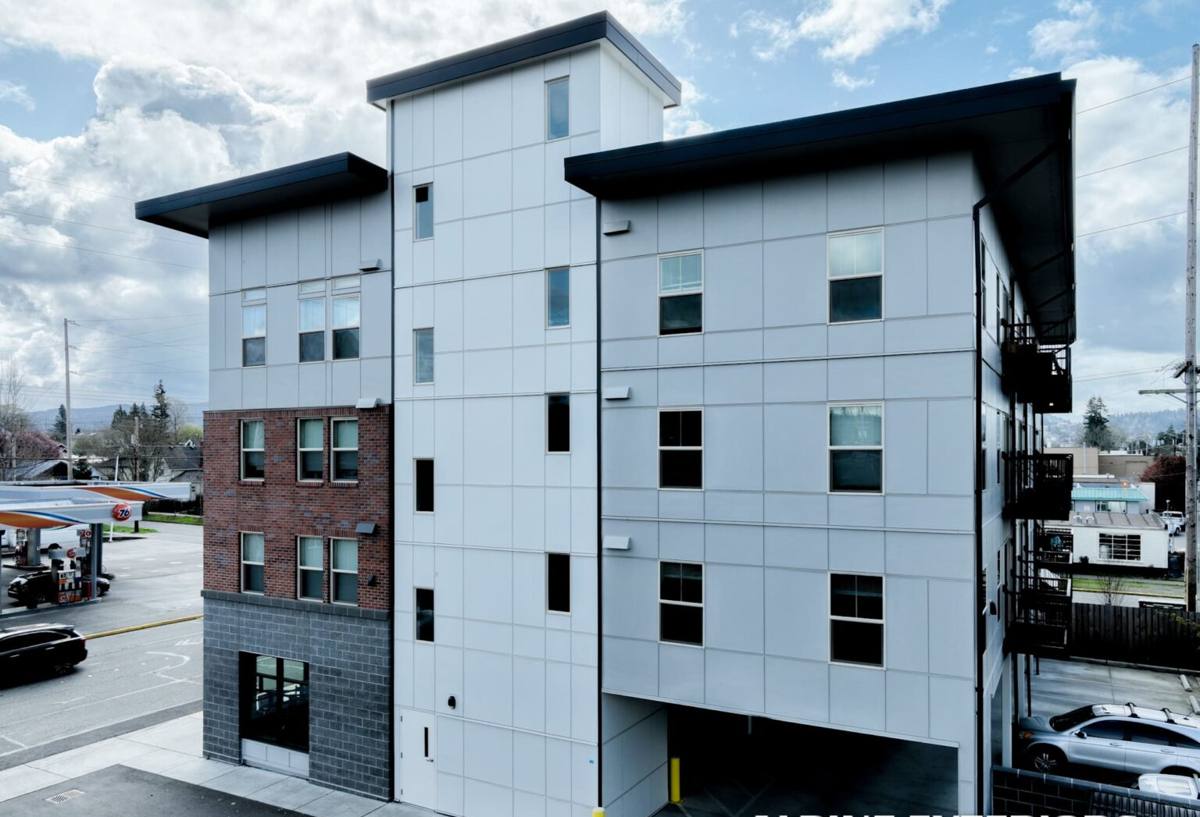
Why We Only Install James Hardie Fiber Cement Siding
We get asked fairly often why we don't offer vinyl, LP SmartSide, or one of the other fiber cement brands like Cemplank or Allura. The honest answer is that we standardized on James Hardie years ago because, in a climate like Whatcom County's, the margin for error in siding materials and installation is small, and Hardie's product line consistently gives us the fewest ways for water and rot to win.
Vinyl is inexpensive and low-maintenance in the sense that it doesn't need painting, but it's a thin, flexible material that expands and contracts significantly with temperature swings, can crack in hard freezes, and doesn't offer the same impact resistance or dimensional stability that fiber cement does. LP SmartSide is an engineered wood product — it performs reasonably well when installed and maintained exactly to spec, but wood-based substrates are inherently more vulnerable to moisture intrusion than cement-based ones, and in a region with this much sustained damp and moss pressure, that's a trade-off we're not willing to build a reputation on. Other fiber cement brands aren't bad products in principle, but we don't have the same depth of field experience with their specific formulations, factory finishes, and warranty structures that we have with Hardie, and we'd rather stand fully behind one system we know inside and out than split our expertise across several.
James Hardie fiber cement is non-combustible, dimensionally stable across our temperature range, and comes with a factory-applied ColorPlus finish that's baked on under controlled conditions rather than field-painted — which matters a great deal in a climate where a job-site paint job has to fight rain and humidity to cure properly. Hardie also engineers specific product lines (the HZ5 line, for this climate zone) for exactly the kind of moisture exposure Whatcom County sees.
What "Climate-Engineered" Actually Means
Hardie's HZ5 formulation is built for regions with more moisture and freeze-thaw cycling than the milder HZ10 zones used in parts of the Southeast. Practically, that means the board itself is formulated to resist moisture absorption and swelling better in exactly the conditions Sumas sees most of the year — long wet stretches followed by cold snaps, not one extreme or the other.
What Correct Siding Installation Involves
The siding material is only part of the equation. Most siding failures we get called out to inspect in this area aren't a failure of the board itself — they're a failure of the water-management system underneath it. A correct installation gets several things right at once.
Moisture Management Behind the Siding
Every wall assembly needs a drainage plane — house wrap or building paper installed correctly, lapped properly, with a rainscreen gap in most applications so that any water that does get behind the siding has somewhere to go and can dry out rather than sitting against the sheathing. This is invisible once the job is done, which is exactly why it's the step that gets shortcut most often by crews trying to move fast.
Fastening and Flashing
Hardie siding has specific fastening requirements — nail placement, spacing, and depth all affect how the board performs over time, and over-driven or under-driven fasteners are one of the most common causes of premature siding problems we see. Flashing at every window, door, and roofline intersection has to be installed so water is directed out and away from the wall assembly, not just tucked in and hoped for. In a place that gets as much driving rain as Sumas, flashing detail is not optional trim work — it's the difference between a wall that stays dry for decades and one that starts rotting from the inside in five years.
Factory Finish, Field-Sealed Cuts
ColorPlus finish is factory-cured and holds up far better than field-applied paint, but every cut edge exposes raw fiber cement, and every cut edge needs to be sealed with the correct touch-up product before installation. Skipping this step is a small shortcut that creates a moisture entry point at every single cut on the house.
Our Process for Sumas Homes
We run the same process on every siding installation, adjusted for the specific house and lot.
1. On-Site Assessment
We walk the exterior, check the current siding and sheathing condition where accessible, and look at drainage, shade patterns, and moss buildup on the existing walls — all of which tell us how the house is actually being exposed to weather, not just how it looks from the street.
2. Removal and Substrate Check
Old siding comes off and we inspect the sheathing underneath before anything new goes up. If there's hidden water damage or rot, we address it before installation starts rather than sealing a problem behind new siding.
3. Weather Barrier and Rainscreen
House wrap, flashing, and drainage gap installation happen next, following Hardie's published installation requirements for our climate zone.
4. Siding Installation
Boards are cut, sealed at every cut edge, and fastened to spec, with trim, corners, and butt joints detailed to shed water rather than trap it.
5. Final Walkthrough
We walk the finished job with the homeowner, check caulking and touch-up work, and confirm everything matches what was scoped.
Signs a Sumas Home Needs New Siding
- Persistent moss or algae staining that returns within a season of cleaning, especially on north-facing walls
- Soft spots, bubbling, or visible warping in the siding material
- Paint that's peeling or bubbling repeatedly in the same spots, which often points to trapped moisture rather than a paint quality issue
- Visible gaps, cracking, or separation at seams, corners, and trim
- Rising energy bills that aren't explained by anything else, which can indicate the wall assembly is no longer performing as insulation and air barrier
- Musty smells or visible staining on interior walls near exterior corners
Any one of these on its own isn't necessarily an emergency, but they're worth having a professional look at before the next wet season, since moisture problems behind siding tend to get more expensive the longer they sit unaddressed.
Cost Factors for Siding Installation in Sumas
Every home is different, so we don't quote pricing sight unseen, but these are the main variables that move the number:
| Factor | Why It Matters |
|---|---|
| Home size and wall complexity | More square footage and more corners, gables, and dormers mean more material and labor time |
| Current siding removal | Tear-off and disposal of old material adds time versus a bare or already-stripped wall |
| Sheathing or structural repair | Rot or damage found underneath the old siding needs to be fixed before new siding goes on |
| Board profile and accessories | Lap siding, shingle-style panels, and trim details vary in material and labor cost |
| Color and finish selection | Factory ColorPlus finishes are priced differently than primed-for-paint options |
| Site access | Tight lots, fencing, or landscaping that limits equipment and material staging can add time |
Why a Local Lynden Crew Matters for Sumas Homes
Whatcom County is a small enough region that a crew based in Lynden isn't a stretch to reach Sumas, but proximity isn't really the point — familiarity is. We've worked enough homes in this corner of the county to know how moss establishes on shaded walls here, how much driving rain a given roofline and wall orientation actually takes on, and which details on a house tend to get overlooked by installers who aren't used to this specific stretch of weather. A crew that only occasionally works this area is starting from general knowledge every time. A crew that works it regularly is applying lessons learned from the last house down the road.
There's also a practical service side to this: warranty work, follow-up questions, and future maintenance are all easier when the company that installed your siding is a short drive away rather than based somewhere that only sends a crew through occasionally.
Checklist: What to Ask Before You Hire a Siding Contractor in Sumas
- Are you a certified installer for the siding product you're proposing, and can you explain why you recommend that specific product for this climate?
- What's your process for handling sheathing damage discovered during tear-off?
- Do you install a drainage plane and rainscreen gap, and can you explain how it works?
- How do you handle fastening and cut-edge sealing on fiber cement products specifically?
- What does the manufacturer's warranty actually cover, and is it transferable if you sell the home?
- Can you provide a written scope of work before starting, not just a total price?
A contractor who can answer these clearly and specifically, without vague reassurances, is generally one who understands the material and the climate well enough to install it correctly.
If your Sumas home needs new siding, or you're just trying to figure out whether what you have is holding up, we're happy to take a look. Reach out using the form below for a free, no-pressure estimate — we'll walk the house, tell you honestly what we see, and explain your options in plain terms.