 Lynden Roofing
 Energy-Efficient Windows in Laurel: What This Climate Demands
Laurel is one of the farming communities that sits just outside Lynden, in the open agricultural country of northern Whatcom County near the Canadian border. It's a different setting than a wooded or waterfront lot — homes here tend to sit on more open ground, with fewer windbreaks and longer sightlines across fields, which means wind and wind-driven rain reach the walls and windows with less to slow them down first. Add in the same marine-influenced weather that shapes the whole Nooksack valley — salt-tinged air moving in off the Sound, frequent rain that rarely falls straight down, and mild, damp conditions that give moss and mildew a long season to work — and you get a climate that's genuinely hard on windows, not just uncomfortable to live in.
Lynden Roofing Co works on roofs, siding, and windows across Whatcom County, and while roofing is our core trade, we treat windows the same way we treat a roof-to-wall transition: as a system that has to be built and sealed correctly the first time, because the failures don't show up until a wet season or two later. In Laurel specifically, that means designing every window project around open-field wind exposure, sustained rain, and a heating season where a poorly performing window shows up directly on the utility bill.
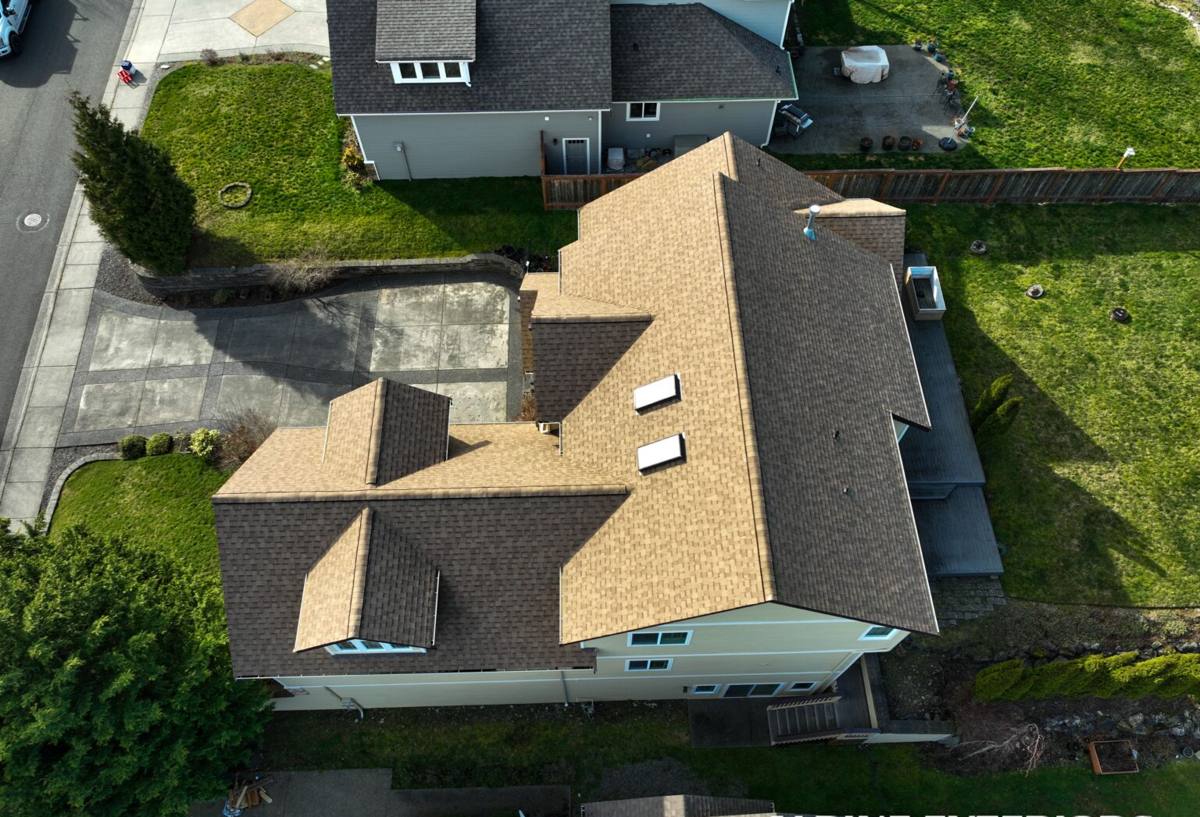
Why Energy Efficiency Matters More on Open Farmland
"Energy-efficient windows" gets used as a marketing phrase a lot, but on a Laurel property it has a very literal meaning. A home standing in open farmland with limited tree or structure cover on one or more sides takes a steadier, more direct wind load than a home tucked into a wooded lot or a tighter neighborhood block. That wind doesn't just make a house feel drafty — it actively drives cold air through any gap in a window's seal, and it pushes rain sideways into flashing details that a calmer site would never test as hard.
A lot of the older farmhouses and rural homes in this area were built with single-pane or early double-pane windows that were never designed for today's energy standards, and many were installed without the flashing and air-sealing detail we'd consider standard now. On an open, wind-exposed lot, that gap between old construction practice and current performance shows up faster and more noticeably — in higher heating bills, cold spots near windows in winter, and condensation that never quite goes away.
Understanding the Numbers: U-Factor and Solar Heat Gain
Window energy performance is usually described with two numbers, and both matter for a Whatcom County home even though our climate is heating-dominated rather than cooling-dominated.
| Rating | What It Measures | Why It Matters in Laurel |
|---|---|---|
| U-Factor | How well the window resists heat loss (lower is better) | Directly tied to winter heating cost and how cold a room feels near a window on a windy day |
| SHGC (Solar Heat Gain Coefficient) | How much solar heat passes through the glass (lower blocks more heat, higher lets more in) | Matters more on unshaded, south- or west-facing walls common on open farmland lots |
| Air Leakage Rating | How much air passes through the window assembly itself | A bigger factor here than in sheltered areas, given steadier wind exposure |
For most Laurel homes, a low U-factor is the priority, since our winters are the season that drives energy cost. On a wall with little shade — which is common on open agricultural lots without mature trees nearby — a moderate SHGC can also help keep a south-facing room from overheating on clear days, without sacrificing the natural light that makes those walls worth having windows on in the first place.
Frame Materials and Real-World Energy Performance
The frame matters as much as the glass for actual energy performance, especially on a property that takes a steady wind load. A few things to weigh:
| Frame Material | Insulating Behavior | Air-Seal Durability Over Time | Realistic Lifespan Here |
|---|---|---|---|
| Vinyl | Good insulator; multi-chambered frames perform well | Solid if welds and seams are done correctly at installation | 20-30 years |
| Fiberglass | Excellent; dimensionally stable across temperature swings | Very good; expands and contracts less than vinyl, keeping seals tighter longer | 30-40+ years |
| Wood, painted or clad | Naturally good insulator | Depends heavily on ongoing maintenance and finish upkeep | 15-30 years depending on upkeep |
| Aluminum | Poor without a thermal break; conducts cold readily | Can be reasonable with a quality thermal-break design | 20-30 years |
Fiberglass and quality vinyl tend to be the most straightforward choices for a wind-exposed farmland lot, because they hold their air seal with less dimensional movement than wood or uninsulated aluminum. That said, we'll walk through the actual trade-offs for your home's exposure and budget rather than steering everyone toward the same product — a sheltered wall on the same house doesn't always need the same answer as an open, wind-facing one.
Full-Frame Replacement vs. Insert Replacement
For energy efficiency specifically, this decision matters more than homeowners often expect. Insert replacement fits a new window into the existing frame and opening — it's faster, less disruptive to surrounding siding and trim, and it works well when the existing frame is structurally sound, square, and properly flashed. But it can only improve the window itself; it doesn't fix a poor air seal or damaged flashing already built into the wall.
Full-frame replacement removes the old window down to the rough opening and rebuilds the flashing and air-sealing from scratch. It costs more and takes longer, but on an older Laurel home where the original construction never included modern air sealing around the rough opening, it's often the only way to actually close the gap between what the new window is rated for and what the wall around it will actually deliver. We'll tell you honestly which situation your home is in rather than defaulting to whichever option is cheaper and leaving performance on the table.
Installation Details That Actually Determine Energy Performance
A high-performance window installed with average technique will underperform a modest window installed correctly. On every job in this area, that means:
- A properly pitched sill pan and correctly lapped flashing so wind-driven rain sheds outward instead of working into the wall assembly
- Continuous, gap-free insulation and low-expansion foam around the full perimeter of the frame, not just caulk at the visible seam
- Housewrap or building paper integrated with the window flashing in the correct shingle-lap order, so water always moves down and out
- Weep holes and drainage paths left open and functional rather than sealed shut during install
- Interior air sealing at the frame-to-framing gap, which affects comfort and energy use just as much as the exterior weatherproofing does
- Corrosion-resistant hardware and fasteners suited to sustained damp, salt-tinged air rather than standard interior-grade fasteners
None of this adds meaningfully to the cost of the window itself, but skipping any of it is exactly what turns a high energy-performance window into one that still lets in drafts and eventually moisture, regardless of what its rating label says.
Signs a Laurel Home Is Losing Energy Through Its Windows
- Noticeably higher heating bills compared to a similarly sized home, without an obvious other cause
- A cold draft or a distinct temperature drop near a closed window, especially on windy days
- Condensation or fogging between panes, which usually means a failed seal on a double- or triple-pane unit
- Interior condensation on the glass or frame during cold snaps, which can point to poor insulation or air sealing around the window
- Visible daylight, cracked caulk, or gaps around the frame when viewed from inside
- Difficulty latching a window fully, which can leave a small but constant air gap
- Rooms near older or original windows that feel noticeably colder than the rest of the house
Any one of these on its own is worth a look. Several of them together, especially in an older farmhouse with original windows, usually mean the windows are costing more in wasted energy than a replacement would cost over the same stretch of years.
Rebates, Incentives, and Weighing the Investment
Utility and state programs for energy-efficient window upgrades do exist and change from year to year, so it's worth checking with your utility provider directly on current eligibility and requirements before budgeting a project — we won't quote specific rebate amounts here since those programs shift, but we're happy to point you toward where to look. Beyond any incentive, the real return on an energy-efficient window replacement comes from two places: a measurable drop in heating cost over the years you own the home, and a wall assembly that's no longer taking on water through an aging, poorly sealed frame. For a wind-exposed Laurel property, both of those add up faster than they would on a more sheltered lot.
Why a Local Whatcom County Crew Matters
A crew that works roofs, walls, and windows across this county through every season learns things a spec sheet never tells you — how much harder an open farmland lot gets hit by wind compared to a sheltered one two miles away, how a sill pan needs to be pitched differently depending on which direction a wall faces, and which flashing details are worth the extra time on install day so a homeowner isn't dealing with a draft or a leak two winters later. That local knowledge is exactly what separates a window that performs the way its rating label promises from one that doesn't.
Beyond Windows: Roofing and Siding
Windows are one piece of a home's exterior envelope, and on a Laurel property they don't perform in isolation from the roof and siding around them. Roofing is our core trade, and we pay close attention to how a roof-to-wall transition and the flashing above a window interact — a leak that shows up around a window head is sometimes actually a roof or siding flashing issue, not a window problem at all. Because we handle roofing, siding, and windows, we can look at the whole wall and roof assembly together instead of treating a window as an isolated product and missing where the real issue is coming from.
Get a Free, No-Pressure Estimate
If your Laurel-area home has windows that are drafty, fogging, hard to operate, or just old enough that you suspect they're driving up your heating bill, we're glad to take a look and give you a straightforward, honest read on what it actually needs. Reach out using the form below to schedule a free estimate — no pressure, no upsell script.