 Lynden Roofing
 Why Board & Batten Holds Up Differently in Everson
Board and batten looks simple from the curb — wide boards, narrow battens covering the seams, clean vertical lines. But the vertical orientation changes how water moves across the wall compared to standard horizontal lap siding, and that matters more in Everson than in a lot of places. This part of Whatcom County sits in a low river valley near the Nooksack, where humidity lingers longer after a storm than it does on higher, more exposed ground. Add the marine air that pushes inland off the Salish Sea, months of driving rain each winter, and the shaded, tree-lined lots common around Everson, and you have ideal conditions for moss, mildew, and slow moisture intrusion if the siding underneath isn't detailed correctly.
None of that means board and batten is a bad choice here — it's one of the better-suited styles for the area's farmhouse and craftsman-style homes. It just means the installation has to account for what the climate actually does to a wall, not just what looks good once the boards are up.
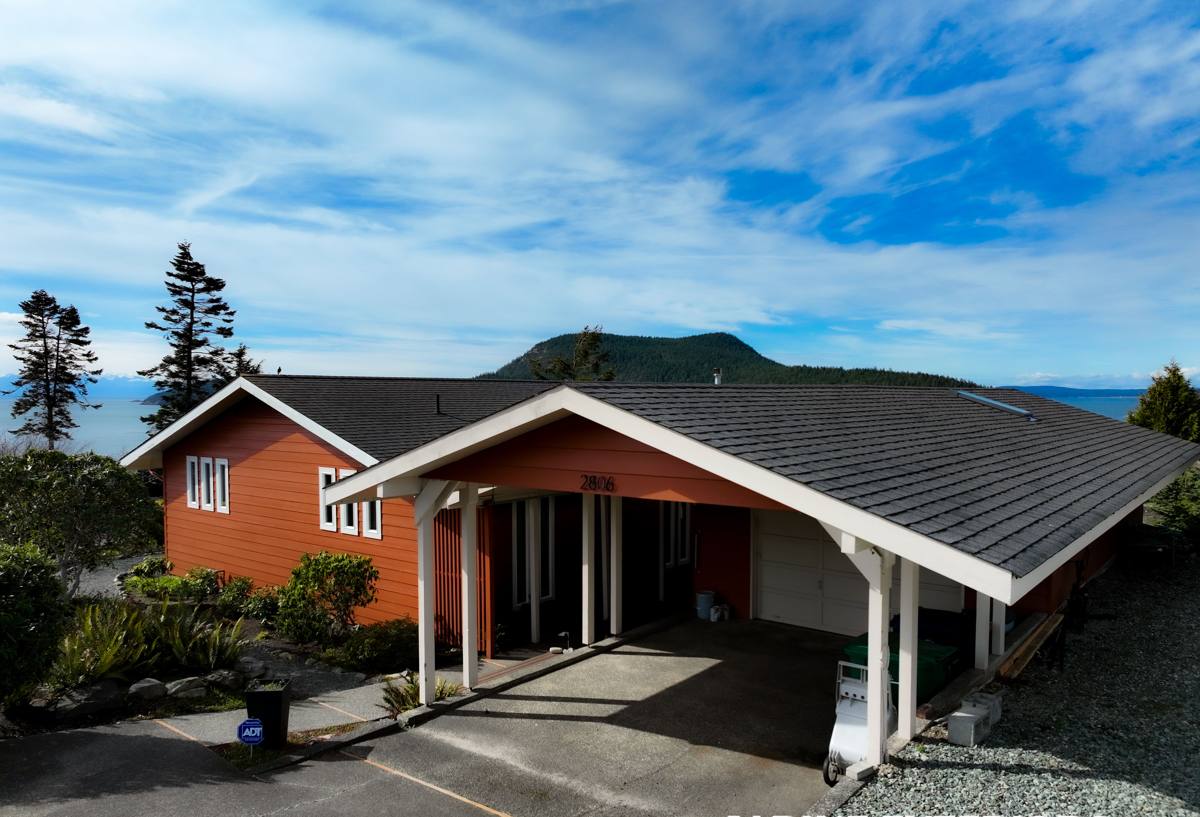
What Everson's Climate Actually Does to a Vertical Wall System
Long Moss Season
Whatcom County's moss season isn't a few weeks — it's most of the year on north-facing or shaded walls. Moss holds moisture against the substrate, and on siding systems that weren't installed with a drainage gap, that trapped moisture eventually finds a way behind the cladding.
Driving Rain and Wind-Driven Water
Storms coming off the Pacific don't just fall straight down — wind pushes rain sideways into wall assemblies, and vertical battens create dozens of seams running top to bottom. Every one of those seams is a potential entry point if it isn't flashed and caulked to spec.
Cold Snaps and Outflow Wind
This part of Whatcom County occasionally sees sharp winter cold snaps when outflow wind funnels down from the north. Siding materials expand and contract with temperature swings, and fiber cement needs to be fastened with that movement in mind — especially on long vertical boards where a fixed, over-nailed board can crack.
What a Correct Board & Batten Installation Actually Involves
A good-looking board and batten job and a correctly built one aren't always the same thing. The visible boards are the last step — everything underneath is what determines whether the siding is still doing its job in fifteen years.
- A continuous weather-resistive barrier installed and lapped correctly behind the entire wall, with no gaps at seams or penetrations
- A drainage gap (rainscreen) between the barrier and the siding, so any moisture that does get past the boards can drain and dry instead of sitting against the wall
- Proper flashing at every window head, door head, and horizontal trim transition — the points where vertical battens are most likely to funnel water
- Correct fastener placement and spacing that allows the boards to move slightly with temperature and humidity changes without splitting or popping
- Kick-out flashing anywhere a roofline meets a sidewall, so roof runoff doesn't dump directly behind the siding
- Adequate clearance between the bottom of the siding and the ground or any hard landscaping, to keep splash-back and standing moisture away from the lowest boards
Skip any one of these and the siding can still look right for a year or two. The problems show up later, usually as staining, soft trim, or moss creeping up from the bottom edge — by which point the fix is more involved than it would have been at install time.
Why We Only Install James Hardie for This Style
Board and batten shows up in a few different materials — engineered wood, vinyl panel systems, and fiber cement among them. We install James Hardie fiber cement exclusively, and for this particular siding style the reasoning is straightforward: vertical siding has more seams and more exposed edges than horizontal lap siding, and those are exactly the spots where a material's real-world moisture behavior gets tested.
James Hardie's fiber cement is non-combustible and dimensionally stable, so it doesn't swell, cup, or rot at cut edges and seams the way wood-based products can if a seam isn't perfectly sealed. Hardie's HZ5 product line is engineered specifically for climates with prolonged moisture exposure — which describes a Whatcom County winter well. The factory-applied ColorPlus finish also matters more on board and batten than on lap siding, because the vertical grain pattern and sharp batten shadow lines show inconsistent color or touch-up work much more obviously than a horizontal profile does.
We're not going to tell you every other material on the market is junk — most have a legitimate place. We've just made a standard for our own crews: we only put our name behind installations we're confident will still look and perform right in twenty years, and for board and batten in this climate, that means Hardie fiber cement, installed to spec.
Our Process for an Everson Board & Batten Project
1. On-Site Assessment
We look at the whole wall system, not just the surface — existing moisture damage, current flashing details, roofline intersections, and how much shade and airflow each elevation gets. A wall shaded by mature trees on the north side gets treated differently than a sun-exposed south wall.
2. Tear-Off and Substrate Check
Once the old siding is off, we check the sheathing and framing underneath for rot or soft spots before anything new goes up. Covering a moisture problem with new siding just hides it — it doesn't fix it.
3. Barrier and Rainscreen Installation
This is the step that gets skipped on rushed jobs and is the one that matters most in this climate. We install the weather-resistive barrier and drainage gap before a single board of visible siding goes on.
4. Board, Batten, and Trim Installation
Boards and battens go up with correct fastening and spacing, and every flashing detail at windows, doors, and rooflines is built as we go — not caulked over afterward.
5. Final Inspection
We walk the finished wall looking specifically at seams, corners, and transitions — the places where a rushed job would show its weak points first.
Cost Factors for Board & Batten Siding in This Area
Every home is different, so we won't quote a number without seeing the project — but these are the factors that most commonly move the price up or down on an Everson board and batten job.
| Factor | Why It Matters | Typical Impact |
|---|---|---|
| Existing moisture or rot damage | Requires sheathing repair before new siding goes on | Moderate to significant increase |
| Board width and batten spacing | Narrower spacing means more boards, seams, and labor hours | Modest increase |
| Home height and roofline complexity | More gables, dormers, and roof-to-wall intersections mean more flashing detail | Moderate increase |
| Trim and corner detailing | Custom corner boards and window trim add material and install time | Modest increase |
| Full rainscreen vs. minimal drainage gap | A properly vented rainscreen system costs more up front but reduces long-term moisture risk | Modest increase, long-term value |
| Access and site conditions | Tight lots, tree cover, or difficult grading can slow tear-off and staging | Modest increase |
Living with Board & Batten Through Whatcom County's Moss Season
Even a correctly installed system needs a small amount of upkeep in this climate — the goal of good installation is to make that upkeep minor instead of structural.
- Rinse moss and algae off shaded walls once or twice a year with a garden hose and soft brush — avoid pressure washers, which can force water behind seams
- Trim back vegetation and tree limbs that keep a wall section shaded and damp longer than the rest of the house
- Walk the exterior after major windstorms and check caulking at window and door trim for cracking
- Keep gutters clear so roof runoff doesn't overflow directly onto a sidewall
- Repaint or refresh caulk joints on schedule — ColorPlus finishes hold up well, but caulk joints are a maintenance item on any siding system
Why It Matters That the Crew Already Works in Everson
A lot of siding problems in this region trace back to a crew that installed the same details they'd use in a drier climate — because that's what they know. A crew that already works Lynden and Everson regularly has already seen how a north-facing wall behaves under a stand of fir trees, how a low-lying lot near the river holds moisture longer after a storm, and which flashing details actually matter once the rainy season sets in. That's not something you can fully substitute with a spec sheet — it comes from doing the work here, on homes like yours, season after season.
If you're considering board and batten siding for a home in Everson, we're happy to walk the property, look at what your walls are dealing with, and put together a straightforward, no-pressure estimate — just fill out the form below.