 Lynden Roofing
 Storm Damage in Wiser Lake: What This Climate Does to a Roof
Wiser Lake sits in a wooded, semi-rural pocket of Whatcom County just outside Lynden, and that setting shapes what a roof out here has to survive. The tree cover around the lake means wind doesn't just push on a roof in one direction — it funnels, gusts, and drops limbs from angles a roof on an open lot never has to deal with. Add in driving rain that comes in sideways off Pacific storm systems, moisture-laden marine air that carries a faint salt edge even this far inland, and a moss season that can run eight months or longer, and you've got a roof that's under near-constant low-grade stress even between storms.
Most storm damage in this area isn't the dramatic kind. It's a handful of lifted shingles after a windstorm, a soft spot where a branch came down, a flashing seam that started leaking during three days of hard rain. Left alone, small damage like this turns into rot, mold, and interior water stains by the next wet season. Caught and repaired correctly, it's a straightforward fix that protects everything underneath.
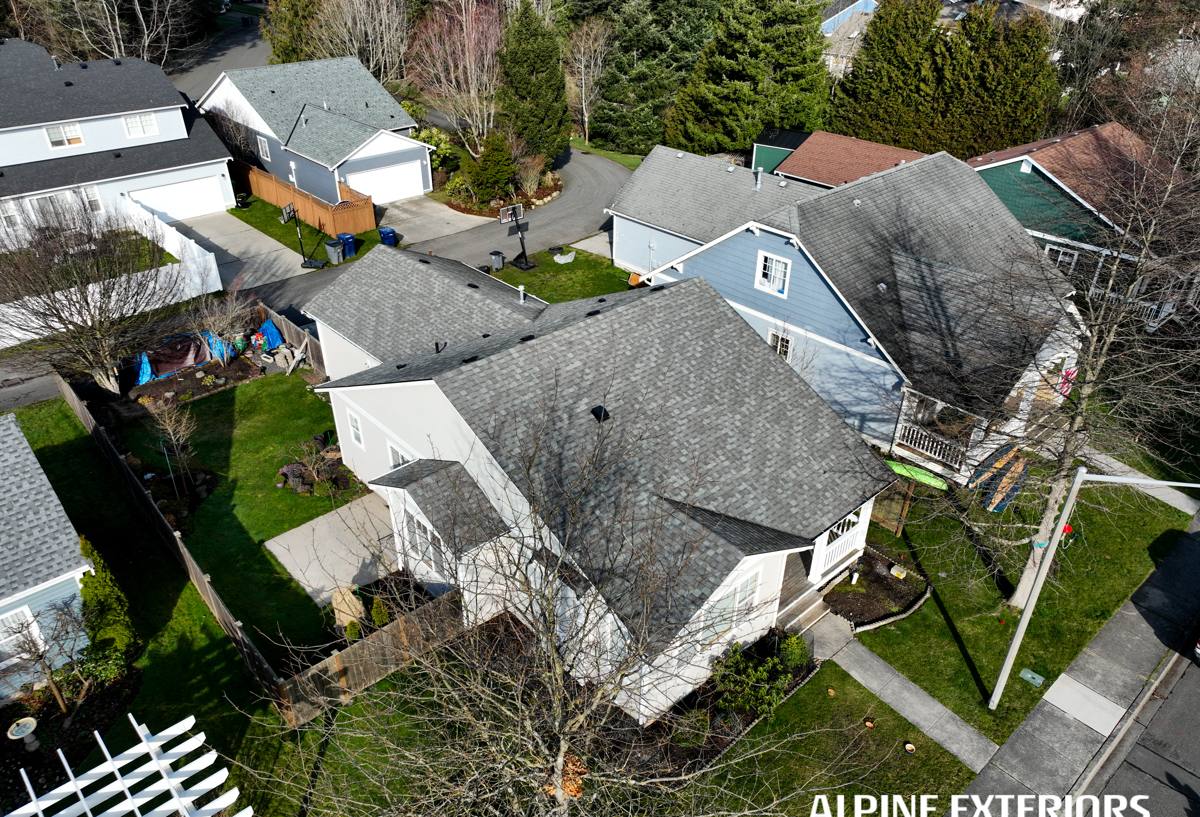
What Storm Damage Actually Looks Like
Wind Damage
Sustained wind and sharp gusts — common around Wiser Lake because the open water and surrounding trees create their own wind patterns — can lift shingle tabs, crease them, or tear them off completely. Wind damage is often invisible from the ground. A shingle can be creased or have a broken seal without looking obviously wrong until the next hard rain finds the opening.
Impact Damage From Falling Limbs
Tree-lined lake properties see more limb strikes than roofs on cleared lots. A direct hit can crack or puncture shingles and, in harder impacts, damage the roof decking underneath. Even a glancing hit that doesn't puncture anything can loosen granules and shorten the life of the shingle in that spot.
Water Intrusion
Whatcom County's driving rain finds any gap in flashing, any lifted shingle edge, any nail that's backed out. Water doesn't always show up where it enters — it can travel along the decking or rafters and stain a ceiling several feet from the actual damage, which is why storm repair has to include more than just patching the visible spot.
Ice and Cold-Snap Damage
Wiser Lake doesn't see heavy snow most winters, but the occasional hard freeze after a wet stretch can cause ice to form in gutters and along roof edges. That ice dam backs water up under the shingles above it, which is a different failure mode than wind or impact damage and needs a different fix.
Why a Quick Patch Isn't the Same as a Correct Repair
After a storm, it's tempting to have someone slap a tarp or a few shingles over the obvious problem and call it done. That approach handles the symptom, not the cause. If the underlying decking got wet before the patch went on, sealing it back up traps moisture instead of stopping it — which sets up rot and mold that won't show up until it's a much bigger job. A correct repair confirms what's underneath the surface damage before closing it back up, matches materials so the repaired section performs the same as the rest of the roof, and re-checks the flashing and ventilation in that area rather than just the shingles.
What a Proper Storm Damage Repair Involves
A Real Inspection, Not a Glance
A proper storm repair starts by checking the full roof, not just the spot the homeowner noticed. Wind and impact damage often has a companion problem a few feet away — a lifted shingle near the obvious tear, a flashing nail that backed out during the same storm. Missing those means a second repair call within a season or two.
Matching Materials
Shingles fade and weather over time, so a repair on a roof that's a few years old won't match perfectly no matter what's used. A good repair gets as close as reasonably possible in profile and color and is upfront with the homeowner about what to expect, rather than promising an invisible patch that isn't realistic.
Flashing and Underlayment
Most leaks that show up after a storm trace back to flashing — around a chimney, a vent pipe, a valley — rather than the shingles themselves. A correct repair checks and reseats or replaces flashing in the damaged area and confirms the underlayment beneath it is still doing its job, since a torn or waterlogged underlayment will keep leaking even with new shingles on top.
Structural Decking Check
Any impact damage or long-term leak gets a check of the roof decking itself before new shingles go down. Soft, delaminated, or rotted decking has to be replaced — covering it back up just hides a problem that will get worse.
Our Storm Damage Repair Process
- Initial contact and temporary protection. If your roof is actively leaking or has an open section, our first priority is stopping further water intrusion — usually a tarp or temporary seal — before anything else.
- Full roof inspection. We walk the roof (or use a camera where a walk isn't safe) to document every area of damage, not just the spot that prompted the call.
- Written scope and estimate. You get a clear, itemized explanation of what's damaged, what needs to be repaired versus what can be left alone, and an honest cost range before any work starts.
- Repair work. Damaged shingles, flashing, and decking are replaced to match the surrounding roof as closely as possible, with attention to proper sealing and ventilation in the repaired area.
- Cleanup and final check. Debris and old materials are cleared from the property, and we do a final walk-through so you can see the completed work before we consider the job done.
Repair or Replace? Cost and Decision Factors
Not every storm-damaged roof needs a full replacement, and not every roof should be patched indefinitely. These are the factors that actually drive that decision:
| Factor | Leans Toward Repair | Leans Toward Replacement |
|---|---|---|
| Age of roof | Under 10-12 years, still within expected service life | Near or past the shingle's rated lifespan |
| Extent of damage | Isolated to one section or a few spots | Spread across multiple roof planes |
| Repair history | First or second repair on this roof | Repeated repairs in the same areas over the years |
| Decking condition | Solid, dry decking under the damage | Soft, rotted, or repeatedly wet decking |
| Material matching | Current shingle line still available | Discontinued or heavily weathered shingles that won't blend |
| Typical cost range | Generally a few hundred to low thousands of dollars | Generally several thousand and up, depending on size and materials |
We'll walk you through where your roof falls on each of these before recommending one path over the other — our goal is the option that actually holds up, not the one that's biggest.
Working With Your Insurance Company
Many storm-related roof repairs are covered under homeowners insurance, particularly wind and impact damage from a specific weather event. We can document the damage with clear photos and a written scope that you can submit to your adjuster, and we're glad to walk an adjuster through the roof directly if that's helpful. We won't inflate a scope to chase a bigger payout or tell you what your policy covers — that's between you and your insurer — but we will make sure the actual damage is documented accurately so you're not shortchanged on a legitimate claim.
After the Repair: Reducing Your Next Storm's Damage
A repair fixes what already happened. A little upkeep afterward reduces how much the next storm costs you — which matters most for tree-shaded, lake-adjacent properties like the ones around Wiser Lake.
- Keep overhanging branches trimmed back from the roofline where it's safe to do so, reducing both impact risk and the shade that feeds moss growth.
- Clean gutters and downspouts at least twice a year — clogged gutters back water up under the roof edge during heavy rain.
- Have moss and debris removed from the roof surface before it builds up thick enough to hold moisture against the shingles.
- Walk the property after any significant windstorm and look for shingle granules in the gutters or downspouts, a sign of wind or hail wear.
- Get a roof checked after any storm that dropped a limb on or near the house, even if there's no visible damage from the ground.
- Schedule a roof inspection every couple of years so small issues get caught before they become storm-driven emergencies.
Why Choose a Roofing Crew That Already Works Wiser Lake
A roof repair around Wiser Lake comes with practical realities that don't apply everywhere — narrower access roads, mature tree cover that limits equipment staging, septic and well systems that need to be protected during material delivery and cleanup, and a wet, moss-prone climate that punishes shortcuts. A crew that already works this part of Whatcom County knows to plan around those things instead of learning them on your job. We're also close enough to Lynden to respond quickly when storm damage needs a fast temporary fix, rather than leaving your roof exposed while a crew drives in from out of the area.
Local experience also means we're used to what actually damages roofs here — wind-driven rain finding weak flashing, moss holding moisture against shingles for months at a time, tree debris after fall and winter storms — rather than applying a generic repair approach built for a drier or more open climate.
If your roof took damage in a recent storm, or you want a straightforward opinion on whether that soft spot or missing shingle needs attention, we're glad to take a look. Fill out the form below for a free, no-pressure estimate — we'll tell you honestly what we find and what it would take to fix it right.