 Lynden Roofing
 Ferndale Decking, Built for the Weather It Actually Gets
Ferndale sits close enough to the water that salt air is part of daily life, and close enough to the Cascades' rain shadow gap that it still catches the driving rain and long wet winters common across Whatcom County. That combination is hard on an outdoor deck. Salt-laden air speeds up corrosion on fasteners and hardware. Driving rain finds its way into end grain, ledger connections, and any gap where flashing was skipped. And the moss season here runs long — often eight or nine months out of the year in shaded yards — which means a deck surface can stay damp and slick far longer than the "dry season" calendar suggests.
None of that means a deck in Ferndale is doomed to fail early. It means the build has to account for moisture from day one, not patch around it after the fact. That's the difference between a deck that needs real work again in five years and one that holds up for decades.
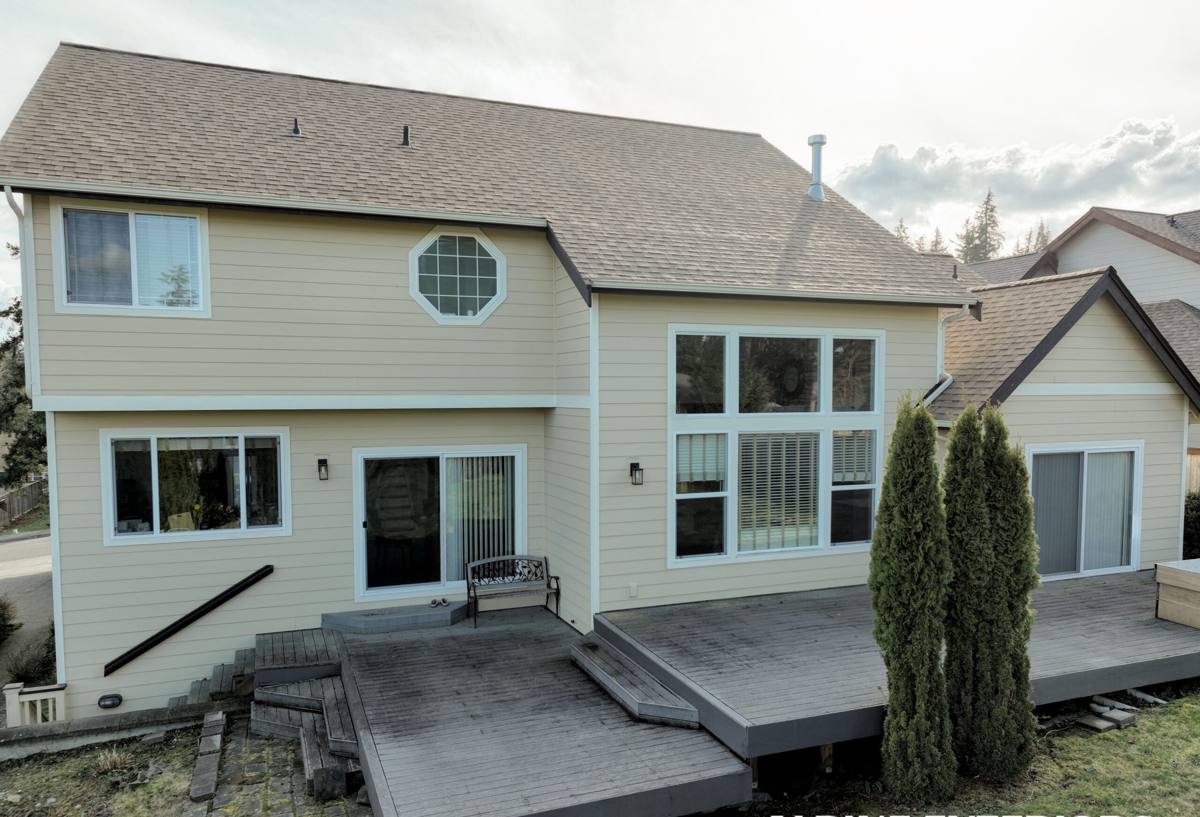
Signs Your Deck Needs Replacing, Not Just Repair
A lot of decks get patched over and over when the underlying problem is structural. Repair makes sense for isolated issues — a cracked board, a loose railing baluster. Replacement is the honest answer when the damage is systemic. Here's what tells us which category a deck falls into:
- Boards that feel spongy or flex noticeably underfoot, especially near the ledger or stair landing
- Rust streaks running down from fasteners, joist hangers, or post connectors
- A visible gap or dark staining where the deck meets the house — a sign the ledger board is separating or trapping water
- Posts that feel loose at the base or show soft, discolored wood when probed
- Persistent moss or algae growth that comes back within weeks of cleaning, even in partial shade
- A deck older than 20 years that has never had the framing inspected, only the surface boards replaced
If more than one or two of these show up, especially anything involving the ledger board or the framing underneath, replacement is usually the more honest recommendation than another round of surface repairs.
What a Correct Deck Replacement Involves
A deck is only as good as what's underneath it. The boards you walk on get the attention, but the parts that actually determine how long the deck lasts are the ones you don't see once the job is done.
Footings and Framing
Footings need to reach proper bearing depth and be sized for the actual load of the deck, not just whatever was there before. When we replace a deck, we check whether the existing footings are adequate or whether they need to be re-poured. Framing lumber gets upgraded to pressure-treated stock rated for ground contact where it's within a few inches of soil or persistent moisture, and joist spacing gets set for the decking material actually being installed, since composite and PVC products often call for tighter spacing than solid wood.
Ledger Attachment and Flashing
This is the single most common failure point on decks in wet climates. The ledger board — the piece that attaches the deck to the house — has to be bolted with proper structural fasteners, not just nailed, and it needs flashing that directs water away from the house sheathing rather than behind it. A poorly flashed ledger is how you end up with hidden rot in the wall framing, which is a much more expensive problem than the deck itself.
Fasteners and Connectors
In a coastal-influenced climate, fastener choice matters more than people expect. Standard galvanized hardware can corrode faster than the wood around it when it's exposed to salt-laden air year-round. We spec stainless steel or heavy hot-dip galvanized fasteners and connectors for anything exposed to weather, and we match fastener metal to the decking material to avoid the kind of reaction that causes black staining around screw heads.
Decking and Railing
The surface material and railing system get chosen based on how the deck is used, how much shade it gets, and the homeowner's tolerance for maintenance. We'll walk through the honest trade-offs of each option rather than pushing whatever has the best markup.
Choosing a Decking Material for Salt Air and a Long Moss Season
There's no single "best" decking material — there's a best fit for the site and how much upkeep the homeowner wants to take on. Here's how the common options stack up for a shaded, wet, coastal-influenced yard like the ones common around Ferndale:
| Material | Upfront Cost | Moisture & Salt Resistance | Moss & Mildew Care | Realistic Local Lifespan |
|---|---|---|---|---|
| Pressure-treated lumber | Lowest | Good if sealed regularly | Needs annual cleaning and resealing | 10-15 years with upkeep |
| Cedar | Moderate | Naturally rot-resistant, but softer surface | Needs regular cleaning and oil or sealant | 12-18 years with upkeep |
| Capped composite | Higher | Very good; resists moisture absorption | Occasional wash, no sealing | 20-25+ years |
| PVC decking | Highest | Excellent; does not absorb moisture | Occasional wash, no sealing | 25+ years |
For a low-maintenance owner who wants to spend a weekend on the deck instead of a weekend maintaining it, capped composite or PVC generally makes sense despite the higher upfront cost, especially in yards that stay shaded and damp for most of the year. For owners who prefer the look and feel of real wood and are willing to reseal on a schedule, pressure-treated lumber or cedar are still solid choices as long as the framing underneath is built correctly. We'll size up the site with you and give a straight recommendation rather than defaulting to the most expensive option.
Our Deck Replacement Process
- On-site assessment. We check the framing, footings, ledger connection, and post condition, not just the surface boards, so the estimate reflects what's actually needed.
- Permit and plan. We handle the permit application and make sure the design meets current code for footing depth, railing height, and structural connections.
- Tear-off. The old decking, railing, and any compromised framing come out. We check the ledger and rim joist condition once the old boards are off, since that's often hidden until then.
- Framing and footing work. Footings are repaired or replaced as needed, framing is set, and the ledger is reattached and properly flashed before anything else goes on.
- Decking and railing installation. Boards and railing go in per manufacturer spec for the chosen material, with fastener spacing and gapping set for wet-climate expansion and drainage.
- Final walkthrough and inspection. We review the finished deck with you, confirm it passes any required inspection, and go over basic care for the material installed.
Permits and Inspections in Whatcom County
Deck replacement that involves new footings, framing, or a ledger reattachment typically requires a permit, since it's structural work attached to the house. That's true whether the project is in Ferndale, Lynden, or elsewhere in Whatcom County. The permit process usually checks footing depth and sizing, railing and guard height, stair geometry, and the ledger attachment method. We build the permit and inspection step into the timeline up front rather than treating it as an afterthought, so there are no surprises about a deck that doesn't pass because a step got skipped.
Slowing Down the Clock: Deck Maintenance in a Wet Climate
Even a well-built deck needs some seasonal attention in a climate that stays wet as much of the year as Whatcom County does. A few habits go a long way toward getting the full lifespan out of the materials:
- Sweep leaves, needles, and debris out of the gaps between boards so water can drain instead of pooling
- Clean moss and algae off the surface before it builds up a thick layer that holds moisture against the boards
- Check that gutters and downspouts near the deck are directing roof water away from the framing below, not onto it
- Reseal or refinish wood decking on the schedule the product calls for, typically every one to two years
- Walk the deck once a year and check for loose fasteners, soft spots, or gaps opening up at the ledger
- Trim back plants and shrubs that are shading the deck and keeping it from drying out between rains
Why a Crew That Already Works Ferndale Matters
A deck built to a generic spec sheet and a deck built for the actual conditions of a site are not the same thing. A crew that regularly works in and around Ferndale already knows which yards stay shaded and damp longest, where salt air is enough of a factor to bump up the hardware spec, and what the local permitting process expects for footing and ledger inspections. That familiarity shows up in fewer surprises during the project and a deck that's built for the weather it will actually see, not just the weather on paper. It also means a shorter drive for warranty work or a follow-up question after the job is done, which matters more than it sounds like once the project is finished and you're the one living with the result.
If you're weighing repair against replacement, or just want an honest look at what your current deck's framing and ledger connection look like, we're happy to come take a look. The estimate is free, there's no pressure attached to it, and you'll get a straight answer about what your deck actually needs.