 Lynden Roofing
 Bellingham's Climate Puts Real Stress on Siding
Homes in Bellingham sit close enough to Bellingham Bay and the Salish Sea that salt-laden air is a daily fact of life, not an occasional weather event. Add Whatcom County's long wet season, driving rain that comes in sideways off the water, and stretches of shade and dampness that keep north- and west-facing walls damp for weeks at a time, and you have a climate that is genuinely hard on exterior building materials. Siding here isn't just a cosmetic layer. It's the primary barrier standing between your home's structure and a combination of salt, moisture, and organic growth that never really takes a season off.
Moss is the most visible symptom of this climate. Given a shaded wall, a little grime, and consistent moisture, moss and algae will establish themselves on almost any siding material within a few years. But moss is a symptom, not the real problem — the real problem is what's happening behind the siding when water finds a way in through a bad seam, a missed flashing detail, or a fastener that backed out. In a marine climate like Bellingham's, siding failures are rarely dramatic. They're slow: a soft spot near a window, a stain creeping down from a butt joint, sheathing that's gone spongy under a section that looked fine from the yard.
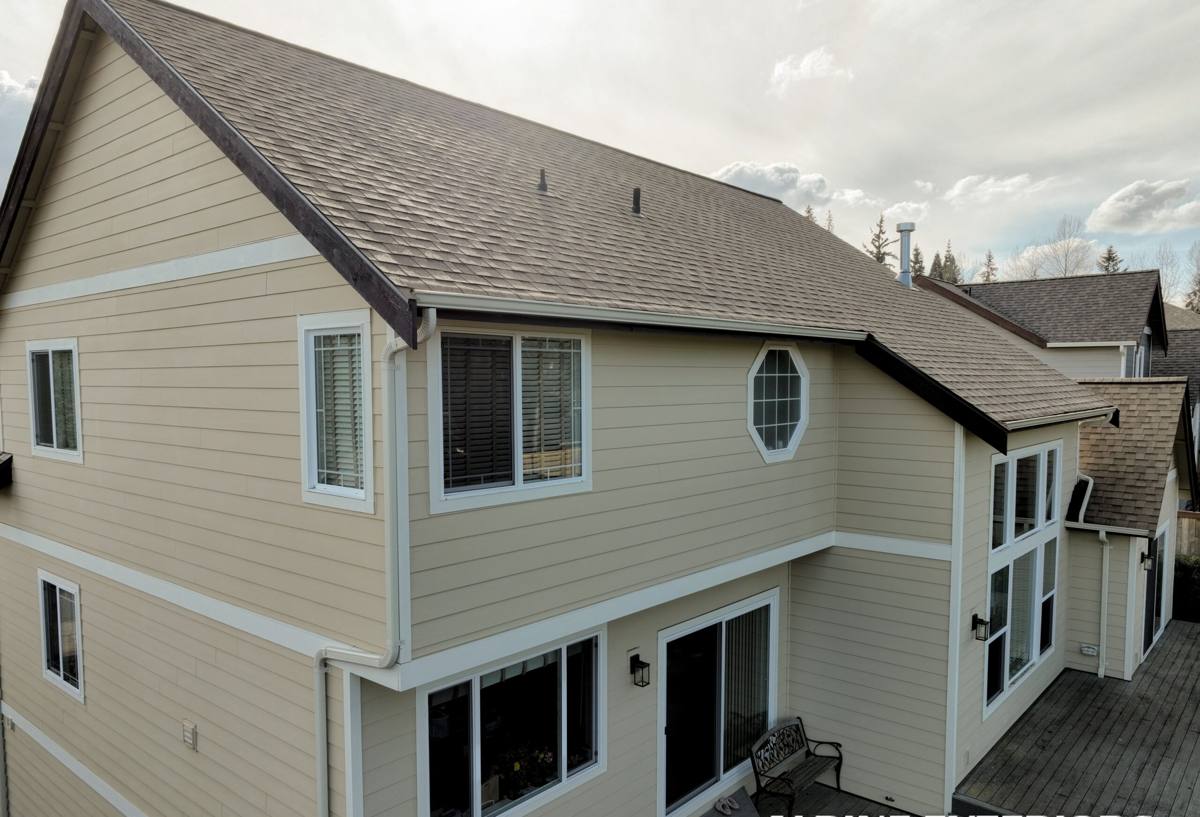
What "Correct" Siding Installation Actually Requires Here
A siding job that would hold up fine in a dry inland climate can fail early in Bellingham if it skips details that matter specifically because of the salt air and rain exposure. Correct installation in this area means treating water management as the central job, not an afterthought to appearance.
Key details that matter more here than elsewhere
- Weather-resistive barrier installed and lapped correctly, with every penetration (vents, hose bibs, light fixtures) properly flashed before siding goes on
- Rainscreen or drainage gap behind the siding so any moisture that does get past the cladding can drain and dry instead of sitting against the wall assembly
- Corrosion-resistant fasteners and flashing hardware rated for coastal/marine exposure, not standard interior-grade hardware
- Proper flashing and kickout diverters at every roof-to-wall intersection, so rain running off the roof is directed away from the siding instead of behind it
- Correct clearance between the bottom of the siding and grade, decks, and roof surfaces to keep splash-back and standing moisture away from the material
- Tight, consistent caulking and sealant at joints and penetrations, using products rated for the exposure the wall actually gets
None of this is exotic. It's standard best practice for exterior cladding. The difference in a place like Bellingham is that skipping any one of these steps shows up faster and costs more to fix, because the climate doesn't give a marginal installation the benefit of the doubt.
Why We Install Only James Hardie Fiber Cement
We made a deliberate decision to install James Hardie fiber cement siding exclusively, and we don't install vinyl, LP SmartSide, Cemplank, Allura, primed spruce, or cedar. That's a real trade-off for us — it narrows what we can offer — but it's one we're comfortable with because of what we see happen to siding in this specific climate over time.
Fiber cement is non-combustible and dimensionally stable in a way wood-based and vinyl products aren't. Vinyl can warp or become brittle with age and temperature swings, and its seams and profile depend heavily on correct expansion allowance to look right long-term. Wood-based composite products can perform well when kept dry and well-maintained, but they're more sensitive to sustained moisture exposure than fiber cement, and sustained moisture exposure is exactly what a Bellingham exterior wall deals with for much of the year. Cedar and primed wood siding require an ongoing maintenance commitment — repainting, sealing, moss and mildew treatment — that most homeowners underestimate when they first choose it, and that commitment only gets more demanding in a marine climate.
James Hardie's HZ5 product line is engineered specifically for climates like ours — colder, wetter regions where moisture cycling and humidity are the dominant stress, as opposed to the HZ10 line built for hot, dry, high-UV regions. That's a meaningful distinction: the same siding line built for Arizona is not the right specification for Whatcom County. Hardie's ColorPlus factory-applied finish also matters here specifically, because it's baked on and warrantied against fading in a way that reduces (though doesn't eliminate) the repainting cycle homeowners are used to with wood siding — a real advantage when a home is exposed to sun, salt, and rain in the same season.
What Hardie doesn't solve on its own
To be fair to the material: Hardie fiber cement doesn't install itself correctly. It's a precision product — cuts, fastening patterns, joint treatment, and clearances all matter, and Hardie's own warranty terms depend on installation to their specification. A poor installation of a good product still fails. That's a large part of why we treat the installation process itself, not just the material choice, as the thing that actually protects a Bellingham home.
Our Installation Process
Every job follows the same sequence, because skipping steps is exactly how coastal climate failures happen.
- Assessment and tear-off. We remove existing siding and inspect the sheathing and framing underneath for any moisture damage, soft spots, or rot that needs to be addressed before new siding goes on — a step that's non-negotiable in a climate where hidden water damage is common.
- Repair and prep. Any compromised sheathing or framing is repaired. This is also when we correct any existing flashing or drainage problems we find, rather than covering them back up.
- Weather-resistive barrier and rainscreen. A properly lapped weather barrier goes on first, followed by a drainage gap system so the wall assembly can dry if moisture ever gets behind the cladding.
- Flashing at every penetration and intersection. Windows, doors, vents, hose bibs, and roof-to-wall transitions all get individually flashed before siding covers them.
- Hardie installation to manufacturer spec. Correct fastener type, spacing, and placement; correct joint treatment; correct clearances from grade, roofs, and decks.
- Trim, caulking, and final detailing. Sealants rated for the exposure, clean trim lines, and a final check of every penetration and joint.
- Walkthrough. We go over the finished job with the homeowner, including what maintenance (if any) to expect going forward.
Flashing and Drainage: Where Coastal Jobs Actually Fail or Succeed
Most siding problems we get called out to inspect in this region trace back to one of a small number of water-management details, not to the siding material itself. The table below summarizes the details that matter most in a Bellingham climate and what happens when they're done wrong.
| Detail | Why it matters in Bellingham's climate | Consequence if done wrong |
|---|---|---|
| Roof-to-wall flashing / kickouts | Directs roof runoff away from the wall in heavy, driving rain | Water tracks behind siding, rots sheathing at the intersection |
| Rainscreen / drainage gap | Lets the wall assembly dry between the frequent wet spells typical here | Moisture stays trapped against sheathing, promotes rot and mold |
| Fastener corrosion resistance | Salt air accelerates corrosion of standard-grade hardware | Fasteners weaken, streak, or back out over time |
| Grade/deck clearance | Keeps splash-back and standing moisture off the bottom edge of siding | Bottom courses absorb moisture, invite moss and rot first |
| Caulk and sealant quality | Sealed joints are the first defense against wind-driven rain | Joints open up, water intrusion starts at seams |
Color, Texture, and Moss-Resistance Considerations
Homeowners often start this project thinking about color and finish, and that's a reasonable place to start — but a few choices matter more in this climate than in a drier one. Darker colors and heavily shaded elevations (typically north- and west-facing walls) are the areas most prone to visible moss and algae growth over time, regardless of siding material. ColorPlus finishes hold their color and resist fading better than field-applied paint, which reduces one maintenance task, but no factory finish makes a wall immune to moss if that wall stays shaded and damp. Where it matters, we'll talk through gutter and drainage placement, plantings near the wall, and finish choice together, since those decisions affect how much upkeep a homeowner signs up for later.
What Siding Installation Typically Costs
Costs vary by home size, number of stories, existing siding removal, and how much sheathing repair is needed once tear-off begins — we won't quote a number without seeing the house. The factors below are the ones that most affect the final price on a Bellingham project specifically.
| Cost factor | Why it moves the price |
|---|---|
| Tear-off and disposal | Removing existing siding, especially multiple layers, adds labor and disposal cost |
| Sheathing/framing repair | Moisture-related damage found during tear-off must be repaired before new siding goes on |
| Wall complexity | Dormers, multiple gables, and cut-ups around windows and trim add labor time |
| Siding profile and accessories | Lap width, trim style, and accent details affect material and labor cost |
| Access and site conditions | Multi-story sections, tight lot lines, and staging needs affect labor time |
We provide a written estimate after an in-person look at the home, so the number reflects your actual walls and conditions rather than a generic average.
Maintenance Once It's Installed
Correctly installed Hardie siding is genuinely low-maintenance compared to wood, but "low-maintenance" doesn't mean "no attention needed" in a climate like this one.
- Rinse siding periodically to keep salt residue, grime, and early moss growth from building up, especially on shaded walls
- Keep gutters clear so overflow doesn't run down the face of the siding
- Trim back plantings and trees that keep a wall section shaded and damp
- Walk the exterior once or twice a year and look at caulk lines and trim joints for gaps or cracking
- Address any soft spots, staining, or bubbling paint immediately rather than waiting for the next season
Why a Crew That Already Works Bellingham Matters
Siding installation isn't a generic skill applied the same way everywhere. A crew that regularly works homes in Bellingham and the surrounding Whatcom County area has already seen which wall orientations grow moss first, which older neighborhoods tend to have specific sheathing or moisture issues under the existing siding, and what level of wind-driven rain exposure a given lot actually gets based on its position relative to the water. That local pattern recognition shows up in small decisions during the job — where to add extra flashing attention, which clearances to be strict about, which finish will actually hold up on a shaded elevation — that a crew unfamiliar with the area's specific conditions might not think to prioritize.
It also means a crew that stands behind the work is reachable and accountable locally, not working through a distant office. For a job that's meant to protect a home for decades in a demanding coastal climate, that local accountability is part of what you're paying for, not a side benefit.
If you're planning a siding project for a Bellingham home, we're happy to walk the property, look at what's there now, and talk through what correct installation looks like for your specific walls and exposure. Reach out for a free, no-pressure estimate using the form below.